How to monitor executive perception in AI: a guide for communications teams and agencies
Journalists, investors, candidates and buyers now ask ChatGPT, Gemini and Google AI who runs a company and whether that person is any good. The answer is written in seconds, from whatever the assistant finds, and it can be wrong: a former CEO still in post, a career invented from a namesake, an old controversy told as current. This guide is for communications leads and agencies who want to monitor executive perception in AI answers: what to ask, how to score what comes back, how to benchmark a leadership team against its industry, and how to correct what is wrong.
The short answer
- Track questions, not names alone. Assistants answer "Who is the CEO of Acme?" and "Is Acme's leadership experienced?" differently from "Who is Jane Smith?". Track all three kinds.
- Score two things separately: factual accuracy against an official fact sheet, and tone. A flattering answer with a wrong career history is still a problem.
- Benchmark against peers. A tone score means little alone. Run the same questions on the leaders of the competitors, and compare.
- Trace every error to a page. Assistants repeat the pages they cite. The fix is at the source, not in the assistant.
- Keep it to public, professional information, and tell the people you are monitoring that you do it.
What to monitor
| Dimension | Example question | What you check |
|---|---|---|
| Identity and role | "Who is the CEO of [company]?" "Who founded [company]?" | Names, titles, start dates, former leaders still shown as current |
| Biography | "What is [name] known for?" "What is [name]'s background?" | Past roles, education, dates, achievements, and facts borrowed from a namesake |
| Tone | "Is [company]'s leadership team experienced?" "Is [name] a good leader?" | Sentiment of the answer, and the reasons the assistant gives |
| Association | "Any controversy about [name]?" | Whether an old or resolved story is told as current, and which pages it comes from |
| Authority | "Who are the experts on [topic]?" | Whether the executive is named as a reference in their field, next to which peers |
Ask each question in the markets and languages where the company has an audience: the pages assistants cite change by country. See how to write prompts your audience asks.
A method in five steps
1. Write an official fact sheet
For each executive: full name, current title, start date, previous roles with dates, education, and the two or three facts the company wants stated. It is the reference every answer is checked against. Without it, "accurate" is a matter of opinion.
2. Build the question set
Per person, write 5 to 8 questions from the table above, in the wording a journalist or a buyer would use. Add a few questions about the leadership team as a whole. Keep the set fixed, so each update is comparable with the last.
3. Run it on several assistants, repeatedly
Answers vary between assistants and between runs, so run the set on each assistant that matters, at a regular cadence, and read the trend. A single answer proves nothing. How to measure AI visibility explains why.
4. Score accuracy and tone
- Accuracy: the share of answers with no factual error against the fact sheet, plus a list of the errors found.
- Tone: a sentiment score per answer with its reason, then the average per person. Read the lowest scores. Automated scores are not infallible: check a sample by hand (see how to track brand sentiment in AI answers).
- Sources: for every error and every low score, the pages the answer cited.
5. Benchmark against the industry
Run the same questions on the leaders of two to five competitors, or of the client's competitors if you are an agency. Then compare: how often each leader is named when the assistant is asked about the category, the tone, and the accuracy. The result tells you whether a score of 70 is good in this industry. In an agency retainer, report it next to the brand's own AI visibility figures.
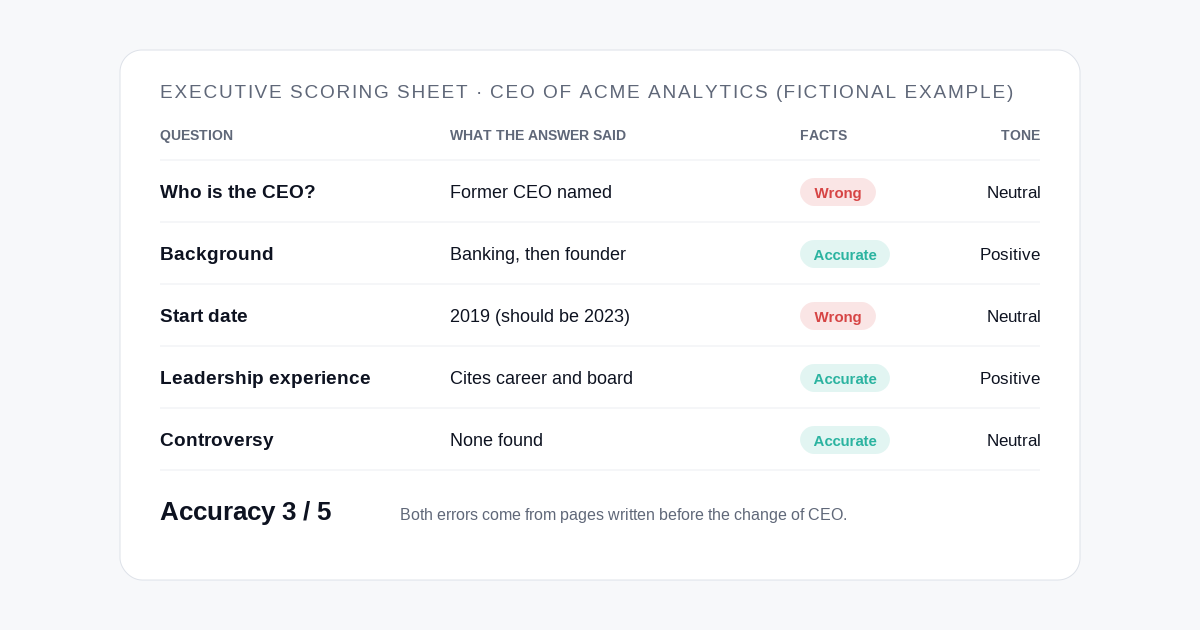
A worked example: scoring one executive
Here is what a scoring sheet looks like for the CEO of a fictional software company, Acme Analytics. The answers are illustrative, written to show the errors teams most often find; they are not real answers about a real person.
| Question | What the answer said | Against the fact sheet | Tone |
|---|---|---|---|
| Who is the CEO of Acme Analytics? | Names the co-founder who left in 2023 | Wrong: former CEO still in post | Neutral |
| What is the CEO's background? | Former head of data at a bank, then founder | Accurate | Positive |
| When did the CEO join? | 2019 | Wrong: the CEO joined in 2023; 2019 is when the former CEO started | Neutral |
| Is Acme's leadership team experienced? | Yes, cites the CEO's banking years and two board members | Accurate | Positive |
| Any controversy about Acme's CEO? | None found | Accurate | Neutral |
What the sheet tells the team:
- Accuracy is 3 out of 5, and both errors share a cause: the assistant still reads pages written before the change of CEO. The fix is a list of pages to update, starting with the ones the wrong answers cite: an old press release, a directory profile, the former CEO's own profile.
- Tone is good where the facts are right. The positive answers repeat the career on the leadership page, which shows that page is read. Keep it current.
- The next step is the trend. Run the same five questions on each assistant after the corrections, and again over the following updates, before reporting a change.
For a benchmark, fill the same sheet for the leaders of two to five competitors, and compare the accuracy and tone scores side by side.
Correcting what is wrong
- Fix your own pages first. One current leadership page, with a short biography per person, the same names and titles as the executives' profiles, and dates.
- Add structured data. Person markup linked to the Organization, as in structured data for AI citations.
- Ask the cited sites to correct. For each error, the trace shows the page the assistant read. Contact its publisher with the fact sheet. How to fix AI hallucinations about your brand gives the steps.
- Separate namesakes. If the assistant mixes the executive with a person of the same name, publish a page that states the role, the company and the field, so that the right person is the clearest match.
- Re-run the questions after the next updates, and keep the history: the proof that a correction worked is the trend.
You cannot make an assistant say what you want. You can make accurate, current and clear information the easiest for it to find.
Monitor responsibly
- Track public, professional information only: role, career, public statements. Not private life.
- Tell the executives, and agree what is tracked and who sees the reports. Answers about named people can contain personal data, so apply your data protection rules (UK GDPR or GDPR) to what you store.
- An agency should have this written in the client contract before it starts.
Tools
You need a tool that runs your own questions, on several assistants, at a regular cadence, and keeps the full answers, the sentiment and the cited pages. Rempa (our product) does this: you add the questions about your leaders to a project, read each assistant's answer in Answers, follow the sentiment of the answers, and see the pages they cite in Sources. Rempa has no dedicated profile per person: leaders are tracked as questions, and its Perception page summarises how the answers describe the brand. See the best AI visibility tools in 2026, and Rempa for agencies.
Frequently asked questions
How can I see how ChatGPT describes our CEO?
Ask it the questions a journalist or buyer would ask, such as who the CEO is, what they are known for and whether the leadership team is experienced, then check each answer against an official fact sheet. Repeat on Gemini and Google AI Mode, and at a regular cadence, because answers change.
Can an agency benchmark how favourably a client's leadership is presented in AI?
Yes. Run the same questions on the client's leaders and on those of two to five competitors, then compare how often each is named, the tone and the accuracy. Without the peers, a score cannot be read.
How do I audit the biographical accuracy of an executive in AI answers?
Write a fact sheet with names, titles, dates and past roles, ask for the biography in several ways, and list every difference. Then trace each error to the page the assistant cited, and correct it there.
Can I make AI stop saying something wrong about an executive?
Not directly. Assistants repeat the pages they read, so correct those pages, publish a clear leadership page and structured data, and check the answers again after the next updates.
Is it legal to monitor what AI says about named people?
Tracking public, professional information about your own leadership team is common practice. Because answers about named people can include personal data, tell the people concerned, limit what you store and apply your data protection rules. This is general information, not legal advice.
More from the blog
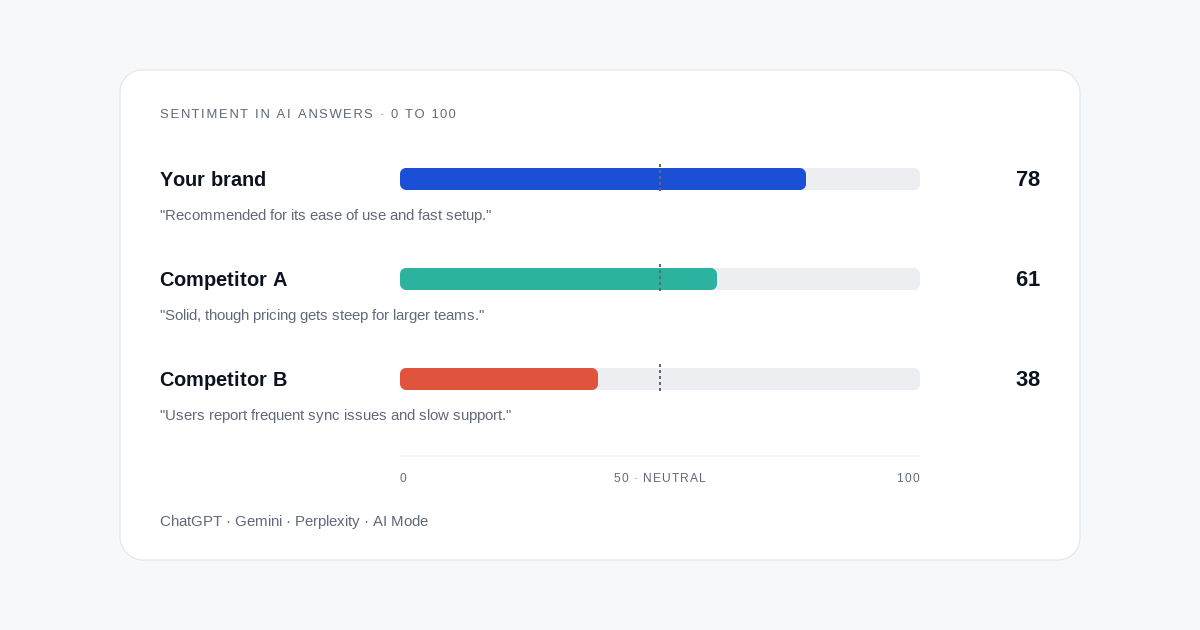
How to track brand sentiment and reputation in AI answers
AI answers have a tone, and buyers read it before your reviews. What to measure, how to check that sentiment scores are right, how to audit your leadership, and what changes the tone.
Read the article →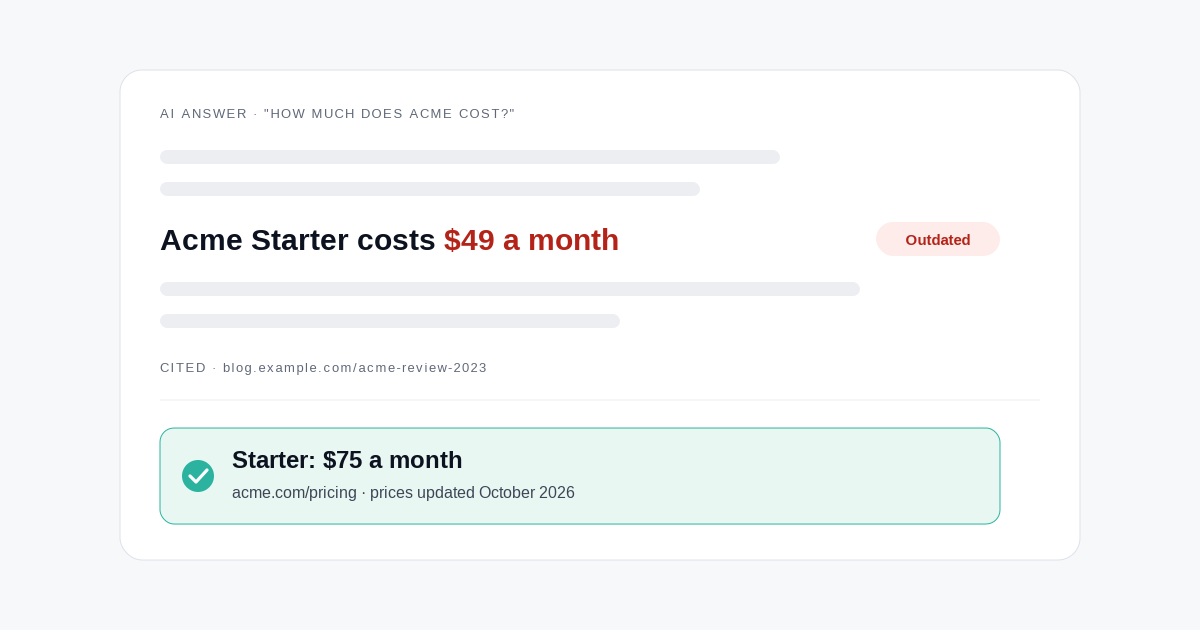
How to fix AI hallucinations about your brand: find the wrong facts, trace them, correct them
Wrong prices, invented features, a CEO who left years ago: AI assistants get brand facts wrong more often than most companies check. How to find the errors and fix them where they come from.
Read the article →
How agencies report AI visibility to clients: share of voice, citations and a monthly report template
"What does ChatGPT say about us?" deserves a better answer than a screenshot. The metrics, setup and monthly report template agencies use for AI visibility.
Read the article →