How to measure your brand's visibility in ChatGPT, Gemini and Perplexity
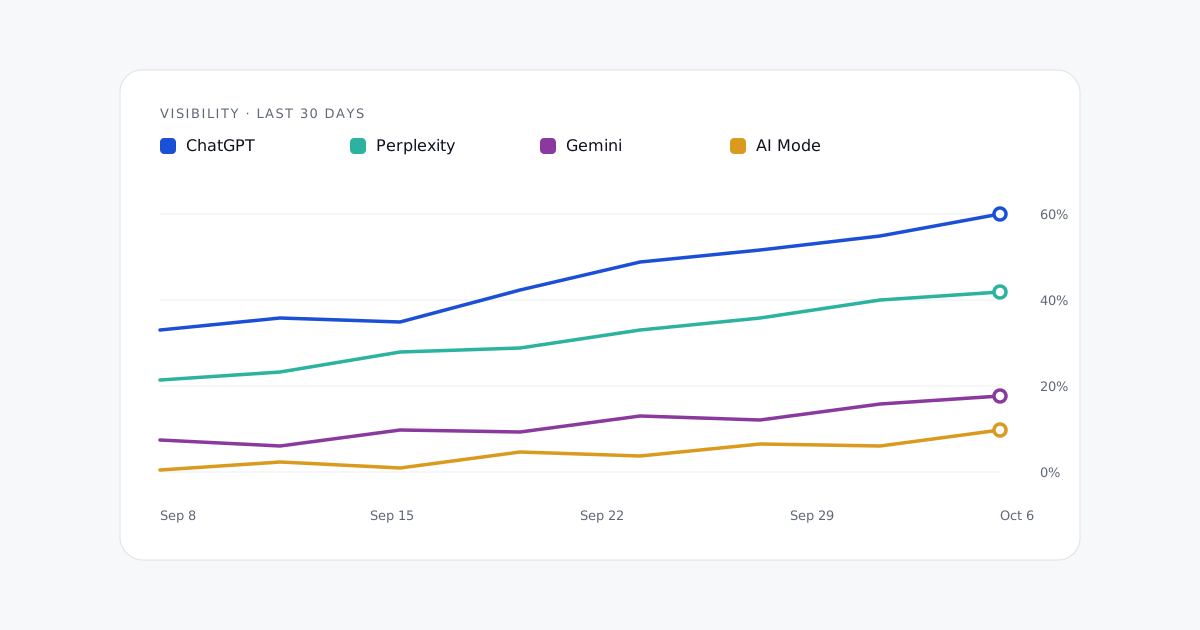
"Are we in ChatGPT's answers?" is the question every marketing team now gets from its management. Answering it with a screenshot is tempting and wrong. Here is how to measure AI visibility in a way you can report on, compare and improve. (For the technical details, from collection routes to confidence intervals, see SERP tracking vs AI citation tracking.)
Why a few manual checks mislead
Ask an assistant the same question three times and you will often get three different lists of brands. Ask it signed in, and it adapts to your history. Ask it today and next week, and the model, its search results or its sources may have changed. A manual check captures one draw of a noisy process, from a biased seat. Good measurement treats AI answers like a survey: many questions, clean conditions, repeated over time, and summary statistics rather than anecdotes.
The measurement setup
- A prompt set. Fifty to a few hundred questions your customers would ask, grouped by topic. The set is your sample; keep it stable so results are comparable over time.
- The engines. At least the ones your customers use: ChatGPT, Gemini, Perplexity, Google AI Mode and AI Overviews are the usual list. Each is measured separately.
- Clean sessions. No account history, no personalization, the country and language of your market.
- A cadence. Daily or every few days. Each run asks every prompt to every engine again.
- A brand list. Your brand, with the other names it goes by, and your main competitors, so that mentions are detected consistently.
From each answer, record four things: the brands named and their order, the sentiment towards each, the sources cited, and the full text, so you can go back and read it.
The five metrics that matter
Visibility
The share of answers that name your brand. If 150 prompts produce 150 answers on ChatGPT and 48 of them mention you, your visibility on ChatGPT is 32%. It is the headline number: it tells you how often you are even in the conversation. Track it per engine and per topic; an overall 32% can hide 70% on one topic and 5% on another.
Average position
When you are named, where in the list. Assistants write in order of preference more often than not: the first brand is "the obvious choice", the fifth is "also available". A move from an average of 3.4 to 2.1 matters as much as a few points of visibility.
Share of voice
Your mentions divided by the mentions of every tracked brand, yours and your competitors'. Visibility tells you how often you appear; share of voice tells you how much of the attention you take from the competitive set. The two can diverge: your visibility can rise while a competitor's rises faster.
Sentiment
How the answer talks about you, on a scale, with the reason. "Reliable but expensive" and "the cheapest option, with fewer features" are both mentions, and they sell to different people. Sentiment is best scored by reading the sentence around the mention, and best used in aggregate, by engine and topic, rather than answer by answer.
Citations
How often your own website is among the sources the answer cites, and, more important, which other sites are cited in your category. Citations are where the clicks go and where the engines get their facts. The list of the most cited domains is your GEO to-do list.
Reading the numbers
A few habits make the metrics useful rather than merely interesting.
- Compare by engine. The engines disagree. Being strong on Perplexity and absent from Gemini is common, and it points at which sources each one trusts.
- Compare by topic. Visibility on "alternatives to [competitor]" prompts and on "best tools for [use case]" prompts are different battles, with different sources.
- Look at trends, not updates. Day-to-day noise of a few points is normal. Judge movements over several updates, and look for breaks that coincide with something you did or something a competitor did.
- Pair the metric with the text. When a number moves, read the answers behind it. The reason is usually obvious in the text: a new source, a changed description, a competitor's launch.
What to put in the monthly report
One page is enough: visibility and share of voice per engine, with the trend; average position against your three main competitors; the top ten cited websites and whether you are on them; three prompts where you lost ground and three where you gained, with the answers quoted. The last part is what turns the report into decisions.
Doing it by hand or with a tool
A first audit can be done by hand: twenty prompts, two engines, a spreadsheet with four columns. It takes an afternoon and it is worth doing once to understand the material. Measuring every week across several engines and hundreds of prompts, with consistent brand detection and sentiment scoring, is what tools like Rempa exist for: they run the prompts in clean sessions, store every answer, and compute the metrics and their history so you spend your time on the gaps, not on the collection.
More from the blog

How to build an enterprise GEO strategy: a framework for organic search directors
GEO at enterprise scale is a program, not a list of tactics: the questions to win, a baseline, four workstreams with owners, and the tools to measure it.
Read the article →
How agencies report AI visibility to clients: share of voice, citations and a monthly report template
"What does ChatGPT say about us?" deserves a better answer than a screenshot. The metrics, setup and monthly report template agencies use for AI visibility.
Read the article →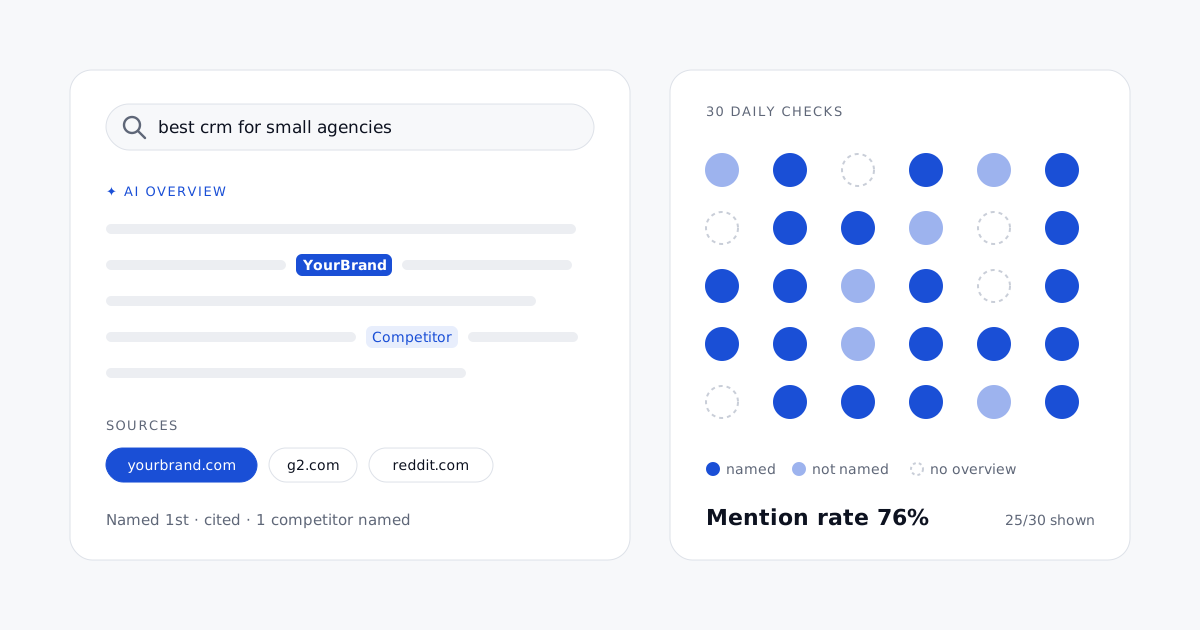
How to track AI Overviews: monitoring brand citations in Google's AI answers, with tool pricing
Search Console will not tell you whether Google's AI summaries name your brand. How to track AI Overviews every day, and what each tool really costs per daily check.
Read the article →