GEO vs SEO: how Generative Engine Optimization differs from traditional search tactics
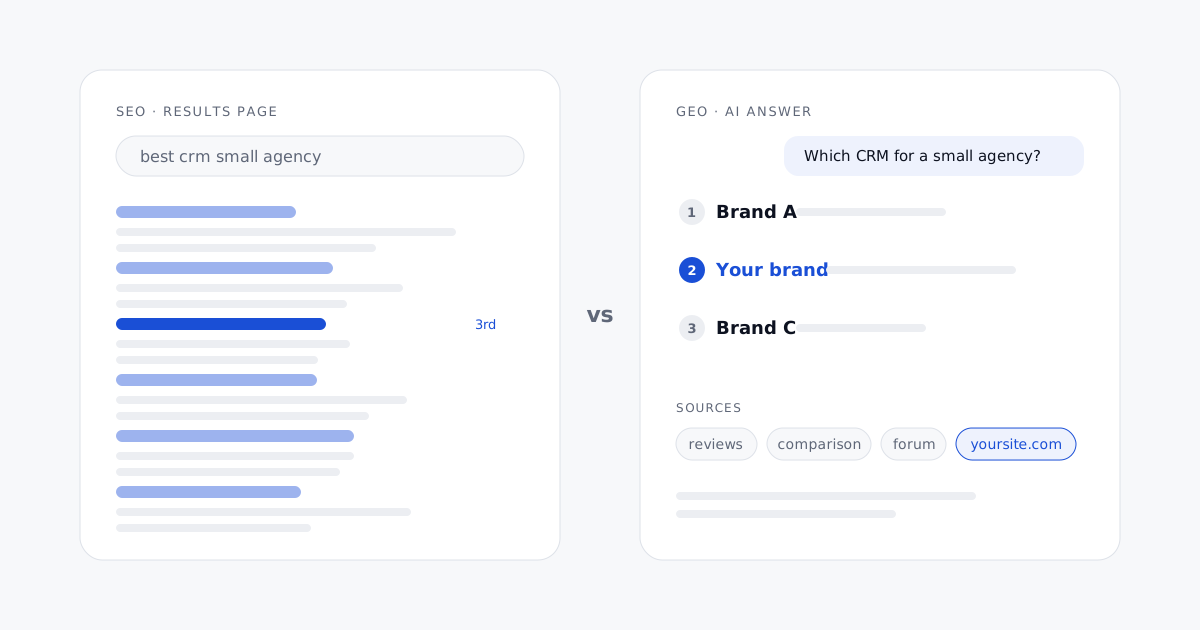
SEO earns your pages a place in a list of results, and visits from the people who click them. GEO, Generative Engine Optimization, earns your brand a place inside the answer that ChatGPT, Gemini, Perplexity or Google's AI Mode writes, often for people who will never see a list at all. They share a foundation, but they measure different things, reward different work and send traffic in different ways. This guide sets the two side by side, tactic by tactic, and shows how to run both without doubling your workload.
The short answer
- SEO optimizes pages to rank in search results, so people click through to your site. Success is a position on the results page, and a visit.
- GEO optimizes your brand's presence across the web so that AI engines name, describe and cite you in their answers. Success is being in the answer, near the top, described the way you want, with your pages among the sources.
- They are not rivals. Most AI answers are built from pages that search engines already index, so good SEO is the entry ticket to GEO. But it is not enough: what other sites say about you, and how your facts are written, weigh more in an AI answer than in a ranking.
GEO vs SEO at a glance
| SEO | GEO | |
|---|---|---|
| Where you appear | Google and Bing results pages: ten links, plus ads and features | Answers written by ChatGPT, Gemini, Perplexity, Copilot, Google AI Overviews and AI Mode |
| What is ranked | A URL | A brand, product or claim, inside a text |
| What success looks like | Top positions and clicks | Being named, named early, described well, and cited as a source |
| The query | Short keywords, 2 to 4 words | Full questions with context: "which CRM for a 20-person agency that uses Gmail?" |
| What decides | Relevance, links, page experience, intent match | What the engine's sources say, how consistent they are, how specific and verifiable your facts are |
| Your own site's weight | Central: your page is what ranks | One source among several; review sites, comparisons, forums and press often weigh more |
| Stability | Rankings move over days and weeks | The same question can return different brands from one run to the next |
| How you measure | SERP tracking, Search Console, analytics | AI citation tracking: repeated prompts across engines and markets: visibility, position, share of voice, sentiment, citations |
| How it brings traffic | Directly, by clicks on your result | Partly by clicks on cited sources, mostly by influence: branded searches, direct visits, shortlists |
How each one drives organic traffic
SEO: rank, click, visit
The SEO model is a funnel you can see end to end. Someone searches, your page ranks, a share of searchers click, and the visit lands in your analytics with the query or the landing page attached. Twenty years of tooling exist to measure each step, and the economics are well known: the first positions take most of the clicks, and each lost position costs a predictable share of traffic.
That funnel is narrowing at the top. In the Datos and SparkToro 2024 zero-click study, 58.5% of US Google searches and 59.7% of EU searches ended without any click. AI Overviews push further: Pew Research found that users clicked a traditional result in 8% of visits to a results page with an AI Overview, against 15% without one, and clicked a link inside the AI summary itself in about 1% of visits. Ahrefs estimates that the top organic result loses around 58% of its click-through rate when an AI Overview is shown. Search demand is not collapsing; Google handles more searches than ever. What shrinks is the share of searches that end on your site.
GEO: mention, consideration, then a visit, often later
GEO drives traffic through three channels, and only the first looks like SEO:
- Citation clicks. Perplexity, ChatGPT search, Copilot, AI Overviews and AI Mode link to their sources. If your page is one of them, some readers click. This traffic shows up in analytics as referrals from chatgpt.com, perplexity.ai and similar, or as Google organic for AI Overviews and AI Mode.
- Branded demand. When an assistant recommends you, the reader often opens a new tab and searches your name, or types your address. The visit is real, but your analytics credits branded search or direct traffic, not the AI answer that caused it.
- The shortlist effect. Many buyers ask an assistant which vendors to consider, then compare the three or four names it gives them. Being on that list decides whether you are evaluated at all, even if the purchase happens weeks later through another channel.
The volumes are still small compared with search: Conductor measured AI platforms at about 1% of website traffic on average across ten industries. But the visits tend to be well qualified, because the reader has already had the comparison explained to them. A 12-month analysis of 94 ecommerce sites by Visibility Labs found ChatGPT referrals converting at 1.81%, against 1.39% for non-branded organic search. Earlier studies found the opposite, so treat the premium as plausible, not guaranteed. The larger effect is the one analytics cannot see: the recommendations that went to a competitor and never produced a visit for anyone to count.
Seven differences that change the work
1. The unit is the brand, not the page
A search engine ranks documents. A generative engine answers a question, and the answer is about brands, products and facts. Your page can be cited without your brand being recommended, and your brand can be recommended without any of your pages being cited, because the engine learned it from a review site. GEO measures the brand in the answer; SEO measures the URL in the list.
2. One answer instead of ten links
An AI answer typically names three to six brands, sometimes one. There is no page two to fall back on, and the order carries meaning: the first brand named is usually framed as the default choice, the fifth as an alternative. Position still matters, but it is position in a sentence.
3. Other people's pages weigh more
AI engines retrieve several pages and write a synthesis. Most of those pages are not yours: comparison articles, review platforms, directories, Reddit and forum threads, trade press, Wikipedia. Rankings and citations also diverge. In July 2025, Ahrefs found that 76% of the pages cited in AI Overviews ranked in Google's top 10 for the same query; in a larger study published in 2026 that share had fallen to about 38%, with the rest split between positions 11 to 100 and pages beyond the top 100. Ranking first is no longer a reliable proxy for being used.
4. Prompts are longer and more specific than keywords
People talk to assistants in full sentences, with their constraints: budget, team size, country, the tools they already use. Google's AI Mode and ChatGPT search also split one question into several sub-queries behind the scenes ("query fan-out") and read results for each. A page written for one head keyword competes less well than a page that answers the specific situations your buyers describe.
5. Answers vary, so measurement is statistical
Ask the same question twice and you can get two lists. Engines sample their wording, search the web differently from one run to the next, and personalize with memory and location. A single screenshot proves nothing; a visibility rate over many prompts, repeated on a schedule, does. SEO rankings fluctuate too, but nowhere near as much.
6. Markets and languages diverge more
The same question asked in French from France and in English from the United States usually returns different brands, because the engine searches local sources in the local language. International SEO deals with this through hreflang and local pages; in GEO, you need presence in each market's own sources and must measure each market separately.
7. Attribution is weaker
Search Console tells you which queries brought impressions and clicks. No AI engine gives brands an equivalent report of the prompts where they were named. GEO teams measure the answers directly, then connect them to softer signals: branded search volume, AI referrals, and the "how did you hear about us?" field.
What stays the same
Most of what makes SEO work also feeds GEO, which is why the two should share a team and a roadmap rather than compete for budget:
- Crawlability. AI answers that search the web rely on indexes: Google's for AI Overviews and AI Mode, Bing's and their own crawlers' for others. A page that is blocked, slow, or only readable after JavaScript runs is invisible to both.
- Useful, expert content. Pages that answer a question completely, with first-hand detail, rank and get cited. Thin pages do neither.
- Authority and mentions. Links from respected sites help rankings; mentions on respected sites shape what an AI says. A digital PR campaign serves both.
- Structure and clarity. Descriptive headings, clear entity names, structured data and consistent facts help search engines understand a page, and help an AI quote it accurately.
Tactic by tactic: from SEO to GEO
| SEO tactic | Its GEO counterpart |
|---|---|
| Keyword research | Prompt research. Write the full questions buyers ask, by persona, use case and decision stage, in each market's language. Use search volumes to weight the topics, not to word the prompts. |
| On-page optimization | Answer-ready pages. Put the answer first, then the evidence. State facts an AI can lift: prices, limits, integrations, who the product is for and not for, dates. Comparison and alternatives pages that are honest about trade-offs get cited. |
| Link building | Source building. Find the pages the engines cite in your category, and get listed, reviewed and correctly described on them. A mention on the comparison article every engine cites beats ten links from pages nobody reads. |
| Technical SEO | AI crawler access. Check that robots.txt and your firewall let in the crawlers that fetch pages for answers (OAI-SearchBot and ChatGPT-User for ChatGPT, PerplexityBot, Googlebot and Bingbot), that key content is in the HTML, and consider an llms.txt file. |
| Rank tracking (SERP tracking) | Answer and citation tracking. Run a fixed set of prompts through several engines on a schedule, from clean sessions, and record brands named, position, sentiment and cited sources. |
| Reputation management | Perception management. Read how each engine describes you and your competitors. Fix outdated or wrong claims at their source, since that is where the engine read them. |
| Local and international SEO | Market-by-market presence. Earn mentions in each country's own directories, press and review sites, and measure each market in its language. |
What the research says works
The term GEO comes from a 2023 paper by researchers at Princeton, Georgia Tech, the Allen Institute for AI and IIT Delhi, presented at the KDD 2024 conference. They built a benchmark of thousands of queries across domains and tested how rewriting a source page changes its visibility in generative answers. Their best methods raised visibility by up to 40%. The changes that helped most were adding citations to credible sources, adding quotations, and adding statistics: making a page more specific and verifiable. Keyword stuffing, the reflex of old-school SEO, did little. The effect also varied by domain, so what works for a software comparison may not work for a health question.
Keep two limits in mind. The experiments rewrote one source at a time in a controlled setup, which is not how a brand competes on the open web. And engines change faster than papers are published. The lasting lesson is the direction: engines favor content they can quote and check.
How to measure each
SEO metrics
Rankings for target keywords, impressions and clicks in Search Console, organic sessions and conversions in analytics, and links earned. These remain essential, and they now underestimate your reach, because part of your audience reads an AI summary instead of clicking.
GEO metrics
- Visibility: the share of answers that name your brand, across your prompts.
- Position: where you appear among the brands named, 1 being first.
- Share of voice: your mentions against your competitors'.
- Sentiment: how favorably the answers describe you.
- Citations: which domains and pages the engines rely on, and whether yours are among them.
Read them by engine, topic and market, and judge trends over weeks rather than single runs. Then connect them to business signals: AI referrals in analytics (sessions from chatgpt.com, perplexity.ai, gemini.google.com, copilot.microsoft.com), branded search volume, and self-reported attribution in your forms. Our guide to measuring AI visibility details the setup. For the engineering side (collection routes, parsing, sampling and confidence intervals), see SERP tracking vs AI citation tracking.
Running both: a 90-day plan
You do not need a separate GEO team. You need to add the answer layer to the work your SEO and content teams already do.
Days 1 to 30: baseline
- Write 50 to 150 prompts from your main topics, personas and markets. Our guide on writing the prompts your customers ask explains how.
- Run them on the engines your buyers use, and record visibility, position, sentiment and sources against your main competitors.
- Audit AI crawler access in robots.txt, your CDN and your firewall, and check that your key pages render without JavaScript.
Days 31 to 60: close the gaps
- List the prompts competitors win and you lose, and the domains cited most often in your category where you are absent.
- Rewrite or create the pages that answer those prompts, answer first, with specific facts and sources.
- Start outreach to the cited sources: review profiles, directory listings, comparison articles, expert quotes for the press. See which sources AI assistants cite.
Days 61 to 90: read the trend and connect it to revenue
- Compare visibility and position with the baseline, by engine and topic.
- Correct wrong or outdated descriptions at their source.
- Report GEO and SEO together: rankings and clicks for the pages, answers and citations for the brand, and the branded demand that ties them together.
Frequently asked questions
Is GEO replacing SEO?
No. Search engines still handle trillions of searches a year, and AI answers that search the web are built on the same indexes. GEO adds a layer on top of SEO: it covers the share of discovery that now happens inside AI answers, where rankings alone no longer tell you whether you are recommended.
If I rank well on Google, will AI engines recommend me?
It helps, but it is not enough. Rankings make your pages available to the engines; the answer itself depends on what all the cited sources say about you and your competitors. Many brands that rank well are absent from AI answers in their category, usually because the comparison and review pages the engines rely on do not mention them.
Is GEO the same as AEO or LLMO?
Mostly, yes. Answer Engine Optimization (AEO) started with featured snippets and voice assistants; LLM Optimization (LLMO) and AI SEO are other names for the same goal. GEO is the most common term for appearing in generative AI answers, and the one used in the research that coined it.
How long does GEO take to show results?
Engines that search the web can pick up a new or updated page within days. Changing what the wider web says about you, through reviews, listings and press, takes weeks to months. Because answers vary, judge progress on trends over four to eight weeks, not on a single run.
Can I see GEO results in Google Analytics?
Partly. Referrals from AI assistants appear as referral traffic from their domains, and you can group them into a channel. Clicks from AI Overviews and AI Mode are counted as Google organic traffic. The influence that leads to a branded search or a direct visit is not attributed, which is why the answers themselves have to be measured.
Sources
- Aggarwal, Murahari, Rajpurohit, Kalyan, Narasimhan and Deshpande, "GEO: Generative Engine Optimization", KDD 2024 (arXiv 2311.09735).
- SparkToro and Datos, "2024 zero-click search study" (July 2024).
- Pew Research Center, Google users and AI summaries (July 2025).
- Ahrefs: AI Overviews and click-through rate (December 2025); "76% of AI Overview citations pull from the top 10" (July 2025); follow-up citation study on 863,000 keywords (2026), as reported by Search Engine Journal.
- Conductor, AI referral traffic benchmarks across ten industries (2025); Visibility Labs, ChatGPT versus non-branded organic conversions on 94 ecommerce sites, as reported by Search Engine Land.
- Google, search volume disclosure (March 2025).
More from the blog

How to build an enterprise GEO strategy: a framework for organic search directors
GEO at enterprise scale is a program, not a list of tactics: the questions to win, a baseline, four workstreams with owners, and the tools to measure it.
Read the article →
How agencies report AI visibility to clients: share of voice, citations and a monthly report template
"What does ChatGPT say about us?" deserves a better answer than a screenshot. The metrics, setup and monthly report template agencies use for AI visibility.
Read the article →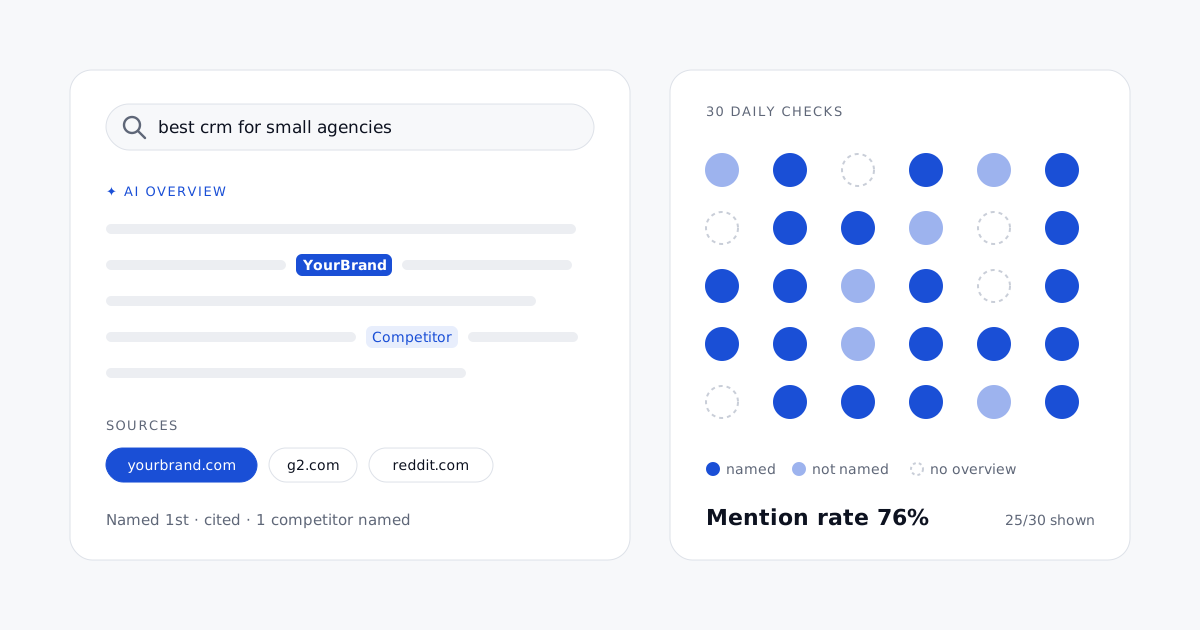
How to track AI Overviews: monitoring brand citations in Google's AI answers, with tool pricing
Search Console will not tell you whether Google's AI summaries name your brand. How to track AI Overviews every day, and what each tool really costs per daily check.
Read the article →