How to track brand sentiment and reputation in AI answers
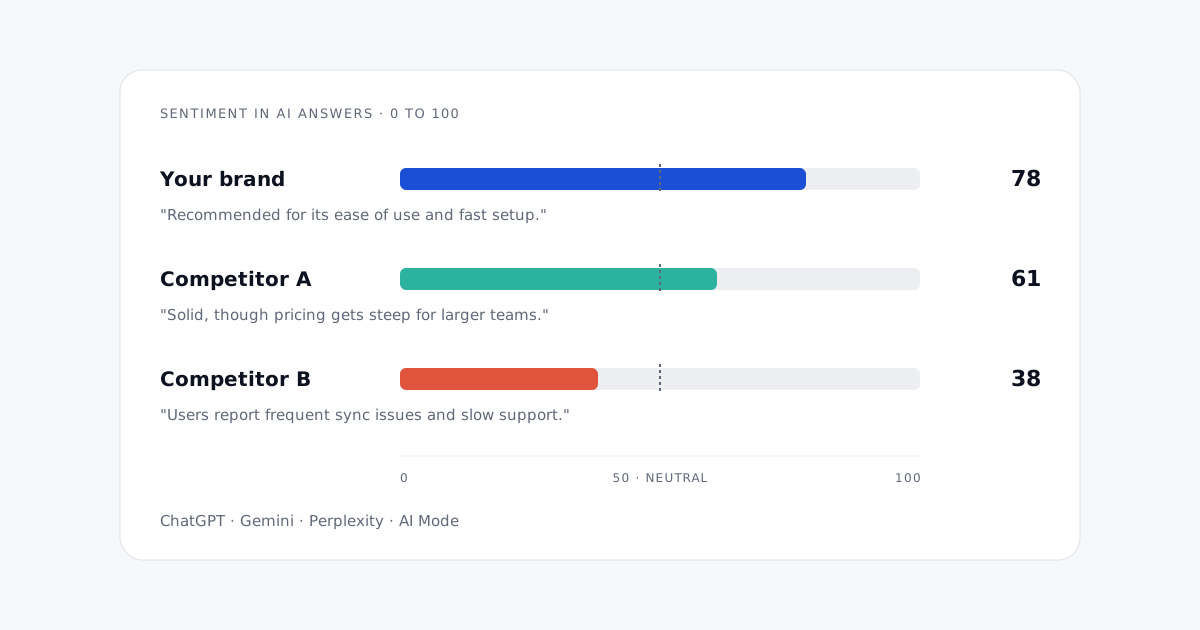
When a buyer asks ChatGPT whether your product is reliable, the answer has a tone: an enthusiastic recommendation, a balanced "good, but", or a warning. That tone now shapes a shortlist before anyone reads a review or calls your sales team. This guide explains how to track brand sentiment and reputation in AI answers, across ChatGPT, Gemini, Perplexity, Copilot and Google's AI, how to check that automated sentiment scores can be trusted, how to audit what assistants say about your leadership, and what actually changes the tone.
Why AI sentiment is not social listening
Social listening tools were built to follow what people post on social media, forums and news sites. AI answers are a different object: one synthesized opinion, written by the assistant, read by the buyer at the moment of choice. The two complement each other, but they answer different questions:
| Social listening | AI answer monitoring | |
|---|---|---|
| What is read | Posts, comments, articles written by people | The answers ChatGPT, Gemini, Perplexity and others give to buyers' questions |
| Volume | Thousands of mentions, most never seen by a buyer | A few dozen answers, each read at the moment of choice |
| Unit of sentiment | One author's opinion | The assistant's verdict, often comparing you with competitors |
| What drives it | Events, campaigns, customer experience | The pages the assistant reads: reviews, forums, comparisons, press, your site |
| How to change it | Respond, engage, run campaigns | Fix the sources: correct facts, earn better reviews and coverage, answer the recurring objections |
A spike of complaints on social media may never reach AI answers; a two-year-old negative review on a site assistants trust can color every answer for months.
What to measure
- A sentiment score per brand and per answer. Score each answer for each brand it names, on a fixed scale (for example 0 to 100, 50 being neutral), so you can compare yourself with competitors in the same answers.
- The reason behind each score. A number without its reason cannot be checked or acted on. "Recommended for ease of use" and "listed, with a note on limited integrations" lead to different work.
- Recommended, listed or warned against. Being named is not being recommended. Track how often the assistant puts you first, names you neutrally, or advises against you.
- The recurring themes. The strengths and weaknesses assistants repeat about you across answers: that summary is your brand perception in AI, and the weaknesses are your to-do list.
- The sources behind negative answers. Which review sites, threads or articles the critical answers cite.
- By assistant and by market. Tone often differs between ChatGPT, Gemini and Perplexity, and between countries.
How to set up sentiment tracking
Sentiment only shows on questions where an assistant has to form an opinion. Add these to the questions you track (see writing the prompts your customers ask):
- Choice questions: "What is the best [category] tool for [use case]?", "[your brand] vs [competitor]", "Alternatives to [your brand]".
- Trust questions: "Is [your brand] reliable?", "[your brand] reviews", "Is [your brand] good for enterprises?".
- Problem questions: "Problems with [your brand]", "Why do customers leave [your brand]?". They are uncomfortable, and buyers ask them.
Run them on the assistants your buyers use, from each market you sell in, every day or every few days: tone moves when new reviews, articles or forum threads appear. Read rates over many answers rather than reacting to one, and look at the reasons whenever the average drops (see how to measure AI visibility).
How to check that automated sentiment scores are right
Most tools score sentiment with a language model. That is fast and consistent, but not infallible. Before reporting the numbers to leadership, run a simple check:
- Take a sample of 50 answers that name your brand, across assistants and questions.
- Score them by hand, two people separately, on the tool's scale or simply as positive, neutral or negative.
- Compare with the tool's scores. Agreement on the direction (positive, neutral, negative) for at least 8 answers in 10 is a good level; disagreements on neutral versus slightly positive are normal.
- Read the disagreements. The usual traps: a single score for an answer that praises one brand and criticizes another, a list that names you without any opinion scored as positive, irony, and a brand name that is also a common word.
Prefer tools that score each brand separately within an answer and give the reason for each score: you can check any number in seconds.
How to audit what AI says about your leadership
Buyers, journalists and candidates also ask assistants about a company's leaders. Errors there are sensitive: a former CEO still named, a wrong career history, a controversy attached to the wrong person. Audit it like any other topic:
- Ask the questions people ask: "Who is the CEO of [company]?", "Who founded [company]?", "What is [name] known for?", "Is [company]'s leadership team experienced?".
- Check the facts against an official list: names, titles, dates, past roles, and the tone of the description.
- Trace the sources: professional profiles, your own team page, press coverage, encyclopedic pages and old interviews.
- Correct at the source: an up-to-date leadership page with one short biography per person, Person structured data linked to your Organization, a current press kit, and corrections requested from the sites that are wrong (see how to fix AI hallucinations about your brand).
What changes the tone of AI answers
Assistants repeat the opinions of the pages they read. To change the tone, change what those pages say:
- Review sites and forums. When the critical answers cite a review platform or a forum thread, that is where to act: ask satisfied customers for reviews, answer criticism publicly, and show what has changed.
- Earned media. Coverage in publications that assistants cite gives them a new, recent opinion to quote. Digital PR that lands on cited sites moves both visibility and tone; coverage on sites they never cite moves neither.
- The recurring weaknesses. If every answer says you lack an integration or are expensive for small teams, publish the facts that answer it: the integration if you built it, the plan that fits small teams, an honest page on who you are not for.
- Wrong facts. A negative tone often rests on an outdated fact, an old price or a fixed limitation. Correct it at its source.
Tools to track sentiment in AI answers
AI visibility tools read the answers themselves, which social listening tools do not. Among them:
- Rempa scores each brand named in each answer from 0 to 100, with a one-sentence reason, for you and your competitors, and sums up after each update the strengths, weaknesses and words assistants associate with your brand, with the full answers and their sources. Rempa is our product.
- Peec AI, Profound, Otterly.AI and Semrush also report sentiment in AI answers; Peec AI adds brand attribute scoring and the objections assistants raise, and Semrush the narratives associated with a brand.
Our comparison of the best AI visibility tools in 2026 covers prices and coverage.
Frequently asked questions
How do I know if ChatGPT talks about my brand negatively?
Ask it the questions your buyers ask, especially comparisons, "is it reliable" and "alternatives to" questions, several times and in each market, and read the tone towards your brand. An AI visibility tool does this every day, scores the sentiment per brand and keeps the reason for each score.
Can social listening tools track sentiment in AI answers?
Social listening tools follow what people publish on social media, forums and news sites. AI answers are generated on demand and are not published, so they need a tool that asks the assistants the questions and reads their answers.
How accurate is automated sentiment analysis of AI answers?
Good enough for trends when each brand is scored separately with a reason, but check it: score a sample of 50 answers by hand and compare. Agreement on positive, neutral or negative for at least 8 answers in 10 is a sound level.
How can I see how AI describes our CEO and leadership team?
Add questions about your leaders to the questions you track, check names, titles and history against an official list, and trace any error to the pages the assistants cite. Correct those pages and keep an up-to-date leadership page on your site.
Does digital PR change how AI assistants talk about a brand?
Yes, when the coverage lands on sites that assistants read and cite. They repeat the opinions of those pages, so recent, positive coverage there can change the tone of their answers; coverage on sites they never cite has little effect.
More from the blog
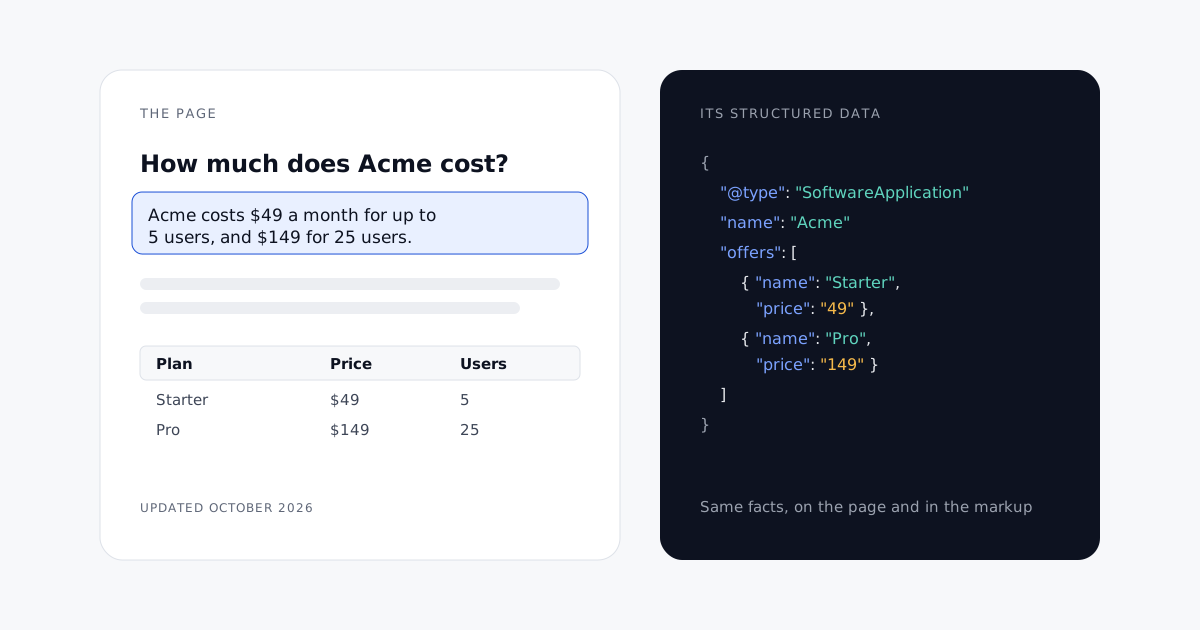
Structured data and content structure for AI citations: what helps assistants use your pages
Schema markup helps less than many guides promise; the page itself decides whether an assistant can quote it. Which structured data matters, and how to write pages AI answers cite.
Read the article →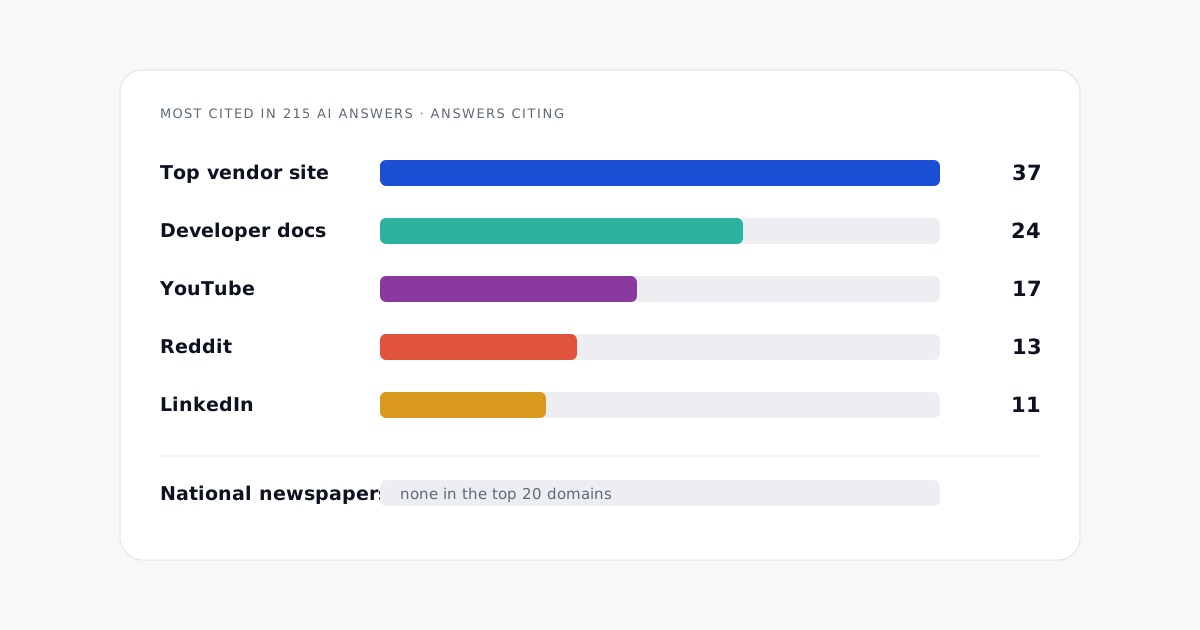
Digital PR for AI visibility: how to get your brand cited in ChatGPT, Gemini and Perplexity
Assistants cite a different set of sites than the ones PR teams pitch. How coverage reaches AI answers, which tactics get your brand cited, and how to measure a campaign on AI mentions.
Read the article →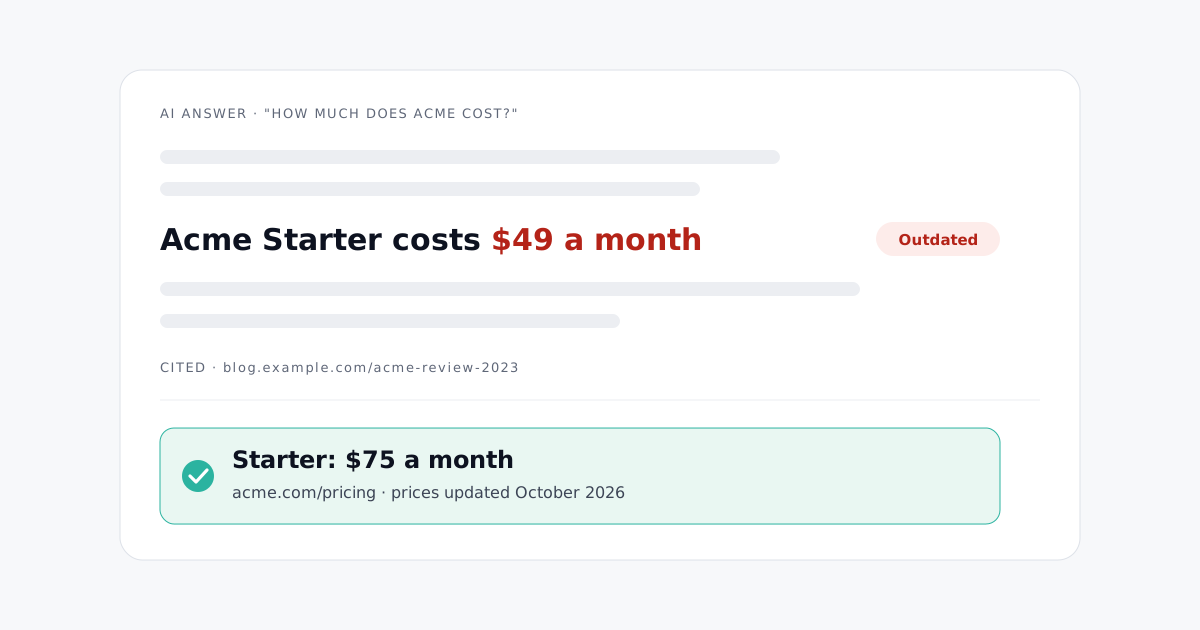
How to fix AI hallucinations about your brand: find the wrong facts, trace them, correct them
Wrong prices, invented features, a CEO who left years ago: AI assistants get brand facts wrong more often than most companies check. How to find the errors and fix them where they come from.
Read the article →