Writing the prompts your customers actually ask an AI
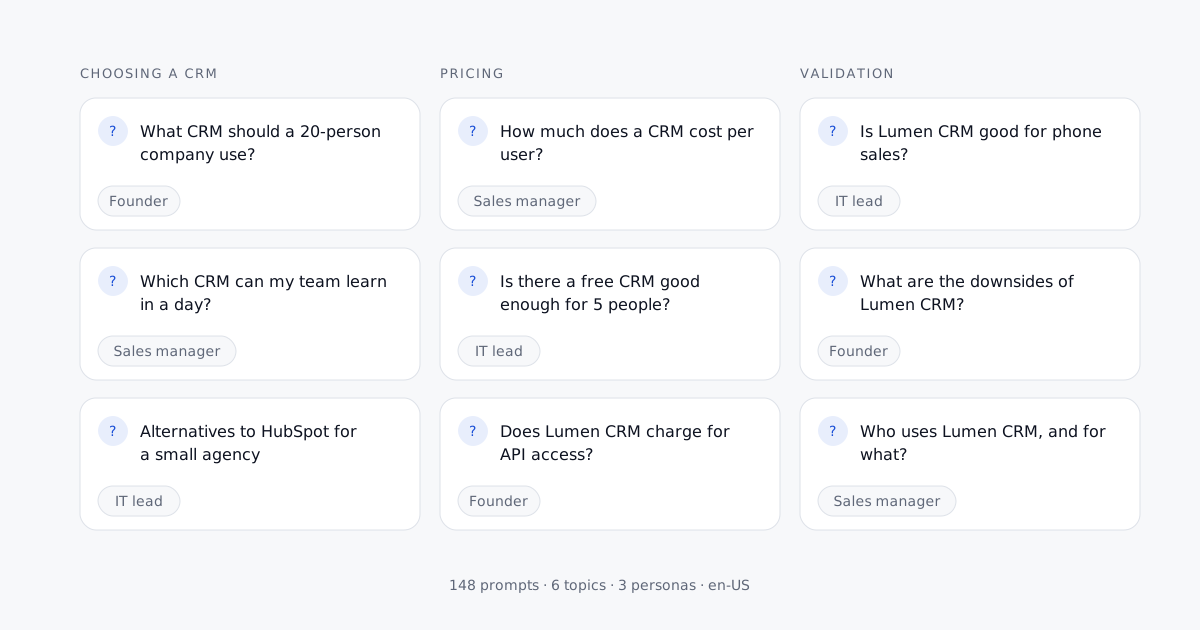
The prompts you track are the questions you choose to be judged on. Pick keywords, and you will measure a search engine. Pick the real questions of real buyers, and you will measure what AI assistants tell them about you. Here is how to build a prompt set that reflects your customers.
Prompts are not keywords
Nobody asks an assistant "crm small business". They ask "What CRM should a 20-person company use if we mostly sell by phone?" The difference is not cosmetic. Full questions carry a situation (company size, channel), a constraint (budget, integration, country) and an intent (compare, choose, check). Assistants answer each differently, and name different brands for each. A prompt set made of keywords measures nothing anyone experiences.
Write every prompt as a complete sentence someone could type without feeling silly. If it reads like a search query, rewrite it.
Structure: topics, personas, stages
A good set is organized along three axes, so that results can be read by slice.
Topics
The subjects your buyers ask about: choosing a tool, pricing, migration from a competitor, a specific use case, integrations, compliance. Five to ten topics, each with a few subtopics, cover most products. Topics are how you will later see that you are strong on "pricing" questions and absent from "alternatives to…" ones.
Personas
The same topic sounds different from a founder, a sales manager and an IT lead. "Which CRM can my team learn in a day?" and "Which CRM has a proper API and SSO?" name different brands. Write prompts in each persona's words and vocabulary.
Decision stages
- Discovery: "What tools help a small sales team keep track of leads?" Broad; your brand competes with the whole category.
- Comparison: "Pipedrive or HubSpot for a 10-person agency?" and "alternatives to [competitor]". The most valuable prompts to win, and the most sensitive to third-party comparison pages.
- Validation: "Is [your brand] good for…", "what are the downsides of [your brand]". Here you are always named; the question is how.
Writing the prompts
A few rules that make prompts realistic and measurement stable:
- One question per prompt. "Which CRM is cheapest and has the best mobile app?" is two questions; the answer will straddle them.
- Add the situation. Size, industry, budget, country, existing tools. Specific prompts produce specific, comparable answers.
- Use your customers' words, not your positioning. If they say "quote tool" and you say "CPQ platform", track "quote tool". Support tickets, sales calls and community threads are the best sources of phrasing.
- Include prompts that name competitors, and a few that name you. They measure comparison and validation, which the discovery prompts cannot.
- Avoid leading prompts. "Why is [your brand] the best?" measures the assistant's politeness.
- Keep the wording fixed. Once a prompt is tracked, do not edit it; add a new one. Edited prompts break the history.
Markets and languages
AI answers are local. The brands recommended to a buyer in Germany are not those recommended in the United States, and the sources cited differ even more. Track each market as its own project, with prompts written in the market's language by a native speaker, not translated. If you sell in three countries, you have three prompt sets, and three different competitive pictures.
How many prompts
Enough to make the metrics stable, few enough to maintain. Thirty prompts give a first picture; fifty to one hundred and fifty, spread across topics, give per-topic numbers you can trust; a few hundred suit broad catalogs or agencies tracking several brands. Beyond that, returns diminish and noise does not fall much. Whatever the size, keep the set balanced: a set that is 60% pricing questions will tell you mostly about pricing.
Maintaining the set
Review it quarterly. Retire prompts about discontinued products. Add prompts for new use cases, new competitors and new objections you hear from sales. Mark additions with a date so trend charts can be read correctly. And resist the urge to track only the prompts you win; the ones you lose are the reason to measure.
A starting template
For each of your five main topics, write: two discovery questions from your main persona, two from a secondary persona, two comparison questions (one naming a competitor, one asking for alternatives to a competitor), one pricing question, one validation question about your brand. That is forty prompts, balanced, in an afternoon. Rempa can draft a first set from your brand profile and let you edit it; however you produce it, read every prompt aloud before you track it. If it does not sound like a customer, it is not measuring one.
More from the blog

How to build an enterprise GEO strategy: a framework for organic search directors
GEO at enterprise scale is a program, not a list of tactics: the questions to win, a baseline, four workstreams with owners, and the tools to measure it.
Read the article →
How agencies report AI visibility to clients: share of voice, citations and a monthly report template
"What does ChatGPT say about us?" deserves a better answer than a screenshot. The metrics, setup and monthly report template agencies use for AI visibility.
Read the article →
How to track AI Overviews: monitoring brand citations in Google's AI answers, with tool pricing
Search Console will not tell you whether Google's AI summaries name your brand. How to track AI Overviews every day, and what each tool really costs per daily check.
Read the article →