How to get your products recommended by ChatGPT and other AI assistants

A shopper asks ChatGPT for the best moisturizer for sensitive skin, or a good ride-on toy for a three-year-old. The answer names a few products, sometimes with a price and a shop. If your products aren't there, you're out before the comparison starts. This guide looks at what AI assistants do on shopping questions, using Rempa's studies in retail and consumer goods, and gives six steps to get your products into their answers.
What AI answers look like on shopping questions
We put 12 shopper questions to ChatGPT, Gemini and Google AI Mode in several categories, 36 answers per study. Four patterns stand out. These are small samples, so read them as signs, not market shares.
- Retailer pages can outweigh brand sites. In our US skincare study, ulta.com is cited in 10 answers and sephora.com in 8, against 6 for paulaschoice.com, the most-named brand's own site.
- A brand's own site can also lead. In our UK raw pet food study, in a category of direct-to-consumer brands, bellaandduke.com is cited in 23 of the 36 answers. The questions there were written from that brand's own offer, which favors it, but the feeding guides and ingredient details of such brands are what assistants can quote.
- ChatGPT often shows where to buy. In our US toys study, 8 of ChatGPT's 12 answers name a retailer, against 3 for Gemini and 3 for Google AI Mode. Its product cards end in "Shop at Walmart" or "Shop at Target", with a price.
- Each model behaves differently. In our UK consumer electronics study, Amazon is named in 8 answers, all of them from Google AI Mode, whose product cards list the shops. Gemini names a retailer in 1 answer of 12.
Two different games follow from this. A brand has to be named as the product to buy. A retailer has to be named as the place to buy it. The steps below serve both, but check which one you're playing on each question.
How ChatGPT chooses products
OpenAI's help pages give the official outline. It says product results are selected independently and are not ads, with ads handled separately. The selection draws on the question and its context, on structured metadata from first-party and third-party providers (such as price and description), and on other third-party content. Rankings weigh several factors, such as available options, price and reviews, and the emphasis shifts with the request: a stated budget makes price matter more. When several merchants sell a product, availability, price, quality and being the maker or primary seller all count.
In practice, an assistant has to find your product, understand who it suits, and find others who confirm it. Each step below works on one of those.
Six steps to get your products recommended
1. List the questions shoppers ask, by need
Shoppers rarely ask for a product name. They describe a situation: "a moisturizer with SPF for breakout-prone skin", "an integrated washing machine under £500", "a phone for an elderly relative". In our skincare study, brands are filed by need: actives go to ingredient-led brands, sensitive skin and sunscreen to dermatologist brands. List 30 to 100 questions by use, budget, buyer and constraint, in each market's language (see writing the prompts your customers ask).
2. Make your catalog readable
Let the crawlers in: allow OAI-SearchBot, and the other crawlers in our guide to AI crawlers and robots.txt, and check that your bot protection doesn't block them. E-commerce sites deserve extra care here, since they often run strict anti-scraping rules. Keep the name, price, availability and main attributes in the HTML of the product page, not only in scripts.
3. Write product pages that answer questions
A description that says "premium quality" gives an assistant nothing to repeat. State the facts a shopper's question turns on:
- Who it is for and not for: skin type, age, room size, skill level.
- Measurable attributes: dimensions, ingredients and concentrations, capacity, compatibility, materials.
- Practical terms: price, delivery, returns, warranty, stock.
- Evidence: tests, certifications and reviews. Our skincare study found dermatology sources and published studies among the cited sites, so explain the claims you can back up in plain words.
Then add buying guides and fair comparisons, such as "how to choose" and "X vs Y". In our study of what AI assistants cite, comparison, ranking and review pages make up about a fifth of the cited pages on sites that publish their own content.
4. Publish clean product data, and a feed if you can
Add Product structured data with offers to your pages, and keep it identical to what the page shows (see structured data for AI citations). Wrong or stale data does harm, since prices in answers can lag behind your changes.
OpenAI also documents a product feed. Its reference requires an ID, title, description, URL, brand, seller name, image, availability and price for each item, and notes that eligibility does not guarantee display. Checkout needs a separately enabled integration. Availability depends on your platform and on OpenAI's onboarding: OpenAI's help pages say that Shopify merchants' product data reaches ChatGPT through Shopify Catalog. Check where you stand before you build anything.
5. Work on the pages that aren't yours
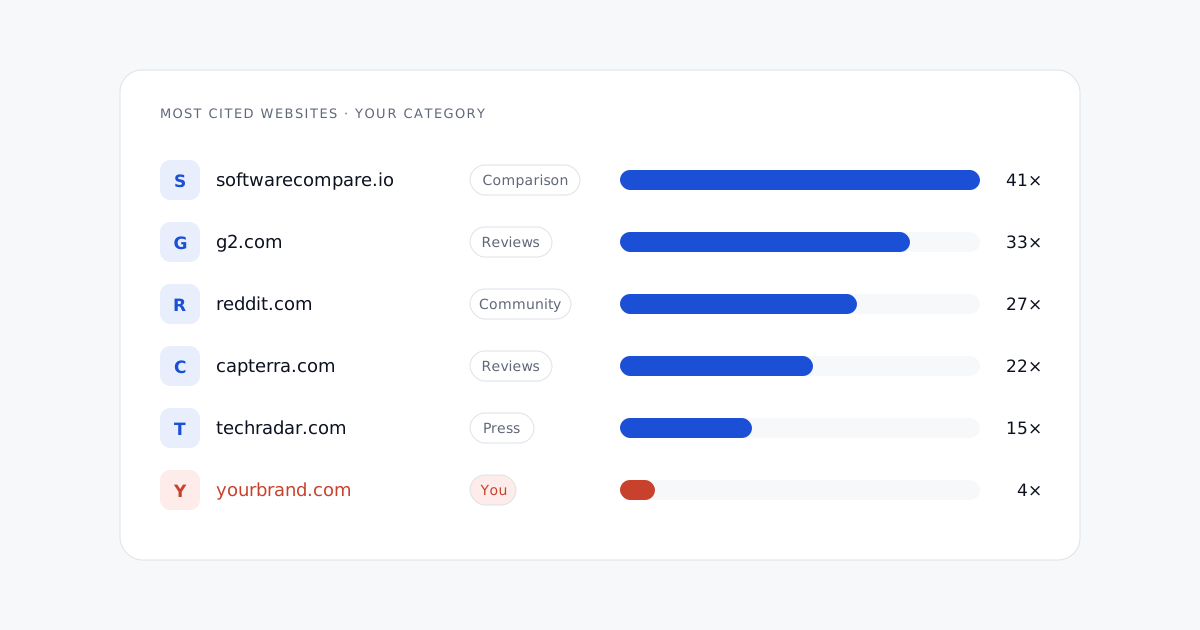
Find the sites cited on your questions, and work on them in order of citations. Your category decides the list:
- Retailers that stock you. Your descriptions, ratings and reviews on their product pages feed what AI says about you. Give them complete data, and collect genuine reviews.
- Comparison sites and specialist media. Send samples and facts to the authors of the "best of" pages that are cited. See digital PR for AI visibility.
- Experts and forums, where they are cited. Our citation study found Reddit cited less than its reputation suggests, and much less by ChatGPT than by Google's models. So check your own questions before investing there.
6. Measure by model, by need and by name
Run your questions regularly on each assistant and record whether you're named, in what position, with what product and which shop, and with which sources. Read the answers too: a wrong price or an outdated range is a fact you can correct. Answers vary from one run to the next, so judge trends over several runs, as explained in how to measure AI visibility.
Brand or retailer: what changes
| Brand | Retailer | |
|---|---|---|
| The goal | Be named as the product to buy | Be named as the place to buy |
| Pages to build first | Product pages by need, evidence, comparisons | Category pages, buying guides, delivery and returns terms |
| Pages to influence | Retailers' product pages, reviews, specialist media | Comparison sites and "where to buy" articles |
| The question to track | "What is the best… for…" | "Where can I buy…", and the shops listed on product cards |
Frequently asked questions
Can you pay to appear in ChatGPT's product results?
OpenAI says product results are not ads, and that ads are handled separately from them. A paid placement therefore does not buy you a place in the organic results.
Do I need a product feed to be recommended by ChatGPT?
Our studies show products named and pages cited through ordinary web content, and OpenAI lists third-party content among its inputs. A feed adds structured data, but it does not guarantee display. Start with your pages and crawler access, then look at a feed.
Why does ChatGPT recommend competitors with worse products?
Assistants repeat what they read. A competitor can be named because it appears on the pages cited for that question, or because its pages state who it suits. Read the sources of the answer to find out which.
How long does it take to appear in AI shopping answers?
There is no fixed delay. Assistants that search the web can use a new page after it is crawled, but being named also depends on other sources, which take longer to win. Measure from a baseline, and expect to judge progress over weeks and months.
Does this also work for Google AI Mode and Gemini?
The steps do, but the results differ by model. In our studies, the three models don't name the same products or cite the same sites, so track each one separately.
More from the blog
Which sources do AI assistants cite, and how to get your brand into them
When an assistant recommends a product, it is summarizing a comparison site, a review platform or a forum thread. Find those sources and get into them.
Read the article →
AI crawlers and robots.txt: which bots to allow so your site appears in AI answers
One line in robots.txt can remove you from ChatGPT search; a similar one only refuses training. What each AI crawler does, what to allow, and how to check it works.
Read the article →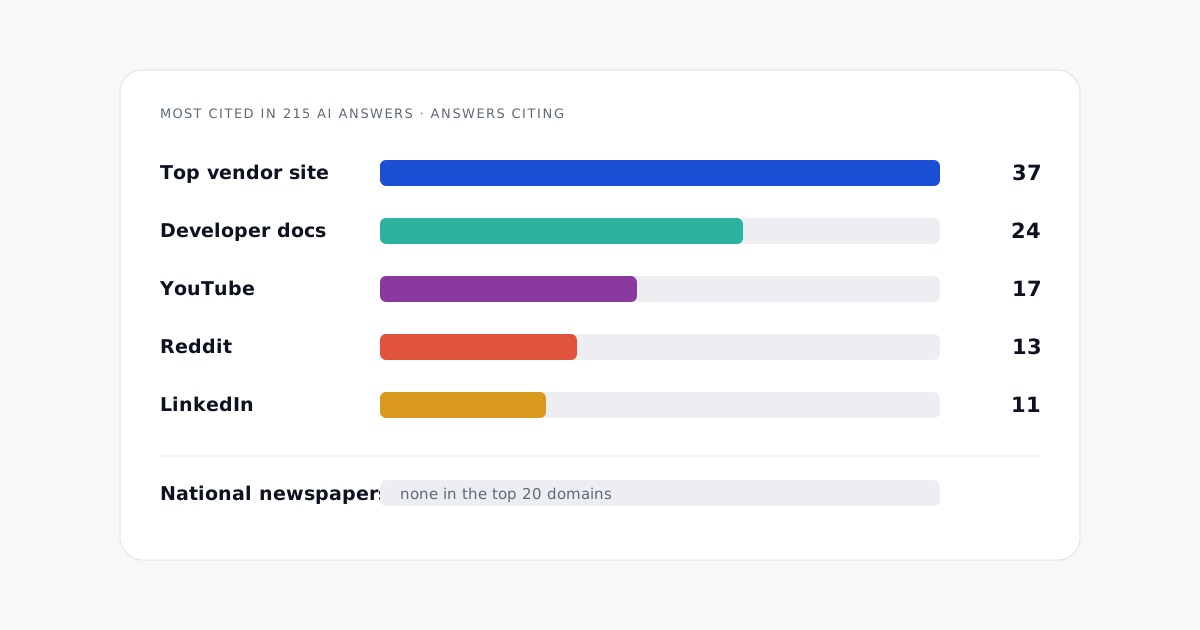
Digital PR for AI visibility: how to get your brand cited in ChatGPT, Gemini and Perplexity
Assistants cite a different set of sites than the ones PR teams pitch. How coverage reaches AI answers, which tactics get your brand cited, and how to measure a campaign on AI mentions.
Read the article →