How to build an enterprise GEO strategy: a framework for organic search directors

An enterprise GEO strategy is not a list of tactics for ChatGPT. It is a program: which questions the brand must win in AI answers, in which markets, measured how, owned by whom, and funded against which business result. This guide gives organic search directors a six-step framework to build one, the GEO tools each step needs, a four-quarter roadmap, and the mistakes that stall most programs in their first months.
What an enterprise GEO strategy covers
Generative Engine Optimization (GEO) is the work of making AI assistants (ChatGPT, Gemini, Perplexity, Copilot, Claude, Google AI Overviews and AI Mode) name your brand, describe it accurately and cite your pages when buyers ask them for advice. For a single website, that can be a side project of the SEO team. For an enterprise, with several business units, product lines, countries and agencies, it needs the same things as any other channel strategy:
- Scope: the topics, products and markets that matter, and the ones that do not.
- Measurement: a baseline and a small set of metrics everyone reads the same way.
- Workstreams: owned content, third-party sources, technical access and brand facts, each with an owner.
- Governance: who decides, who executes, how often results are reviewed, and how they reach leadership.
If you are new to the discipline, start with our introduction to GEO and how GEO differs from SEO. The rest of this guide assumes the basics and focuses on running GEO at scale.
The six-step framework
1. Tie GEO to a business goal
"Be visible in ChatGPT" does not survive a budget review. Anchor the program on a result the business already tracks, then pick the GEO metric that leads to it:
- Pipeline in a considered B2B purchase: presence on the AI shortlists for "best X for Y" and "X alternatives" questions, since many buyers now start there.
- Market share in a competitive category: AI share of voice against named competitors, topic by topic.
- Brand risk: sentiment and factual accuracy of what assistants say about the brand, its prices and its products.
- Organic traffic under pressure: citation share in Google AI Overviews and AI Mode for the queries that used to send clicks.
Write the goal as one sentence the CMO would sign: "Within twelve months, be named in at least half of the AI answers to our top 100 buyer questions in the US and UK, and first among the brands named in a third of them."
2. Map the questions you must win
The prompt set is the strategy made concrete: it is what you will be judged on. Build it from the buyer's side, not from your keyword list:
- Start from topics that match your product lines and business units.
- For each, write the questions buyers ask an assistant at each stage: discovery ("how do I…"), comparison ("best X for Y", "X vs Y"), validation ("is X reliable", "how much does X cost").
- Write them for each persona and in each market's language: a question in French returns French sources and often French brands.
- Weight topics by search demand: the Google volume of equivalent queries is the best available proxy for how often a question is asked.
Between 100 and 500 prompts per market is typical for an enterprise program; fewer than 50 per topic makes trends noisy. Our guide to writing the prompts your customers ask details the method.
3. Measure a baseline
Run the prompt set across the assistants your buyers use, from clean sessions, in each market, at a fixed cadence (daily or every few days), for at least two weeks before any change. Record for each answer which brands are named, in which order, how they are described, and which pages are cited. The five metrics to report are visibility, average position, share of voice, sentiment and citations; how to measure AI visibility defines each one.
A baseline per topic, engine and market is what makes the rest of the program measurable. Without it, every later win is an anecdote.
4. Diagnose the gaps
Read the baseline in three passes:
- Where you are absent: topics and questions where competitors are named and you are not. Rank them by demand at stake.
- Who the engines listen to: the domains and pages cited in those answers. Comparison sites, review platforms, forums, trade media and competitors' own pages are the sources that shape the answer.
- What they get wrong: outdated prices, discontinued products, wrong positioning, or a weakness repeated from an old review.
The output is a backlog: each line is a gap, the evidence behind it (prompts, engines, cited sources), the demand at stake, and the workstream that will fix it.
5. Run four workstreams
| Workstream | What it does | Usual owner |
|---|---|---|
| Owned content | Pages that answer the questions you lose: comparisons, alternatives, pricing, use cases, original data. Answer first, then evidence; facts an AI can quote. | SEO and content teams |
| Third-party sources | Get listed, reviewed and correctly described on the pages the engines cite: comparison articles, review platforms, directories, trade media, community threads. | PR, partnerships, product marketing |
| Technical access | Let AI crawlers in (robots.txt, firewall and bot rules), keep key facts in the HTML, add structured data, keep the site fast and indexable in Google and Bing. | Technical SEO and web engineering |
| Brand facts | One source of truth for prices, products, positioning and leadership, kept consistent across the site, profiles, listings and press materials; fix wrong facts at their source. | Product marketing and communications |
Most enterprises already have these teams. The strategy's job is to give each one a GEO backlog and a metric, not to create a new department.
6. Set governance and reporting
- One accountable owner, usually the head of organic search, with a named lead in each workstream and in each major market.
- A monthly review of the metrics by topic and market, the backlog, and what changed after each action.
- A quarterly report to leadership on the goal set in step 1, with AI referral traffic, branded search demand and self-reported attribution ("How did you hear about us?" answers mentioning ChatGPT or AI) as business signals.
- Rules for agencies and markets: the same prompt set structure, the same metrics, the same tool, so results add up across the group.
GEO tools: what an enterprise program needs
Searches for "GEO tools" and "generative engine optimization tools" return long lists. In practice an enterprise stack has four layers, and most of it already exists:
| Layer | Purpose | What to look for |
|---|---|---|
| AI visibility tracking | Run your prompts across assistants and measure mentions, position, sentiment and citations | Engines and markets you need, daily cadence, competitors, cited sources at page level, history, exports and an API, access for several teams |
| SEO suite | Rankings, search demand, technical audits, links | Search volumes by market to weight topics; AI Overview flags on tracked keywords |
| Analytics and logs | AI referral traffic, AI crawler activity | Referrer segments for chatgpt.com, perplexity.ai, gemini.google.com, copilot.microsoft.com; server logs showing GPTBot, OAI-SearchBot, PerplexityBot, Googlebot |
| Content and PR workflow | Execute the backlog | A way to tag tasks by topic and source, so results can be read against actions |
When choosing the tracking layer, test candidates on your own twenty most important questions for a week, in your main market, and compare what they report with what you see in each assistant. For tracking Google's AI features specifically, see how to track AI Overviews, which compares tools and costs.
A four-quarter roadmap
| Quarter | Focus | Deliverables |
|---|---|---|
| Q1: measure | Goal, prompt set, baseline | Signed goal, prompt set for the priority markets, tracking live, baseline report, first backlog, AI crawler access checked |
| Q2: fix the obvious | Quick wins | Wrong facts corrected, comparison and pricing pages rewritten, listings on the most cited review sites and directories |
| Q3: earn sources | Third-party presence | PR and partnership campaign aimed at the cited publications, original data study, community presence where engines cite forums |
| Q4: scale | More markets and topics | Prompt sets for the next markets, playbook for local teams and agencies, annual review against the goal |
Mistakes that stall enterprise GEO programs
- Measuring with screenshots. One answer, from one account, on one day, says nothing; answers change from run to run. Measure rates over many answers.
- Tracking keywords instead of questions. "CRM software" is a keyword; "which CRM should a 50-person agency use" is what buyers ask an assistant.
- Averaging across markets and engines. A brand can lead in ChatGPT in the US and be absent from Gemini in Germany. Report each separately.
- Only publishing on your own site. Engines lean heavily on third-party pages for "best" and "vs" questions. The sources workstream is often where the fastest gains are.
- Blocking AI crawlers by accident. Bot protection and old robots.txt rules often shut out the crawlers that fetch pages for answers. Check them in the first month.
- No owner. GEO sits between SEO, content, PR and product marketing. Without one accountable owner, every team assumes another one has it.
Frequently asked questions
What is a GEO strategy?
A GEO strategy is a plan to make AI assistants name, describe and cite your brand when buyers ask them for advice. It defines the questions to win in each market, how visibility is measured, the content, source, technical and brand-fact work that improves it, and who owns each part.
How do I build a GEO strategy for an enterprise brand?
Tie the program to a business goal, map the buyer questions to win by topic, persona and market, measure a baseline across the main AI assistants, diagnose where you are absent and which sources the engines cite, run four workstreams (owned content, third-party sources, technical access, brand facts), and review the results monthly with one accountable owner.
What are the best GEO tools?
An enterprise stack combines an AI visibility tracker (prompts across assistants, with mentions, position, sentiment and citations), an SEO suite for search demand and technical audits, analytics and server logs for AI referrals and crawlers, and the content and PR workflow you already use. Choose the tracker by testing it on your own questions, markets and engines.
How long does a GEO strategy take to show results?
Fixing wrong facts and getting listed on the most cited sources can change answers within weeks, once engines that search the web pick up the new pages. Content and PR work usually takes one to three months to show in the metrics. Plan on a year to reach a stable position across topics and markets.
Who should own GEO in a large company?
Usually the head of organic search or SEO, because GEO relies on the same foundations and measurement habits. Content, PR, product marketing and web engineering each own a workstream, and each major market has a local lead.
In short
An enterprise GEO strategy turns "be visible in AI" into a program: a goal tied to the business, a prompt set that defines what you are judged on, a baseline, a backlog drawn from the gaps and the cited sources, four workstreams with owners, and a monthly review. The tools matter less than the discipline of measuring the same questions, the same way, every week.
More from the blog

How agencies report AI visibility to clients: share of voice, citations and a monthly report template
"What does ChatGPT say about us?" deserves a better answer than a screenshot. The metrics, setup and monthly report template agencies use for AI visibility.
Read the article →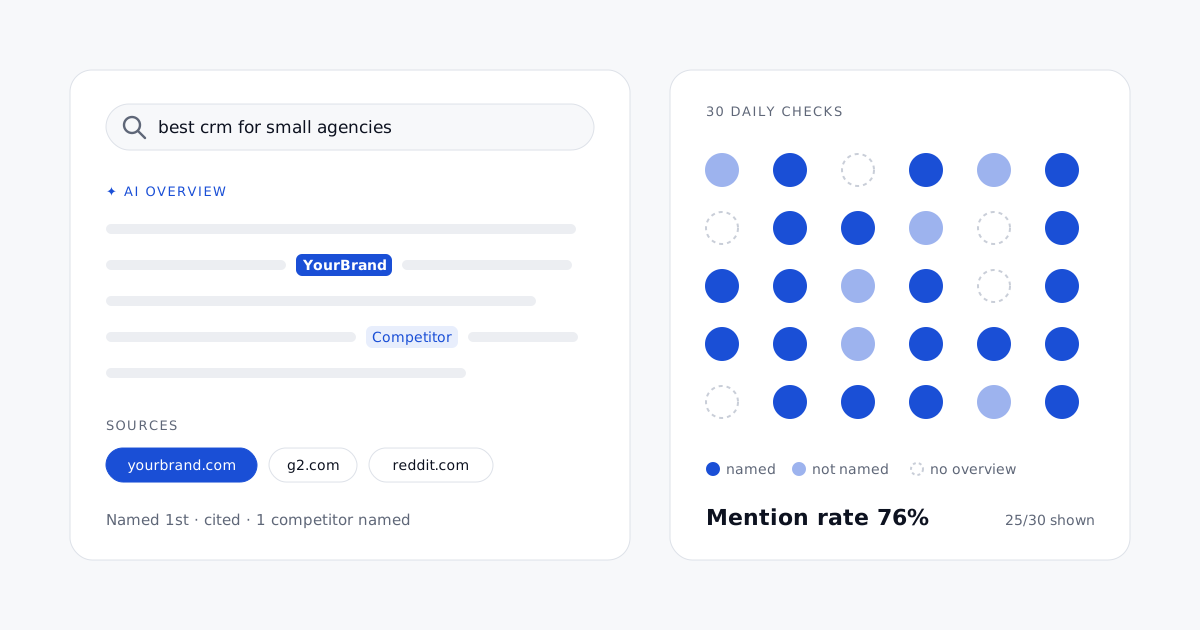
How to track AI Overviews: monitoring brand citations in Google's AI answers, with tool pricing
Search Console will not tell you whether Google's AI summaries name your brand. How to track AI Overviews every day, and what each tool really costs per daily check.
Read the article →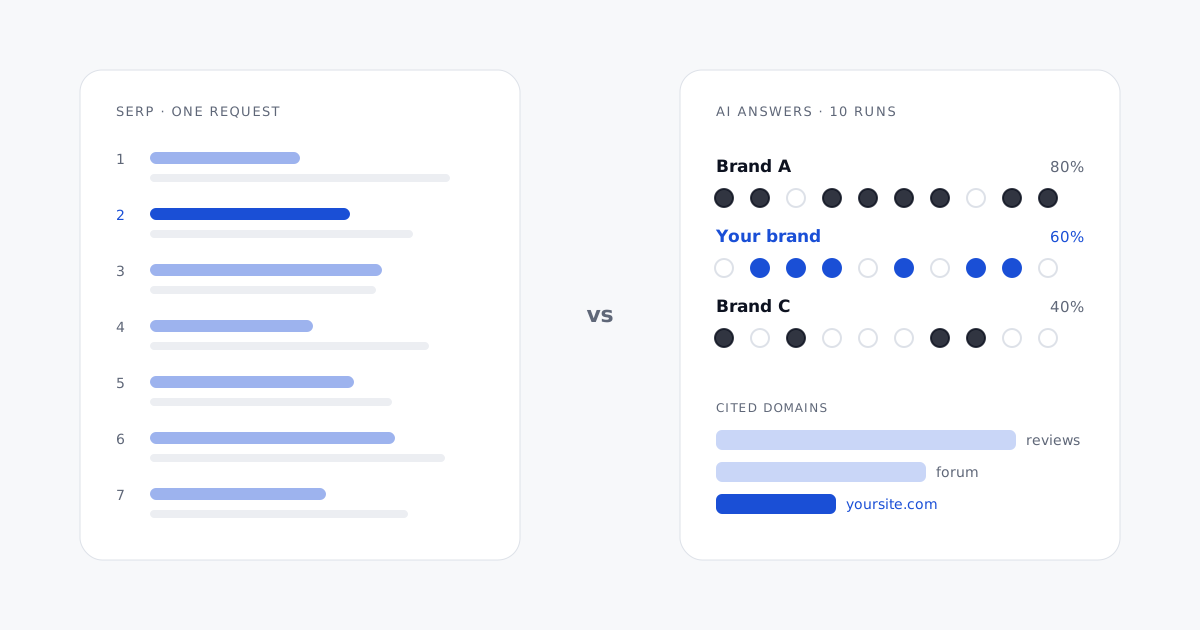
SERP tracking vs AI citation tracking: a technical breakdown
SERP tracking reads a typed list that barely moves; AI citation tracking reads generated text that changes on every run. What that changes in collection, parsing, sampling, storage and reporting.
Read the article →