SERP tracking vs AI citation tracking: a technical breakdown
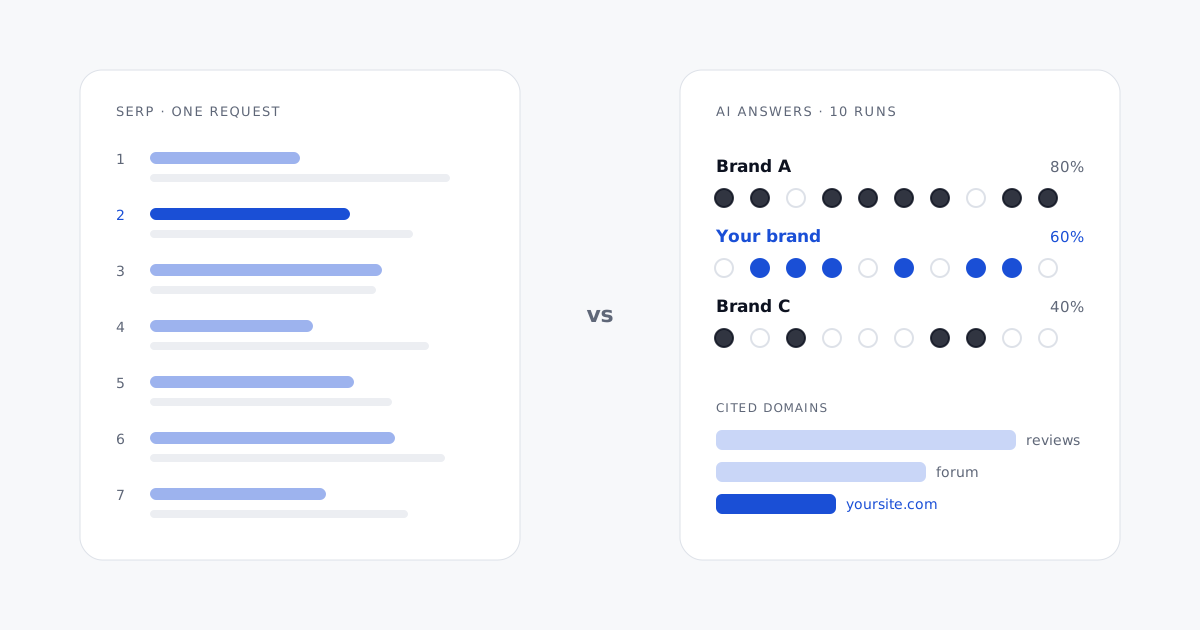
SERP tracking and AI citation tracking look alike on a dashboard: a list of queries, a number per query, a trend line. Underneath they solve different measurement problems. A SERP is a ranked list of documents that barely moves between two requests. An AI answer is generated text that names brands, cites sources and changes from one run to the next. This resource breaks down the differences layer by layer: what is observed, how it is collected, how it is parsed, how much sampling it needs, and how the data should be stored and read.
SERP tracking and AI citation tracking, defined
SERP tracking (rank tracking) records where your pages appear in a search engine's results page for a set of keywords, by location and device, usually every day. Its output is a position per keyword and URL, plus the search features you own.
AI citation tracking (AI answer monitoring) records what generative engines say when they answer your buyers' questions: whether your brand is named, in which position among the brands named, how it is described, and which pages are cited as sources. Its output is a set of rates over many answers, per engine, topic and market.
Both answer "are we visible where people search?", but the second one cannot be built by adding a column to the first. The rest of this resource explains why.
SERP tracking vs AI citation tracking at a glance
| SERP tracking | AI citation tracking | |
|---|---|---|
| Object observed | A ranked list of URLs and typed features (snippets, People Also Ask, local pack, AI Overview) | Free text, an ordered set of brand mentions inside it, and a list of cited sources |
| Input | A keyword, a location, a language, a device | A full prompt, an engine, a market; sometimes a model version and a search setting |
| Output structure | Structured by the engine: every result has a type and a rank | Unstructured: mentions, positions and sentiment must be extracted from the text |
| Determinism | High: the same request a minute later returns nearly the same list | Low: the same prompt often returns a different set of brands, in a different order |
| Primary unit | The URL, at a rank | The brand, mentioned or not; the cited URL is a second, separate unit |
| Samples per data point | One request | Many answers, aggregated into a rate |
| Main metric | Rank, and visibility indexes weighted by click-through rate | Mention rate (visibility), position among brands named, share of voice, sentiment, citation share |
| Ground truth for traffic | Search Console impressions and clicks | None from the engines; referrers, UTM tags and branded demand as proxies |
1. What is being observed
A SERP is a typed list
A results page is already structured data. Every element has a type (organic result, ad, featured snippet, video, local pack, People Also Ask, AI Overview) and a place on the page. SERP APIs return it as JSON where each item carries a type, a group rank (its position among items of the same type) and an absolute rank (its position on the whole page). The tracker's job is mostly bookkeeping: find your URLs in the list and record where they sit.
An AI answer is text with attachments
An answer from ChatGPT, Gemini, Perplexity, Copilot, Google AI Mode or an AI Overview has three layers, and only one of them is structured:
- The text. Paragraphs, lists or a table, written for a person. Brands appear inside sentences, sometimes as headings, sometimes in passing.
- The citations. A list of source URLs, attached to the whole answer or to individual sentences, depending on the engine.
- The metadata. Model, date, location, whether the engine searched the web, and sometimes the sub-queries it ran.
Two of the three things you want to measure, which brands are named and how they are described, exist only in the text. That is the core difference: a SERP tracker reads positions, an answer monitor has to read language.
2. Collecting the data
Collection for SERP tracking
SERP data comes from scraping the results page or, more often, from a SERP API that does it for you. The request parameters are well understood: the query, a country (gl), an interface language (hl), a precise location, and a device. Depth used to be cheap: one request with num=100 returned a hundred results. Google stopped honoring that parameter around September 2025, so tracking beyond the first page now costs one request per page of ten, and many tools reduced the depth they track.
Collection for AI citation tracking: three routes
- The consumer interface. Ask the question in the product people actually use (chatgpt.com, gemini.google.com, perplexity.ai) through an automated browser or a provider that runs one. This is the closest to what users see, including the product's own system prompt, search behavior and citation display. It is also the most fragile and slowest route.
- The model API with a search tool. Call the vendor's API with web search or grounding enabled. It is fast, cheap and structured, but it is not the product: the system prompt differs, search may be configured differently, and the answer can differ noticeably from what the consumer app returns for the same question. Without search enabled, an API call measures the model's training data, not today's web.
- SERP APIs for Google's AI features. AI Overviews appear on the results page, and AI Mode is a search surface, so several SERP providers return them as structured items with their text and references. Here the two worlds meet: the collection is SERP-like, the parsing is answer-like.
The route is a methodological choice, and it should be recorded with every answer. A visibility rate measured through an API without search and one measured in the consumer app are not the same metric, even with the same prompt.
Live and queued collection
Both kinds of providers often sell two modes: a live call that answers within seconds, and a queued task that is posted, processed later and fetched by polling, at a fraction of the price. SERP tracking adopted queued collection long ago because nobody needs a ranking within the second. The same holds for AI citation tracking, where calls are slower and dearer: a daily run can wait minutes for its answers. Queued collection needs a longer timeout per answer and a worker that tolerates tasks completing out of order.
Sessions and personalization
Search results are personalized lightly; a logged-out request from the right location is a good proxy for the average user. Assistants personalize more: memory, custom instructions, conversation history and connected accounts all change the answer. A monitor must ask each prompt in a fresh session, logged out or with a neutral account, one prompt per conversation. Checking by hand from your own account measures your own history.
3. Localization
In SERP tracking, the market is a parameter: country, language and location are sent with the request and honored by the engine. In AI citation tracking, the market is split across several signals that are not always controllable:
- The language of the prompt. The strongest lever. A question in French returns French sources and, often, French brands. Translating prompts is part of localization, not an afterthought.
- The user's location. Engines that search the web localize their searches from the IP address or the account's region. Collection must exit from the target country, or use a provider that sets the location.
- Explicit context in the prompt. "In Germany", "for a French company": buyers often include it, and it changes the answer. Keep it when real buyers would write it; do not add it everywhere to compensate for a missing location setting.
The practical rule: one market is one language plus one location, and each market is measured and reported separately. Averaging visibility across markets hides the fact that a brand can lead in one country and be absent in the next.
4. Parsing the output
Brand mention extraction
Finding a URL in a list is exact matching. Finding a brand in text is entity recognition, with every classic trap:
- Aliases. A brand appears under its name, a product name, an abbreviation, a former name, or its domain. "HubSpot", "HubSpot CRM" and "hubspot.com" are one entity; the monitor needs an alias list per brand.
- Common-word names. Brands called Notion, Monday, Close or Front collide with ordinary words. Matching must use case, word boundaries and context, and should be checked by a model or a rule that reads the sentence.
- Mentions that are not recommendations. "Unlike Salesforce, this tool…" names Salesforce without recommending it. Sentiment and framing need their own pass.
- Unknown competitors. A rank tracker only looks for the domains you give it. An answer can recommend a brand you never listed; the parser should extract every brand named, not only the ones it was told about, so new competitors show up.
Position
In a SERP, position is given. In an answer, it has to be defined. The most robust definition is the order of first mention among the brands named: the first brand named is position 1. It captures what a reader sees first and works across lists, tables and prose. Two alternatives exist and are worth knowing: the item number in a numbered list (breaks on prose answers) and a weighted prominence score (more informative, harder to explain). Whatever the definition, compute position only over answers where the brand is named, and report it next to the mention rate; an average position of 1.2 over 3 answers out of 100 is not a strong position.
Sentiment and framing
SERP tracking has no equivalent. In answers, how a brand is described is part of the result: the default choice, the budget option, the one with "a steep learning curve". A practical approach is to score each brand mention in each answer, for example from 0 to 100, with a short justification, using a language model with a fixed rubric, and to keep the quotes that support it. Store the score per mention, not per answer, since one answer praises one brand and criticizes another.
Citation normalization
Citations are the heart of AI citation tracking, and the cited URLs need cleaning before they can be counted:
- Tracking parameters. ChatGPT commonly appends
utm_source=chatgpt.comto the links it shows. Strip UTM and click identifiers so the same page counts once. - Redirect wrappers. Some grounding APIs return redirect URLs instead of the final page (Gemini's grounding, for example, returns links on a Google redirect host with the source's title). Resolve them, or fall back on the reported title and domain.
- Canonical form. Lowercase the host, drop
www., fragments and trailing slashes, and decide how to treat AMP and mobile hosts. - Domain grouping. Aggregate by registrable domain using the Public Suffix List, so that
blog.example.co.ukrolls up toexample.co.ukand not toco.uk. - Source typing. Classify domains (your own site, competitors, review platforms, media, forums, reference sites, marketplaces). The type is what turns a list of URLs into an action plan.
5. Variance and sampling
This is the difference that breaks most first attempts at AI citation tracking. A SERP is close to deterministic for a given query, location and moment, so one request per keyword per day is a measurement. An answer is a sample from a distribution. In a study published in early 2026, SparkToro and Gumshoe ran 2,961 prompts 60 to 100 times each on ChatGPT, Claude and Google's AI; for ChatGPT and Google's AI, two runs returned the same list of brands less than once in a hundred, and the same list in the same order closer to once in a thousand. Presence was much steadier than order: the most frequently named brands appeared in roughly two thirds of the answers. The study was not peer reviewed and was run with a vendor of tracking tools, but its direction matches what any monitor sees in its own data.
The consequence: the unit of measurement is a rate over many answers, and every rate has a margin of error. Visibility is a proportion, so a binomial confidence interval applies. The Wilson interval behaves well for small samples and rates near 0 or 100%:
p̂ = mentions / answers
z = 1.96 (95% confidence)
center = (p̂ + z²/2n) / (1 + z²/n)
margin = z · √(p̂(1 − p̂)/n + z²/4n²) / (1 + z²/n)
Two worked examples make the scale concrete. A brand named in 18 of 50 answers has a visibility of 36%, with a 95% interval of about 24% to 50%. With 200 answers at the same rate, the interval narrows to about ±7 points. A week-over-week move from 36% to 42% on 50 answers is noise; the same move on several hundred answers starts to mean something.
Four rules follow:
- Aggregate before you conclude. Report visibility per topic, engine and market over enough answers, not per prompt per day.
- More prompts beat more repetitions. At equal cost, 200 different prompts asked once tell you more than 20 prompts asked ten times, because they also sample the variety of real questions.
- Keep the set stable. Changing prompts changes the population being measured. Add prompts in batches and mark the date, as you would mark a change in a rank tracker's keyword list.
- Show the trend, not the point. A rolling window (for example 7 or 14 days) smooths sampling noise without hiding real shifts.
6. From SERP tracking metrics to AI citation tracking metrics
| SERP tracking metric | AI citation tracking counterpart |
|---|---|
| Rank of your URL | Position: order of first mention among the brands named, averaged over the answers that name you. |
| Share of keywords in the top 10 | Visibility: share of answers that name your brand. The central metric, because presence is the stable signal. |
| Visibility index weighted by CTR | Demand-weighted visibility: each prompt weighted by the search volume of its topic, so lost answers on popular questions count more. |
| Share of voice by estimated clicks | Share of voice: your mentions divided by all brand mentions in the answers, against a defined competitor set. |
| SERP features owned | Citation share: share of answers citing your domain, and the domains cited most in your category. |
| (no equivalent) | Sentiment: how favorably each engine describes each brand, with the supporting quotes. |
Keep visibility and citations apart. A brand can be named without being cited (the engine learned about it elsewhere) and cited without being named (your blog post explains the category, and a competitor gets the recommendation). The second case is common for content-heavy brands, and only shows up if the two are measured separately.
7. A data model for answers
A SERP tracking tool can store one row per keyword, date and URL. AI citation tracking needs to keep the raw answer, because parsing improves and you will want to re-run it, plus three child tables. A minimal record looks like this:
{
  "prompt": "Which CRM is best for a 20-person agency that uses Gmail?",
  "engine": "chatgpt",          "route": "consumer-ui, web search on",
  "market": "us",               "language": "en",
  "asked_at": "2026-10-11T06:12:09Z",
  "text": "…full answer…",
  "mentions": [
    { "brand": "Acme CRM",  "position": 1, "sentiment": 82, "quote": "…" },
    { "brand": "Globex CRM", "position": 2, "sentiment": 74, "quote": "…" }
  ],
  "citations": [
    { "url": "https://www.example-reviews.com/best-crm", "domain": "example-reviews.com", "type": "review" }
  ]
}
With mentions in their own table, the headline metrics are plain SQL. Visibility by engine and week, for one brand:
SELECT a.engine,
       date_trunc('week', a.asked_at) AS week,
       count(*) AS answers,
       round(100.0 * count(m.answer_id) / count(*), 1) AS visibility_pct,
       round(avg(m.position), 1) AS avg_position
FROM answers a
LEFT JOIN mentions m ON m.answer_id = a.id AND m.brand = 'Acme CRM'
GROUP BY 1, 2
ORDER BY 2, 1;
Store the count of answers next to every rate, so any dashboard can show the margin of error, and store the route and model version so a change in collection method is visible as a break in the series rather than a fake trend.
8. Cadence and cost
A SERP request costs a fraction of a cent, and rankings for a keyword change slowly, so daily tracking of thousands of keywords is routine. AI citation tracking costs more per data point: each answer is a model call with web search, sometimes followed by extra model calls to extract mentions and score sentiment. And because one answer is a weak signal, you need many of them.
Budget with this formula: answers per period = prompts × engines × markets × runs. Then choose where to spend. A daily run on a broad prompt set gives the best trend lines; a run every few days on the same set halves the cost and still shows changes, since real shifts in AI answers take weeks. Queued collection, where available, cuts the per-answer price further at the cost of latency, which a scheduled run does not mind.
9. Connecting it to traffic
SERP tracking has a ground truth: Search Console reports impressions, clicks and average position per query, so a rank tracker's estimates can be checked. No AI engine gives brands an equivalent report. AI citation tracking therefore leans on proxies:
- Referrers. Sessions from chatgpt.com, perplexity.ai, gemini.google.com, copilot.microsoft.com and similar, grouped into an AI channel in analytics. Clicks from AI Overviews and AI Mode count as Google organic.
- UTM tags. The
utm_source=chatgpt.comparameter identifies many ChatGPT clicks even when the referrer is missing. - Direct and branded traffic. Readers who copy a name, open a new tab or come back later arrive as direct or branded search. A rising mention rate followed by rising branded demand is the pattern to look for.
- Self-reported attribution. A "how did you hear about us?" field with an AI option captures what analytics cannot.
10. Pitfalls checklist
- Treating one answer as a ranking. It is one draw; report rates with their sample size.
- Measuring the API and calling it ChatGPT. Record the collection route, and use the product surface when you report what users see.
- Asking from a logged-in, personalized account, or several prompts in one conversation.
- Matching brand names without aliases, word boundaries or context.
- Counting only the competitors you listed, and missing the new names the engines recommend.
- Mixing markets, or measuring a foreign market with prompts in English.
- Counting raw URLs without stripping tracking parameters and resolving redirects.
- Changing the prompt set and reading the result as a trend.
- Reading a week-over-week change that is smaller than the margin of error.
Frequently asked questions
What is the difference between SERP tracking and AI citation tracking?
SERP tracking measures the position of your URLs in a list of search results, which is stable enough to read from one request per keyword. AI citation tracking measures whether generative engines name and cite your brand in their answers, which vary from run to run, so it reports rates over many answers: visibility, position among the brands named, sentiment and citation share.
Can SERP tracking tools do AI citation tracking?
Only partly. Many SERP tracking tools now detect whether an AI Overview appears on a results page and whether your URL is among its references. That covers one surface and the citation layer. It does not tell you whether your brand is named in the text, in which position, with what sentiment, or what ChatGPT, Gemini or Perplexity say for the same question.
How many times should each prompt be run?
Fewer than you might think, if you track enough prompts. Precision depends on the total number of answers behind a rate. One run per prompt per engine and period, over a set of 100 to 300 prompts, gives tight enough intervals at the topic and engine level. Repeat runs of the same prompt are useful for studying variance, not as the default.
Why do AI citation tracking tools report different numbers for the same brand?
Because they collect differently: API or consumer interface, search on or off, location and language, prompt set, brand matching rules, and definition of position. Two tools can both be right about their own setup. Compare tools on the same prompts and markets, and look at trends within one tool rather than levels across tools.
Is position in an AI answer meaningful if answers vary so much?
As an average over many answers, yes; as a single number from one answer, no. Order varies more than presence, so position is a secondary metric: read it next to visibility, and only where the brand is named often enough for the average to be stable.
Sources
- SparkToro and Gumshoe, study of the consistency of AI brand recommendations (2026), as reported by Search Engine Land and Search Engine Journal.
- Industry reporting on Google's removal of the
num=100results parameter (September 2025), including Search Engine Land and tool vendors' notices. - Reporting on ChatGPT's
utm_source=chatgpt.comlink parameter and AI referral tracking in analytics (Seer Interactive and others). - Wilson, E. B. "Probable inference, the law of succession, and statistical inference", Journal of the American Statistical Association, 1927.
- Mozilla Foundation, Public Suffix List (publicsuffix.org).
More from the blog

How to build an enterprise GEO strategy: a framework for organic search directors
GEO at enterprise scale is a program, not a list of tactics: the questions to win, a baseline, four workstreams with owners, and the tools to measure it.
Read the article →
How agencies report AI visibility to clients: share of voice, citations and a monthly report template
"What does ChatGPT say about us?" deserves a better answer than a screenshot. The metrics, setup and monthly report template agencies use for AI visibility.
Read the article →
How to track AI Overviews: monitoring brand citations in Google's AI answers, with tool pricing
Search Console will not tell you whether Google's AI summaries name your brand. How to track AI Overviews every day, and what each tool really costs per daily check.
Read the article →