How to benchmark AI share of voice: metrics, a worked example and an audit framework
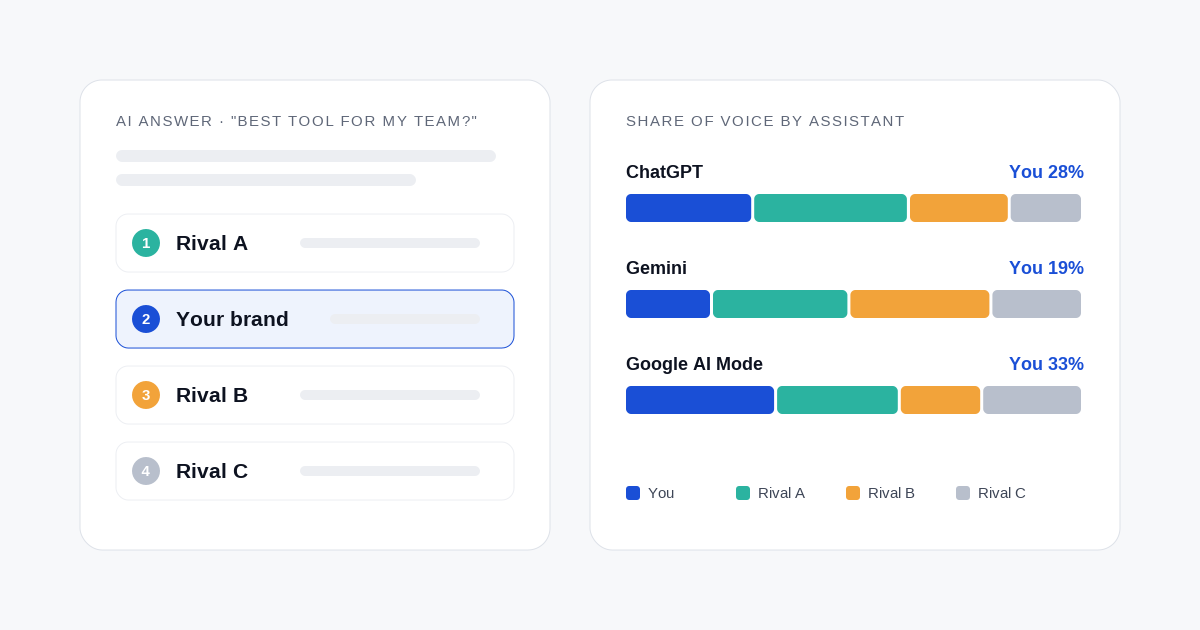
"Are we winning in AI search?" needs a number that compares you with your rivals, the way share of voice does for advertising and PR. In ChatGPT, Gemini and Google AI Mode, that number is AI share of voice: how the mentions of the brands in your category split between you and your competitors. This guide gives marketing leaders the metrics to use, a worked example from 141 UK answers, an audit framework in six steps, and the traps that make a benchmark lie.
The short answer
- AI share of voice is your brand's mentions divided by the mentions of every tracked brand (you and your competitors) in the answers to a fixed set of category questions.
- Report it with visibility (the share of answers that name you) and position (how early you are named). One of the three alone can mislead.
- Weight by position when you can: being named first is worth more than being named sixth, and the weighted share shows it.
- Break it down by assistant and market. The leader in ChatGPT is often not the leader in Gemini, and answers change by country.
- Read the trend, over several updates, on a set of questions that does not change.
The standard metrics
| Metric | Definition | What it tells you |
|---|---|---|
| Visibility | Share of answers that name the brand | How often buyers who ask see you at all |
| Share of voice | Brand's mentions ÷ mentions of all tracked brands, in the same answers | Your weight against the competitors you chose |
| Weighted share of voice | Same, with each mention counted 1 if named first, 1/2 if second, 1/3 if third, and so on | Whether you are the first recommendation or one name in a list |
| Average position | Mean rank of the brand among the brands named, when it is named | How prominent you are when you appear |
| Sentiment | Tone of the answers that name the brand, scored 0 to 100, with a reason | Whether being named helps you |
| Citation share | Share of cited pages that are on the brand's own site | Whether assistants use your pages as a source |
Definitions vary between tools, especially for share of voice: some divide by all brands named, including ones you do not track, some by answers. Write yours down, and do not compare figures from two tools that compute it differently. How to measure AI visibility covers the measurement in more detail.
A worked example: LinkedIn prospecting tools in the UK
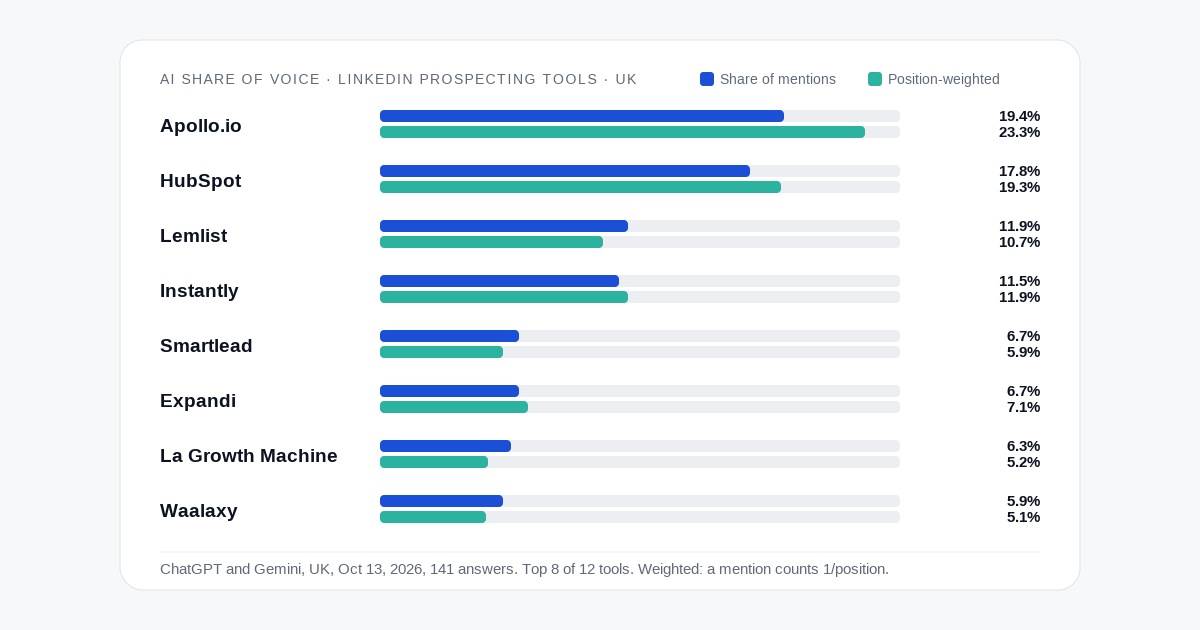
Take a category outside our own: the prospecting tools UK founders, recruiters and sales teams ask about. In our study of LinkedIn prospecting tools, we asked ChatGPT and Gemini 72 questions from the UK on October 13, 2026 (141 answers) and tracked twelve tools. Put yourself in the place of one of them, Waalaxy, benchmarking against the other eleven.
| Tool | Visibility | Share of voice | Weighted share | Sentiment |
|---|---|---|---|---|
| Apollo.io | 35% | 19.4% | 23.3% | 77 |
| HubSpot | 32% | 17.8% | 19.3% | 61 |
| Lemlist | 21% | 11.9% | 10.7% | 71 |
| Instantly | 21% | 11.5% | 11.9% | 67 |
| Smartlead | 12% | 6.7% | 5.9% | 67 |
| Expandi | 12% | 6.7% | 7.1% | 59 |
| La Growth Machine | 11% | 6.3% | 5.2% | 73 |
| Waalaxy | 11% | 5.9% | 5.1% | 65 |
| Dripify | 9% | 4.7% | 4.5% | 62 |
| Reply.io | 8% | 4.3% | 2.8% | 78 |
| Kaspr | 8% | 4.3% | 4.1% | 70 |
What the benchmark tells Waalaxy:
- Where it stands. Waalaxy is named in 11% of the answers and holds 5.9% of the share of voice, eighth of twelve. Apollo.io and HubSpot together take more than a third of the mentions.
- The weighted share changes the order. Apollo.io rises from 19.4% to 23.3%: it is usually named first. Reply.io falls from 4.3% to 2.8%: it is named, but late in the list. Waalaxy slips slightly (5.1%), so position is a second thing to work on.
- Each assistant tells a different story. In ChatGPT, Apollo.io and HubSpot tie at 22.3% of the mentions, and Waalaxy has 7.4%. In Gemini, Lemlist is second with 15.2% (8.3% in ChatGPT), and Waalaxy has 4.5%. An average over the two would hide that Gemini is where Waalaxy is weakest.
- Sentiment separates the leaders. Scores range from 59 (Expandi) to 78 (Reply.io). HubSpot is the second most named tool but scores 61: being named often is not the same as being recommended warmly.
Visibility is the share of the 141 answers naming the tool. Sentiment is the average score of those answers, as scored by a language model. Position is the tool's rank among the tools named in the answer. The study page has the questions, the sources cited and the figures by topic.
An audit framework in six steps
1. Choose the competitors with sales
Take the three to eight brands you actually lose deals to, plus any brand the assistants name often. Share of voice against competitors your sales team does not recognise is not a benchmark leadership will trust.
2. Fix a panel of category questions
Write 20 to 50 questions buyers ask before they know your name: "best X for", "X vs Y", "alternatives to", "how to choose". Keep branded questions apart: they measure perception, not share. Weight the panel towards the topics with real search demand. See how to write prompts your customers ask.
3. Pick the assistants and the market
Track the assistants your buyers use, in the country where they buy. For the UK, that usually means ChatGPT, Gemini, Google AI Mode and AI Overviews, and Perplexity or Copilot depending on the audience, all asked from the UK.
4. Take a baseline
Run the panel several times over two weeks before changing anything. Answers vary between runs, so one run is not a baseline.
5. Compute the metrics the same way every time
Visibility, share of voice (plain and weighted), position and sentiment, per assistant and for all of them together, per topic. Keep the definitions, the panel and the competitor list fixed. When one of them changes, start a new baseline.
6. Report the trend and its causes
Each month: share of voice against last month and the baseline, who gained and lost, on which topics and which assistant, and the pages the assistants cited for the answers you lost. Those pages are where the next actions start. AI visibility reporting for agencies gives a report template.
Traps that make a benchmark lie
- Changing the panel. Adding easy questions raises your share without any real change. Version the panel.
- One run per update. A single answer per question and assistant is noise. Read the trend over several updates.
- Averaging assistants. A gain in ChatGPT can hide a loss in Gemini. Report each one.
- Ignoring position. Ten mentions in sixth place are not ten first recommendations.
- Counting brands you do not track. If the denominator includes every name in the answer, a new entrant changes your share without anything happening to you. Say which you use.
- Reading sentiment without checking it. Automated scores are useful, not infallible. Read the lowest ones (see how to track brand sentiment).
Tools for the benchmark
Rempa (our product) reports visibility, share of voice (plain and position-weighted) per model, position and sentiment per brand, for your competitors too, from the country of your project; it also shows the share reached weighted by Google search demand, and the pages cited for each answer. See the best AI visibility tools in 2026 to compare prices and coverage, and Rempa for agencies for client benchmarks.
Frequently asked questions
What is AI share of voice?
The share of the mentions of the tracked brands (yours and your competitors') that go to your brand, in the answers AI assistants give to a fixed set of category questions. It can be weighted by position, so that being named first counts more.
How does a VP of Marketing benchmark generative share of voice against rivals?
Agree on the competitors with sales, fix a panel of category questions, track them on the assistants buyers use in your market, take a two-week baseline, then report visibility, share of voice, position and sentiment per assistant every month, with the pages cited for the answers you lost.
What is a good AI share of voice?
It depends on how many competitors you track and on the category. Compare yourself with the leader and with your own trend, per assistant, rather than with a fixed target.
How often should share of voice be measured?
Several times a week to daily, read as a trend over weeks. Answers vary between runs, so a monthly snapshot of one run says little.
Can I audit competitors' sentiment as well as their visibility?
Yes. Score the tone of every answer that names a competitor, in the same way as for your brand, and compare the averages and the reasons. In the example above, the scores ranged from 59 to 78 between tools.
Sources
- Rempa, LinkedIn prospecting tools in the UK: 72 questions asked to ChatGPT and Gemini from the UK, October 13, 2026 (141 answers, twelve tools tracked). Weighted share: each mention counted 1/position.
More from the blog
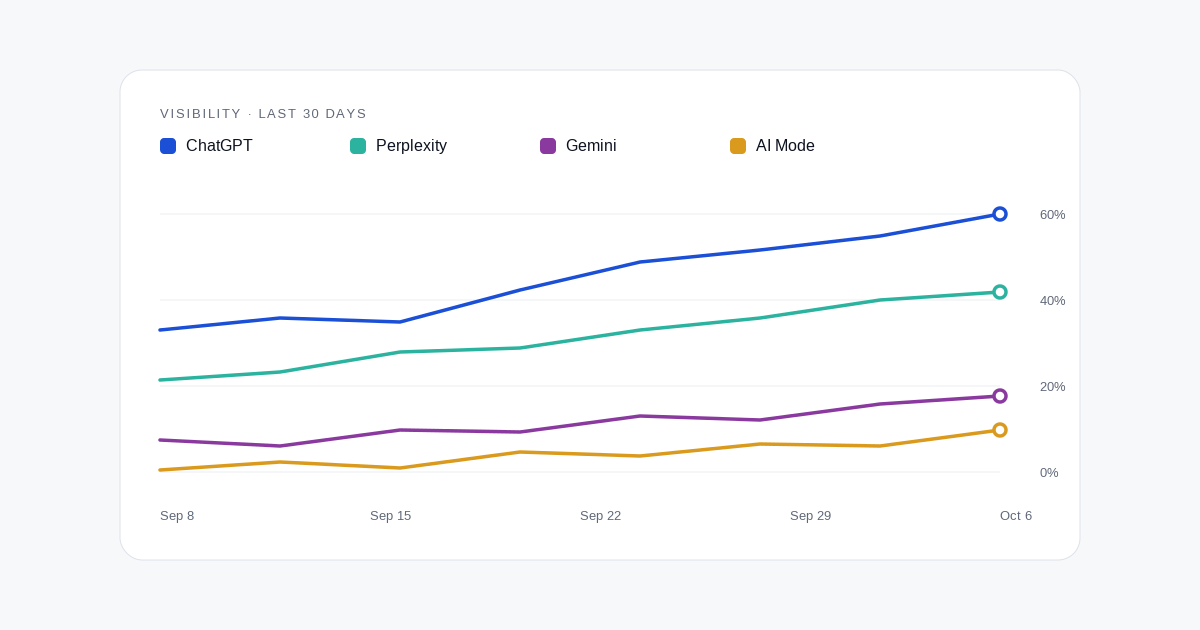
How to measure your brand's visibility in ChatGPT, Gemini and Perplexity
"Are we in ChatGPT's answers?" deserves better than a screenshot. The setup, the five metrics and the habits that turn them into decisions.
Read the article →
How agencies report AI visibility to clients: share of voice, citations and a monthly report template
"What does ChatGPT say about us?" deserves a better answer than a screenshot. The metrics, setup and monthly report template agencies use for AI visibility.
Read the article →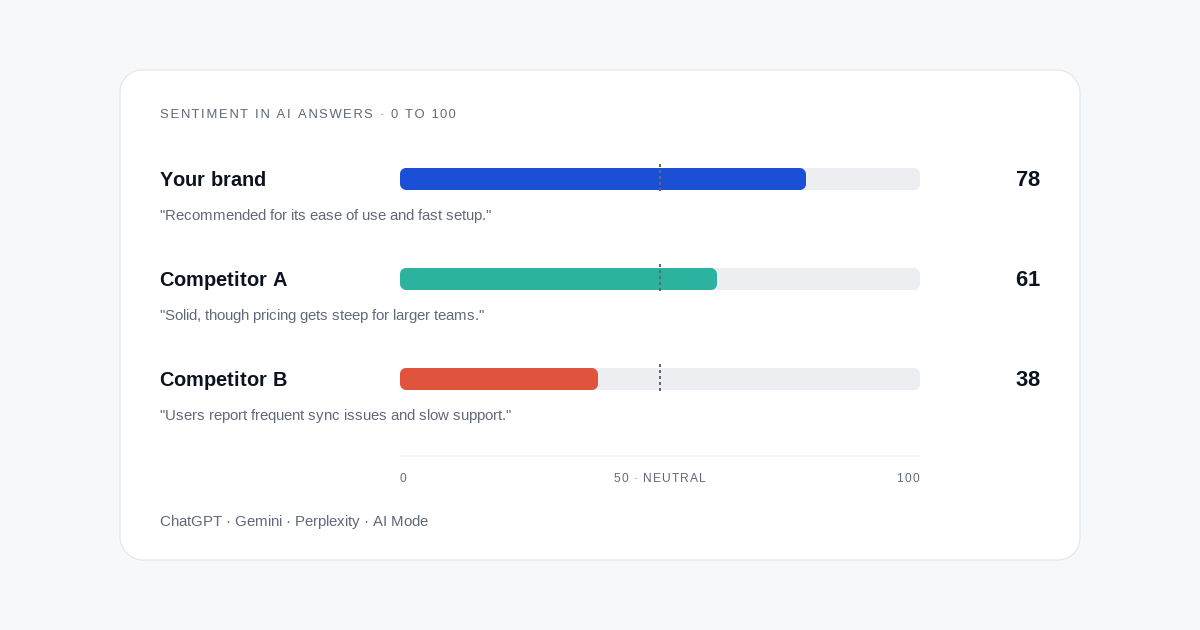
How to track brand sentiment and reputation in AI answers
AI answers have a tone, and buyers read it before your reviews. What to measure, how to check that sentiment scores are right, how to audit your leadership, and what changes the tone.
Read the article →