How a B2B SaaS company gets recommended by ChatGPT
When a buyer asks ChatGPT "what's the best tool for…", the answer names three to six vendors and links to the pages it read. For a B2B SaaS company, being one of those names is now part of being on the shortlist. This guide explains how ChatGPT picks the software it recommends, what it actually cites on B2B software questions (with data from 2,602 answers in our citation study and 372 answers in our own category), and seven steps to make your content the source it quotes.
How ChatGPT picks the software it recommends
On a buying question, ChatGPT almost always searches the web before answering. In our study of 7,911 AI answers to buyer questions, only 0.3% of ChatGPT's answers came without a source. It then writes a shortlist from what it read, mixed with what the model already knows about the category from training.
Three things follow from that:
- The pages it reads decide the shortlist. ChatGPT cites 6.4 websites per answer on average, more than Gemini (2.5) or Google AI Mode (4.2). A vendor that appears on several of those pages, described in the same terms, is the one it names.
- Your own site is a main source. 37% of ChatGPT's citations go to brand websites, and it cites the brand's own site in 31% of its answers. When an answer cites a brand's site, it names the brand 97% of the time; when it doesn't, 18%.
- It reads the web through a search index. ChatGPT search relies largely on Bing's index, and fetches pages with OpenAI's crawlers (OAI-SearchBot for search, ChatGPT-User when a user's question triggers a visit). A page that is not indexed, or that blocks those crawlers, cannot be read at question time.
What ChatGPT cites on B2B software questions
The common advice for SaaS companies is to collect reviews on G2 and get discussed on Reddit. The answers tell a different story:
| What we measured | Result |
|---|---|
| G2, Capterra, GetApp, TrustRadius, Software Advice and Appvizer | Cited in 2.8% of 2,602 answers about B2B software (ChatGPT, Gemini and Google AI Mode together) |
| 1.4% of all answers, almost only on Gemini and Google AI Mode; ChatGPT barely cites it | |
| Comparisons, rankings and reviews | 23% of the pages cited on brand, media and other websites |
| Home pages | 34% of ChatGPT's citations: it links the brands it names to their sites |
| Pricing pages | 1.4% of pages cited: most don't state a price a model can quote |
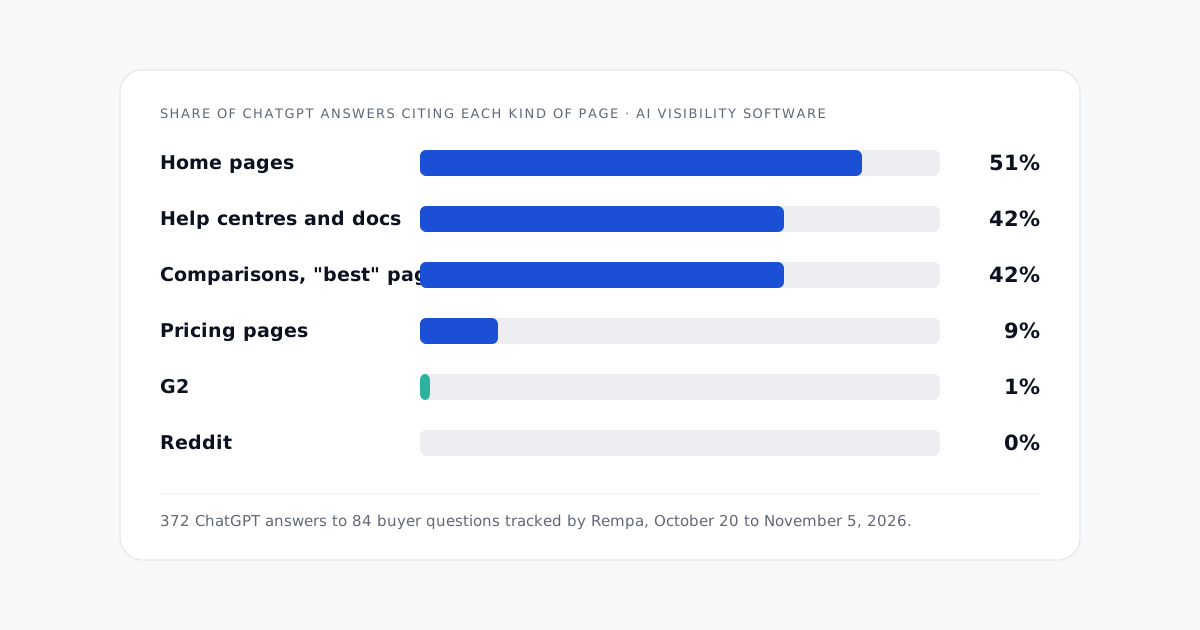
Our own category shows the same pattern. Rempa tracks 84 questions about AI visibility software in ChatGPT. Between October 20 and November 5, 2026, its 372 answers cited 6.6 websites each on average:
- Home pages came first, in 51% of the answers. Vendors' home pages lead: Profound's was cited in 36% of the answers, Peec AI's in 32%, Otterly.AI's in 28%. The vendors ChatGPT names are the ones whose home page says plainly what they do.
- Help centres and documentation (vendors' help pages, Google's and OpenAI's developer docs) appeared in 42% of the answers, on "how do I…" questions.
- Comparison and "best tools" pages, from vendors and publishers, appeared in 42%; pricing pages in 9%.
- G2 appeared in about 1% of the answers, and Reddit in none.
The kind of page is read from its address (pricing, "vs", "best", blog, help or docs), so the shares are approximate. The lesson holds: on software questions, ChatGPT quotes the vendors' own pages and the articles that compare them.
Seven steps to get your SaaS recommended
1. Make your home page say what a model can repeat
It is the page ChatGPT links most when it names you. In the first lines, in plain sentences: your category, who it is for (company size, team, industry), the problems it solves, what it does better than the alternatives, and what it costs. "The all-in-one platform for modern teams" gives a model nothing to quote; "Invoicing and payment reminders for UK freelancers, from £9 a month" does.
2. Publish a page for each buying question
Write the questions your buyers ask an assistant, then make sure one page answers each, in its first lines:
- Use-case and segment pages: "CRM for real estate agencies", "for teams of 5 to 20".
- Integration pages: one per tool your buyers already use, with what the integration does.
- Comparison pages: "you vs a competitor", "alternatives to the market leader", and a fair "best tools for…" page that includes your competitors. If you don't write the comparison of your category, a competitor or a publisher will, and ChatGPT will cite theirs.
Our guide to writing the prompts your customers ask shows how to build that list.
3. Put your prices in the text
"How much does X cost" is one of the most common buying questions, and pricing pages are among the least cited, because most hide the price behind "Contact sales" or show it only in images or scripts. State each plan, its price, what it includes and its limits, in HTML text. If you sell on quote, say what drives the price and give a range.
4. Open your help centre and docs
Documentation answers the "how do I…" questions that come before a purchase, and ChatGPT cites it often. Keep it public, indexable and readable without JavaScript, with one question per article and the answer at the top.
5. Get onto the pages ChatGPT cites in your category
There is no list of sites every SaaS must be on: our study counted 13,982 different cited websites, 64% of them in a single answer. Ask ChatGPT your buyers' questions, record the pages it cites, and look for the third-party ones that name your competitors and not you: comparison articles, niche blogs, industry publications, partner directories. Getting listed or quoted there is the digital PR that moves ChatGPT's answers.
6. Let ChatGPT read your site
- Allow OAI-SearchBot and ChatGPT-User in robots.txt and in your firewall; blocking GPTBot only refuses training. Our guide to AI crawlers has a robots.txt to adapt.
- Make sure your pages are in Bing's index: check Bing Webmaster Tools, and notify new or changed pages with IndexNow.
- Serve the key content in the HTML, not only after JavaScript runs.
- Add Organization and SoftwareApplication structured data with the same facts as the page.
7. Measure prompt by prompt, and again
Track a fixed set of buying questions in ChatGPT, from your market, at a regular cadence: whether you are named, in which position, against which competitors, and which pages are cited. ChatGPT's answers vary from day to day, so read trends over weeks, not one check. Track Gemini, Perplexity and Google's AI answers separately: on the same question, ChatGPT and Gemini share only 8.3% of their cited websites on average.
Mistakes that keep SaaS companies out of the answer
- A home page of slogans. If a model can't tell your category and buyer from it, it names the competitor whose page it can.
- Betting on review platforms and Reddit alone. Worth having for buyers and for training data, but a small share of what ChatGPT cites on software questions.
- No comparison pages. Comparisons are a fifth of what gets cited; leaving them to others means being described by others.
- Hidden prices. ChatGPT answers the price question anyway, with a competitor's numbers or an old article's.
- Blocking the search crawlers while trying to refuse training, or a firewall that turns them away.
- Checking once. One answer is an anecdote; the share of answers over weeks is the measure.
Frequently asked questions
How can a B2B SaaS company optimise content to get recommended by ChatGPT?
Make your home page state your category, buyer, strengths and price in plain sentences; publish a page for each buying question (use cases, integrations, comparisons, pricing); keep your docs public; get listed on the third-party pages ChatGPT cites for your questions; let OAI-SearchBot and Bing index your site; then measure your share of ChatGPT's answers prompt by prompt.
Does ChatGPT use G2 reviews to recommend software?
Rarely as a live source. In our study of 2,602 answers about B2B software, G2, Capterra and their peers were cited in 2.8% of them, and in our own category G2 appeared in about 1% of ChatGPT's answers. Reviews may still shape what models learned in training and matter to buyers who visit those sites.
Which pages does ChatGPT cite most for software recommendations?
The vendors' own pages first, especially home pages, which make up 34% of ChatGPT's citations; then comparison and "best tools" articles, documentation and help centres, and niche blogs. Pricing pages are cited far less, because most don't state prices in text.
How long does it take to appear in ChatGPT's answers?
For answers built from web search, a new or changed page can be read as soon as it is indexed, often within days. Being named consistently takes longer: your page has to be chosen for the question, and the other pages ChatGPT reads have to describe you the same way. Track the change over several weeks.
Can I pay to be recommended by ChatGPT?
Not in the answer itself. ChatGPT shows ads in some countries and plans, but OpenAI says they are labelled as sponsored, kept apart from the answer and do not influence it. The recommendation is written from the pages ChatGPT reads and what the model knows: what you control is your content, where you are cited, and whether ChatGPT can read your site.
More from the blog
How to get your company cited and recommended by Perplexity
Perplexity shows every source it read, which makes it the most transparent assistant to work on. How it chooses what to cite and recommend, and how to become one of its sources.
Read the article →
ChatGPT is the new shortlist: how B2B buyers choose vendors with AI
The first shortlist of many B2B purchases is now written by an AI assistant in seconds. How assistants choose the names, and what to do to be one of them.
Read the article →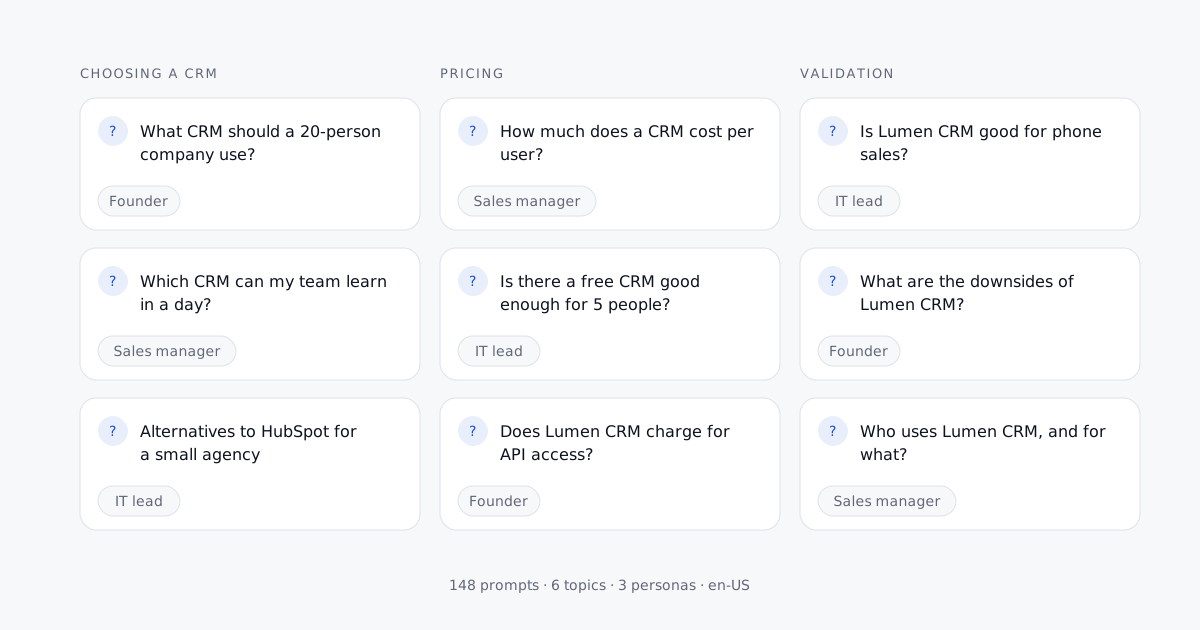
Writing the prompts your customers actually ask an AI
Pick keywords and you measure a search engine. Pick real buyer questions and you measure what AI tells your customers. How to build and maintain the set.
Read the article →