How to get your company cited and recommended by Perplexity
Perplexity searches the web for every question and shows its sources, numbered, next to the answer. For a technology company, that makes it the most transparent AI assistant to work on: you can see exactly which pages it read before naming a vendor. This guide covers what Perplexity documents about how it reads the web, what it cites in practice, how it decides which software platforms to recommend, the steps to get your company cited, and the PR and authority metrics worth tracking.
How Perplexity reads the web
Perplexity does not publish its ranking method. What it does document is how it reaches websites, through two agents:
| Agent | What it does | What it means for you |
|---|---|---|
| PerplexityBot | Crawls the web "to surface and link websites in search results on Perplexity". Perplexity says it is not used to train AI foundation models. | Blocking it in robots.txt or in your firewall keeps your pages out of Perplexity's results. Allowing it does not give your content to model training. |
| Perplexity-User | Visits a page when a user's question needs it, and links that page in the answer. Since a user asked, it "generally ignores robots.txt rules". | Your firewall still has to let it through: a challenge page means the answer is written without you. |
Perplexity publishes the IP ranges of both agents (perplexity.ai/perplexitybot.json and perplexity.ai/perplexity-user.json) and recommends matching the user agent together with those IPs in firewall rules. Changes can take up to 24 hours to apply. One trap it points out: Cloudflare's Bot Fight Mode can still challenge its bots even when a custom rule allows them.
What Perplexity cites
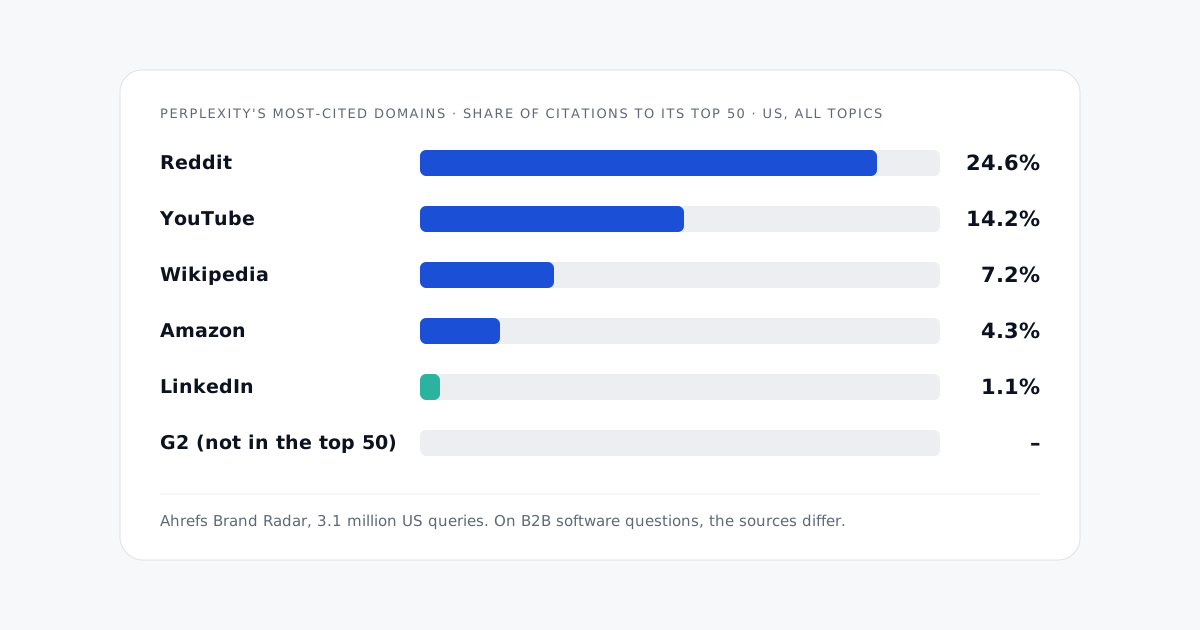
Because every answer lists its sources, Perplexity's citations can be counted at scale. Ahrefs looked at every domain Perplexity cited across more than 3.1 million US queries on all topics (its Perplexity ranking, Brand Radar data). Among the 50 most-cited domains:
- Reddit leads with 24.6% of the citations to those 50 sites, ahead of YouTube (14.2%) and Wikipedia (7.2%).
- Retailers, consumer reviews and health sites fill most of the rest: Amazon, Healthline, Consumer Reports, Tripadvisor, WebMD.
- LinkedIn ranks 20th (1.1%). G2 is not in the top 50.
Two cautions before turning that into a plan. These are all-topic figures, dominated by consumer questions: on B2B software questions the cited sites are different, and much more spread out. And the mix moves month to month. In our own study of 7,911 answers from ChatGPT, Gemini and Google AI Mode, 13,982 different websites were cited, 64% of them in a single answer, and the brands' own sites took a third of the citations. Perplexity was not part of that study, but the lesson carries over: the sources that matter are the ones cited for your questions, and you find them by looking.
How Perplexity decides which software platforms to recommend
For a question like "which platform should a 500-person company use for…", Perplexity searches, reads a handful of pages, and writes a shortlist from them. The sources it shows are the evidence for its choice, so the vendors it names are, in practice, the ones that:
- Appear on several of the pages it retrieves for the question: "best tools for…" articles, comparisons, analyst and media reviews, community threads, partner directories.
- Are described consistently across those pages and on their own site: same category, same buyer, same strengths. A vendor described three different ways is harder to place on a shortlist.
- Answer the question on their own pages: a page about that exact use case, segment or comparison, with facts in the first lines, is a page Perplexity can cite and quote.
- Are readable: pages it can fetch, in HTML, from a site that lets its agents in.
The practical test is to ask Perplexity your buyers' questions and open the sources it lists. Each source that names a competitor and not you is a page to get onto, or a page you should have written yourself.
How to get your technology company cited by Perplexity
1. Let both agents in
Allow PerplexityBot in robots.txt, and allow both PerplexityBot and Perplexity-User in your firewall or CDN, verified by their published IP ranges. Then check your server logs for their visits. Our guide to AI crawlers covers the rules for every assistant.
2. Write pages that answer one question each
Perplexity quotes passages. Pages that put the answer first, with facts (who it is for, prices, integrations, limits, numbers), are easier to quote than pages built around slogans. Give each buying question its own page or section: use cases, segments, integrations, "X vs Y", alternatives, pricing. See how to structure pages for AI citations.
3. Keep pages current, and say when they changed
Perplexity answers with what it finds now, so an outdated page competes badly with a recent one on the same question. Update your key pages when prices, features or integrations change, and show the date of the last update on the page.
4. Be on the pages Perplexity already cites for your questions
List the third-party sources in Perplexity's answers to your buyers' questions, rank them by how often they appear, and work on the ones that name your competitors: ask to be added to comparisons, offer data or a quote to the publication, contribute where the community discusses your category. This is digital PR aimed at AI answers.
5. Publish something others will cite
Original data (a benchmark, a survey, a study of your market) is the kind of page that publications and comparison articles link to, and that Perplexity can cite directly for questions about the category.
6. Track Perplexity on its own
Perplexity, ChatGPT and Gemini do not read the same web: on the same question, ChatGPT and Gemini share 8.3% of their cited sites on average. Track a fixed set of prompts in Perplexity, from your market, and follow whether you are named, in which position, and which pages it cites.
Which digital PR and authority metrics matter for Perplexity
Domain authority scores were built for links and rankings. They say little about whether a publication shows up in Perplexity's answers: in Ahrefs' analysis of the 50 most-mentioned sites, the correlation between Ahrefs Rank and mention share in Perplexity was -0.34, and not statistically significant (see backlinks vs LLM citations). The metrics that tie PR to Perplexity's answers:
| Metric | What it tells you |
|---|---|
| Citation frequency of a publication | How often Perplexity cites that site in answers to your category's questions: the best measure of whether a placement there can reach the answer. |
| Whether the cited page names you | A frequently cited page that names your competitors and not you is your top target. |
| Share of answers naming you | Your visibility in Perplexity, by topic and market, before and after a campaign. |
| Position among the brands named | Being named first or fifth changes what the buyer remembers. |
| Share of voice against competitors | Whether a gain is yours or the whole category's. |
| Citations of your own pages | Which of your pages Perplexity quotes, and for which questions. |
| Description and tone | Whether Perplexity describes your category, buyer and strengths the way you do. |
Reach, domain scores and backlinks still matter for search rankings, which feed what assistants retrieve. Judge a placement for Perplexity by whether the site is cited in your category's answers, and whether the page names you.
Frequently asked questions
What is the best way to get a technology company cited as a source in Perplexity answers?
Let PerplexityBot and Perplexity-User reach your site, publish pages that answer each buying question with facts in the first lines, keep them up to date, and get onto the third-party pages Perplexity already cites for your buyers' questions. Then track which of your pages it cites, prompt by prompt.
Which digital PR and authority metrics matter most for Perplexity?
How often a publication is cited in Perplexity's answers to your category's questions, and whether its cited pages name you. Then your share of answers, position, share of voice and the citations of your own pages. Domain authority scores alone are a weak guide: in Ahrefs' analysis, Ahrefs Rank showed no significant link with mention share in Perplexity.
How does Perplexity decide which enterprise software platforms to recommend?
It searches the web for the question, reads a few pages, and builds the shortlist from them, showing those pages as sources. Vendors that appear across several of the pages it retrieves, are described consistently, and have their own pages answering the question are the ones it names.
Does blocking PerplexityBot keep my content out of AI training?
Perplexity says PerplexityBot is not used to train AI foundation models: it surfaces and links websites in Perplexity's results. Blocking it mainly keeps your pages out of Perplexity's answers.
Does Perplexity cite G2 and Reddit for software questions?
Reddit is Perplexity's most-cited site across all topics in Ahrefs' data, while G2 is not among its 50 most-cited domains. On B2B software questions, the sources depend on the category and the question, so check the sources Perplexity lists for your own buyers' questions before investing in one platform.
More from the blog
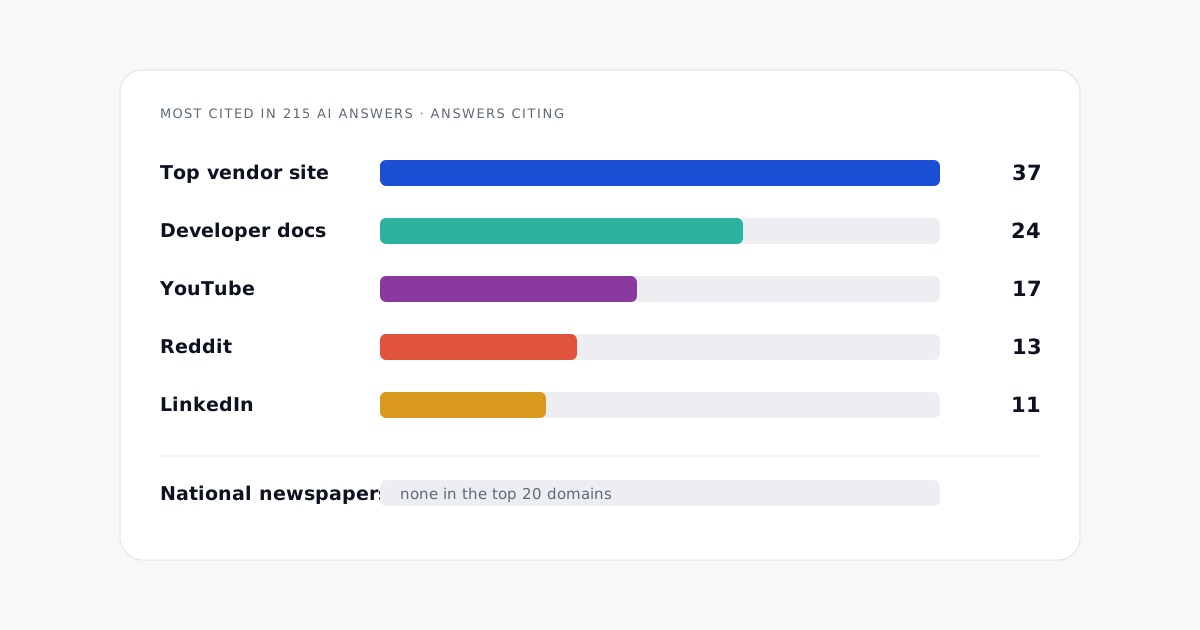
Digital PR for AI visibility: how to get your brand cited in ChatGPT, Gemini and Perplexity
Assistants cite a different set of sites than the ones PR teams pitch. How coverage reaches AI answers, which tactics get your brand cited, and how to measure a campaign on AI mentions.
Read the article →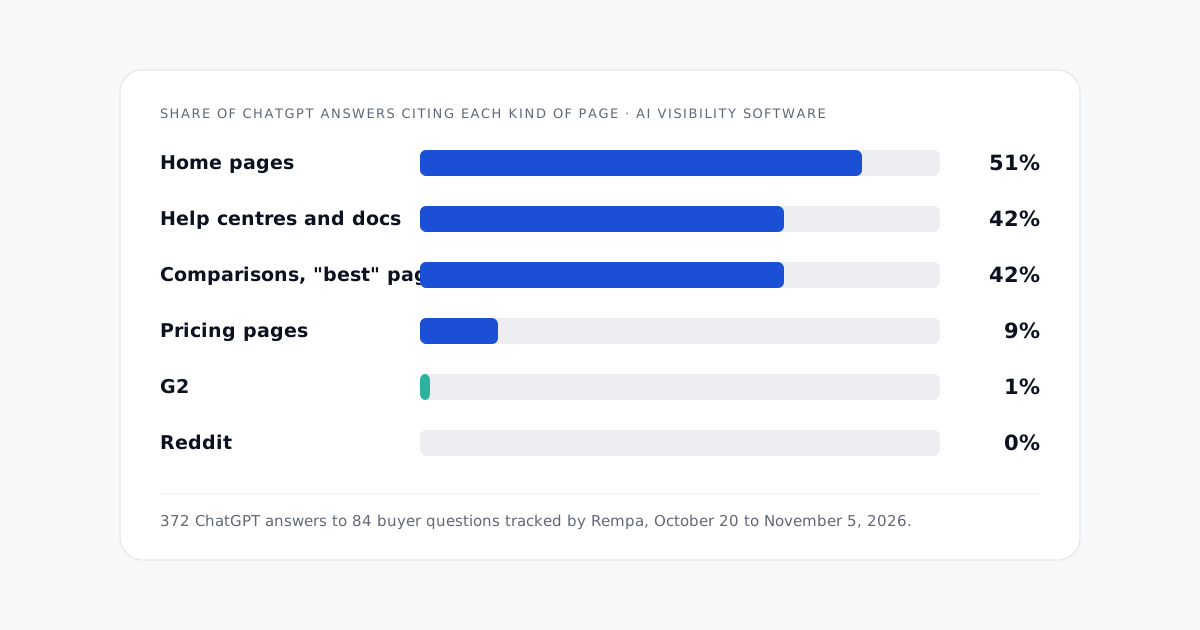
How a B2B SaaS company gets recommended by ChatGPT
ChatGPT builds its software shortlists from the pages it reads, and those are mostly vendors' own pages and comparisons, not G2 or Reddit. What it cites, and seven steps to be named.
Read the article →
AI crawlers and robots.txt: which bots to allow so your site appears in AI answers
One line in robots.txt can remove you from ChatGPT search; a similar one only refuses training. What each AI crawler does, what to allow, and how to check it works.
Read the article →