How to track and audit the sources AI assistants cite in your sector
Every answer ChatGPT, Gemini, Copilot or Google AI Mode gives about your market is built on a handful of websites. Knowing which ones is the starting point of any digital PR or GEO plan: they are the pages to get listed on, the publications to pitch, the competitors' sources to match. But each assistant reads a different web. Across 11,733 answers to buyer questions, of the websites ChatGPT cited on a question, Gemini cited 8.9% on the same question. This guide shows how to track the domains each assistant cites in your sector, how to compare their reference frequency across answer engines, and how a digital PR team turns the list into work.
The short answer
- Track questions, not a domain list. Write the questions your buyers ask, ask them in each assistant from your market at a regular cadence, and keep every cited page with its URL. The domains come out of the answers.
- Count per answer, per assistant. A domain's reference frequency is the share of answers that cite it at least once. Compare it assistant by assistant: the assistants cite different websites for the same question.
- Expect a long tail. A company's 35 or so buyer questions brought up a median of 90 different websites, 70% of them cited only once. The few domains cited again and again are the ones that matter.
- Read the pages, not only the domains. A domain cited for its "best tools" ranking is a listing to get onto; the same domain cited for a news story is not.
Why each assistant needs its own audit
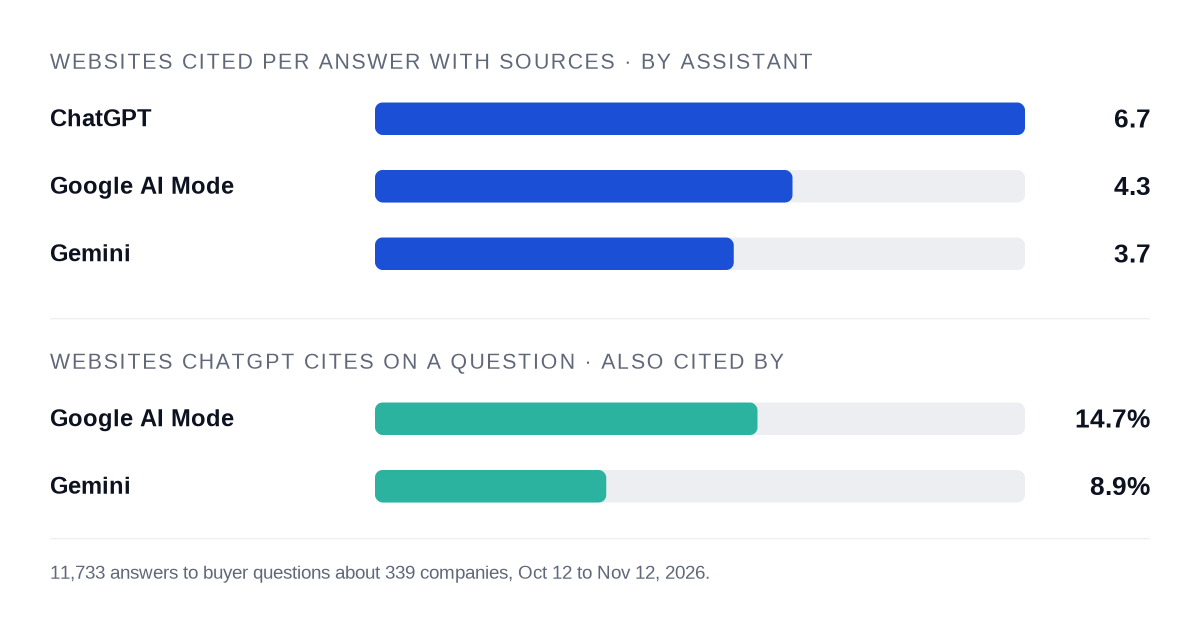
We looked at the sources of 11,733 answers to buyer questions such as "which CRM should a small business choose" or "which agency for B2B lead generation", asked about 339 companies between October 12 and November 12, 2026, to ChatGPT, Gemini and Google AI Mode, about 3,900 answers each. The assistants differ on how much they cite, and on what.
| Measure | ChatGPT | Google AI Mode | Gemini |
|---|---|---|---|
| Answers without any source | 0.5% | 1.3% | 27.7% |
| Websites cited per answer with sources | 6.7 | 4.3 | 3.7 |
| Answers citing the company's own website | 27.1% | 19.3% | 10.4% |
And when two assistants answer the same question, they mostly cite different websites:
| Of the websites cited by… | also cited on the same question by |
|---|---|
| ChatGPT | Google AI Mode 14.7%, Gemini 8.9% |
| Google AI Mode | ChatGPT 22.8%, Gemini 18.0% |
| Gemini | Google AI Mode 20.7%, ChatGPT 16.5% |
On the 2,737 questions where all three cited at least one website, a quarter (24.7%) had a website cited by all three, and 15.6% had no website in common between any two. An audit run in ChatGPT alone tells a PR team little about Gemini, and the reverse. Microsoft Copilot was not part of these audits; its answers draw on Bing, so expect its sources to differ again and audit it on its own if your buyers use it.
How to track the domains AI assistants cite in your sector
- Write 30 to 100 buyer questions. The ones that lead to a shortlist ("best [category] for [use]", "[brand] alternatives", "[brand] vs [competitor]", "how much does [category] cost") in your buyers' language, grouped by topic. Our guide on writing the prompts customers ask gives the method.
- Ask them the way buyers do. In each assistant your buyers use, with web search on, from your market's country and language, without personal history. The publications cited differ from one country to the next.
- Keep every cited page. Store the URL and title of each source, not only the domain, with the answer, the assistant, the date and the brands the answer names.
- Repeat at a regular cadence. Every few days, for at least two weeks. Sources vary from one run to the next; the domains that come back on every run are the stable ones.
- Normalise the domains. Count www and subdomains with their site, and strip tracking parameters (ChatGPT adds
utm_source=chatgpt.comto many links) before counting.
How to compare domain-level reference frequency across answer engines
Build one table with a row per domain and, for each assistant, the share of its answers that cite the domain. Then add the columns a PR team needs to decide:
| Column | How to compute it | Why it matters |
|---|---|---|
| Reference frequency per assistant | Answers citing the domain at least once, divided by the answers of that assistant | Shows where the domain counts: a site cited in 20% of ChatGPT's answers and none of Gemini's is a ChatGPT target |
| Questions covered | The distinct questions on which the domain is cited | A domain cited on one question is a niche source; one cited across topics shapes the whole category |
| Competitors on it | The brands named in the answers citing it, and on the cited pages | The outreach list: domains that name competitors and not you |
| You on it | Whether the cited pages name your brand | Already listed: improve the entry. Not listed: get added |
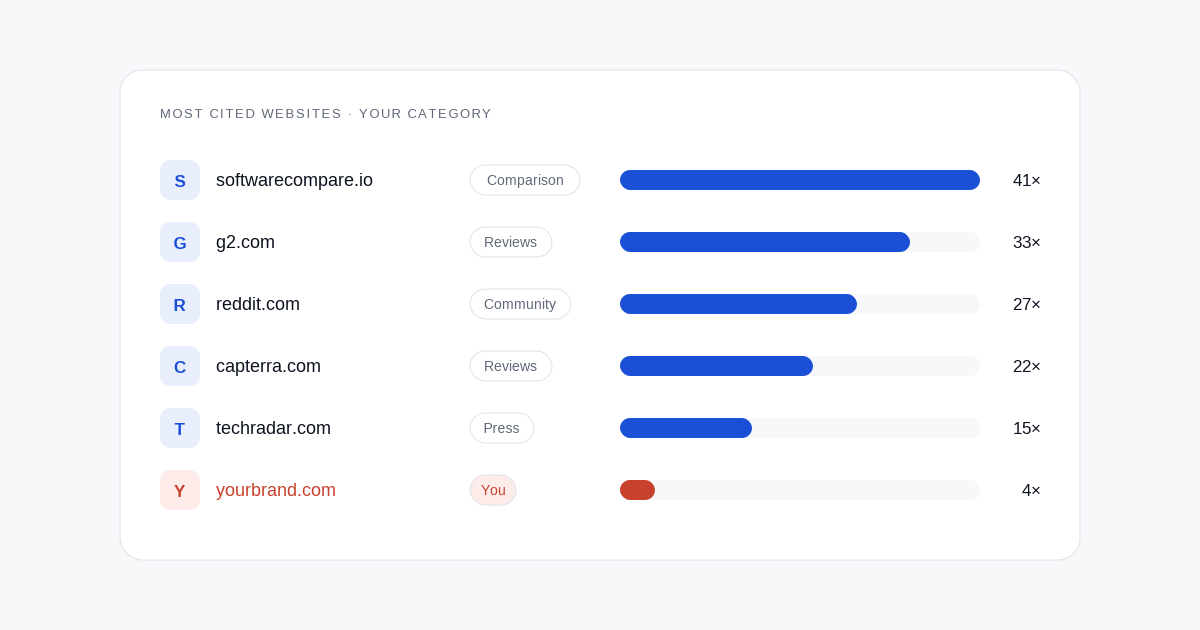
| Kind of source | Comparison or ranking, review platform, directory, media, forum, brand site | Each kind has its own play: a pitch, a listing, reviews, a contribution |
| Trend | Frequency this month against the previous one | Separates lasting sources from one-off citations |
Expect the citations to be spread thin. In our data, the five most cited websites of a company's market accounted for a quarter (25.5%) of the citations on its questions, and the single most cited one appeared in 37.5% of its answers on average. Past the first few, most websites are cited once or twice: look at the domains that come back across questions and runs.
A workflow for digital PR teams
- Shortlist the domains cited on several questions, in the assistants your buyers use, that name competitors and not you. Ten to twenty is enough to start.
- Open the cited pages. Note what the page is (a ranking, a review, a guide, a news story), who wrote it, when it was last updated, and which brands it lists.
- Pick the play for each. A ranking or comparison: ask the author to add you, with facts they can check. A review platform: collect reviews from customers. A directory: complete the listing. A media site: pitch a story or data to the journalist covering the topic. Our digital PR guide details each play.
- Log every placement with its URL and date.
- Check at the next updates whether the page is still cited, now names you, and whether you are named more often on the questions where it is cited. Give it weeks: assistants that search the web pick up a change quickly, the way they describe a brand changes slowly.
With Rempa: every answer keeps the pages it cites, for each assistant you track, ChatGPT, Gemini, Copilot, Perplexity and Google AI Mode among them. The Sources page ranks the websites cited in your market by the share of answers citing them, by assistant, shows the kind of each source and the competitors named next to it, and lists the websites to win: those that name your competitors and not you. Every page exports to CSV, and the REST API serves the same data to your own reporting.
Mistakes in citation audits
- Auditing one assistant. With so little overlap, a ChatGPT audit is not a Gemini audit.
- Counting links instead of answers. An answer can cite the same site five times; count it once per answer, or one verbose answer outweighs ten others.
- Stopping at the domain. The page decides the play. A domain can be cited for its ranking on one question and for an unrelated article on another.
- Ignoring the answers without sources. Gemini answered 28% of buyer questions without citing a page. There, what it says comes from what the model already knows, not from a page you can find; work on consistent facts across the web instead.
- Running it once. A single run shows a snapshot. The list of domains to work on comes from the ones that come back.
Method
The data comes from the audits Rempa ran between October 12 and November 12, 2026: about 12 buyer questions written for each of 339 companies in B2B software, services, retail and consumer goods, mostly in France, the United States and the United Kingdom, each asked to ChatGPT, Gemini and Google AI Mode in the company's market. We kept the 11,733 answers that completed and their cited pages. Domains are counted without www, once per answer. Overlap compares the websites two assistants cited on the same question of the same company, when both cited at least one. Copilot and Perplexity were not part of these audits. These are counts of citations, not a measure of influence: a page can shape an answer without being cited.
FAQ
How do I find which websites ChatGPT cites most often for my sector?
Ask ChatGPT the questions your buyers ask, with web search, from your market, several times over a few weeks, and keep every cited page. Rank the domains by the share of answers that cite them. A dedicated AI visibility tool does this for you and keeps the history.
How can a digital PR team track citations in Copilot and Gemini?
The same way as in ChatGPT, but separately: the same questions asked in each assistant, from the same market, with each answer's sources kept. Compare the domains assistant by assistant, since they overlap little: in our data, Gemini cited 8.9% of the websites ChatGPT cited on the same question.
What is domain-level reference frequency?
The share of an assistant's answers, on your set of questions, that cite a given domain at least once. It tells you how often a website shapes the answers your buyers read, assistant by assistant.
Do ChatGPT, Gemini and Google AI Mode cite the same sources?
Rarely. On the same question, Google AI Mode cited 14.7% of the websites ChatGPT cited, and Gemini 8.9%. On 15.6% of questions, no two of the three cited any website in common.
More from the blog
Which sources do AI assistants cite, and how to get your brand into them
When an assistant recommends a product, it is summarizing a comparison site, a review platform or a forum thread. Find those sources and get into them.
Read the article →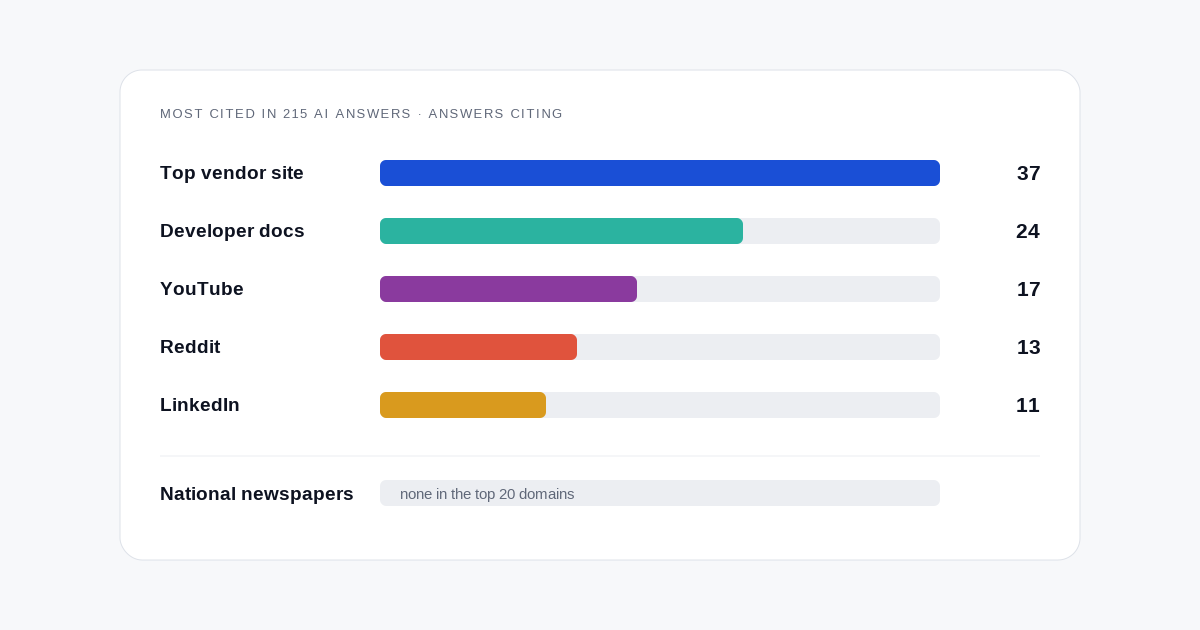
Digital PR for AI visibility: how to get your brand cited in ChatGPT, Gemini and Perplexity
Assistants cite a different set of sites than the ones PR teams pitch. How coverage reaches AI answers, which tactics get your brand cited, and how to measure a campaign on AI mentions.
Read the article →
Securing high-authority AI citations: a digital PR guide
No tactic guarantees a citation, and assistants cite pages, not domains. What they cite in a UK tech category, and six steps to earn and measure citations.
Read the article →