How to monitor your brand in Google Gemini: mentions, citations and market share
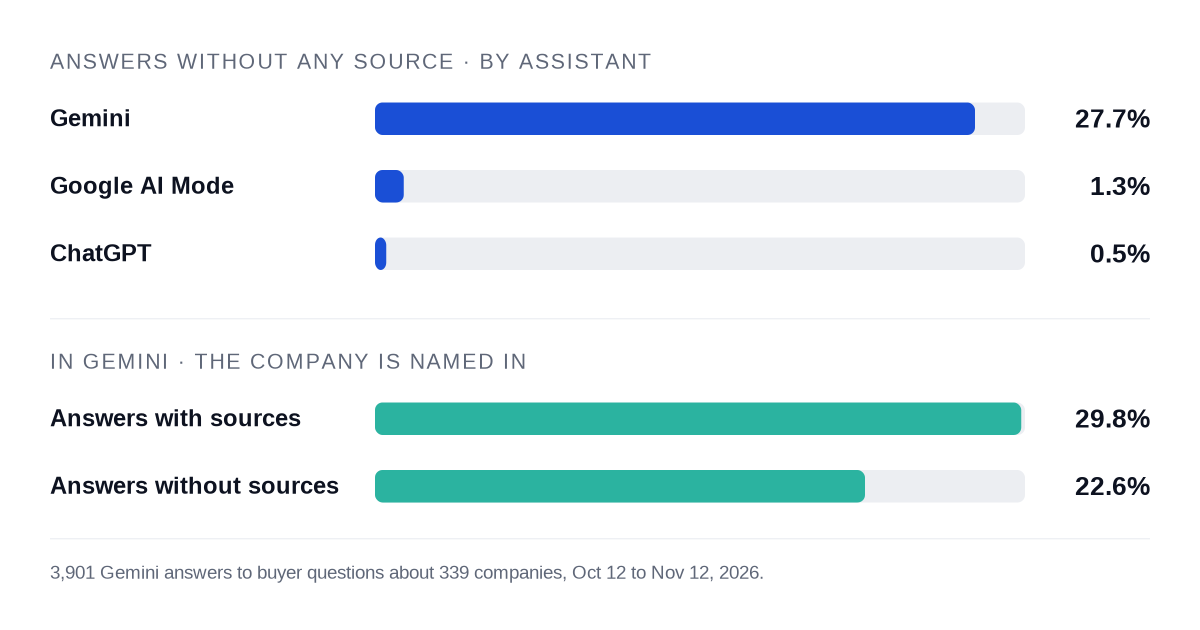
Google Gemini answers buying questions differently from ChatGPT: it cites fewer pages, often none, and recommends its own set of brands. Across 3,901 Gemini answers to buyer questions about 339 companies, 27.7% cited no page at all, and the company was named less often in those answers than in the ones with sources. This guide shows how a digital PR agency or an in-house team can monitor whether Gemini names and cites a brand on commercial queries, how to benchmark its market share and citation frequency against competitors, and how to report it.
The short answer
- Monitor the Gemini app, not the API. Ask your commercial questions in the Gemini your buyers use, from their country and language, and keep each answer with the brands it names and the pages it cites.
- Count the answers without sources apart. More than a quarter of Gemini's answers cite nothing. There, what it says comes from what it already knows: you can measure it, but there is no page to win.
- Benchmark inside Gemini. Share of voice and citation frequency, against the same competitors, on the same questions, compared with ChatGPT side by side but never pooled with it.
- Report monthly, with the answers that changed and the sources behind them.
How Gemini differs on commercial queries
We looked at the answers Gemini, ChatGPT and Google AI Mode gave to the same buyer questions (about 12 per company, such as "which agency for B2B lead generation" or "best payroll software for a small business") for 339 companies, each tracked with up to eleven competitors, between October 12 and November 12, 2026.
| Measure | Gemini | ChatGPT | Google AI Mode |
|---|---|---|---|
| Answers without any source | 27.7% | 0.5% | 1.3% |
| Websites cited per answer with sources | 3.7 | 6.7 | 4.3 |
| Answers citing the company's own website | 10.4% | 27.1% | 19.3% |
| Answers naming the company | 27.8% | 31.7% | 29.0% |
Three consequences for monitoring:
- Answers without sources name fewer brands. In Gemini's answers without sources, the company was named in 22.6% of cases, against 29.8% in the answers with sources, and fewer tracked brands were named overall (1.95 per answer against 2.54). Consumer categories were the most affected: 31.2% of Gemini's answers on retail, services and consumer goods cited no page, against 22.3% on B2B software.
- Its sources are spread thin. Even the website Gemini cited most often across all these answers appeared in about 1% of them. The sources that matter for a client are the ones Gemini cites on that client's questions.
- Its leaders are its own. On the same questions and brands, Gemini named the same leader as ChatGPT for 42% of the companies. A client's position in ChatGPT says little about its position in Gemini; our analysis of AI market share across models gives the details.
How agencies monitor whether Gemini cites their clients
- Write the commercial queries per client. 30 to 100 questions that lead to a purchase: "best [product] for [use]", "where to buy [product]", "[category] for [segment]", "[client] vs [competitor]", "[client] reviews". Group them by product line.
- Agree on the competitors with the client: the three to ten brands it loses sales to.
- Ask in the Gemini app, from the client's market and in its language, in a session without personal history. The API without search does not show what buyers see.
- Record four things per answer: whether the client is named and in which position; which competitors are named; the pages cited, by URL; and whether the answer cites any page at all.
- Repeat at a fixed cadence, every day or every few days. Gemini's answers vary from run to run; a monthly figure is built from many runs.
- Check the client's own pages in the sources. Gemini cites the company's own site far less often than ChatGPT does, so a citation of the client's site in Gemini is a signal worth reporting.
How to benchmark market share and citation frequency in Gemini
Compute each figure for the client and every competitor, on Gemini's answers only:
| Metric | How to compute it in Gemini |
|---|---|
| Recommendation frequency | Gemini answers naming the brand ÷ Gemini answers collected |
| Share of voice | The brand's mentions ÷ all tracked brands' mentions in Gemini's answers, each brand counted once per answer; weighted by 1 ÷ position for the weighted version |
| Citation frequency of the brand's site | Gemini answers citing the brand's own website ÷ Gemini answers with at least one source |
| Citation frequency of a third-party site | Gemini answers citing it ÷ Gemini answers with sources, with the brands each of its pages names |
| Share of answers without sources | Reported next to the others, so a drop in citations is not mistaken for a loss of visibility |
Divide citation frequencies by the answers with sources, not by all answers: otherwise a month where Gemini cites less looks like a month where the client lost its sources. Compare Gemini with ChatGPT and Google AI Mode in a grid, one column per assistant, and read the gaps: where a competitor leads in Gemini and not elsewhere, open its Gemini answers and the pages they cite. For the full metric set and an audit framework, see how to benchmark AI share of voice.
What to do with what you find
- Pages cited next to competitors: the outreach list. Ask the authors of rankings and comparisons to add the client, and complete its listings on directories and review sites. Our tutorial on finding the sources AI cites for competitors gives the steps.
- Answers without sources that leave the client out: no page to win. Work on consistent facts about the client across the web (its site, its profiles, the listings and articles that describe it) and on its ranking in Google for the underlying searches, then check again over weeks.
- Wrong or outdated statements: trace them to the cited page when there is one, and correct the source.
Reporting Gemini to a client
One page per month: the client's recommendation frequency and share of voice in Gemini against its competitors, with the trend since the baseline; the pages Gemini cited that name competitors and not the client, and the placements won; two or three verbatim answers; and the share of answers without sources, so the client reads the numbers correctly. Put Gemini next to the other assistants the client's buyers use, in separate columns. Our guide on AI visibility reporting for agencies has a full monthly template.
With Rempa: Rempa asks the Gemini app your clients' commercial questions from their market, in the UK or any of 52 countries, at each update, and keeps every answer with the brands it names, their position and tone, and the pages it cites by URL. Share of voice, plain and weighted by position, citation frequency and visibility are shown per assistant for the client and its competitors, with the trend, and the reports export to PDF, Word or Excel. See the Gemini tracker and how Rempa collects the answers.
Method
The data comes from the audits Rempa ran between October 12 and November 12, 2026: about 12 buyer questions written for each of 339 companies in B2B software, services, retail and consumer goods, mostly in France, the United States and the United Kingdom, each asked to the Gemini app, ChatGPT and Google AI Mode in the company's market, with the company and up to eleven competitors tracked (eleven for 316 of the 339). We kept the 3,901 Gemini answers that completed (11,733 for the three assistants). Domains are counted without www, once per answer. The leader comparison uses the 323 companies where each assistant named at least one tracked brand. These are counts of mentions and citations, not a measure of influence.
FAQ
How do digital PR agencies track if Google Gemini cites their clients on commercial product queries?
They ask the Gemini app a fixed set of commercial questions per client, from the client's market, at a regular cadence, and record whether the client is named, in which position, which competitors are named, and which pages are cited. The client's citation frequency is the share of Gemini's answers with sources that cite its pages.
How do you benchmark market share against competitors in Gemini?
Track the same questions for the client and its competitors and compute each brand's share of voice in Gemini's answers: its mentions out of all tracked brands' mentions. Compare it with ChatGPT and Google AI Mode side by side; on the same questions, Gemini named the same leader as ChatGPT for only 42% of the companies we audited.
Does Gemini cite sources?
Often, but not always. In our data, 27.7% of Gemini's answers to buyer questions cited no page, against under 2% for ChatGPT and Google AI Mode. When it cites, it cites fewer websites per answer: 3.7 on average.
Is tracking Gemini the same as tracking Google AI Overviews?
No. Gemini is Google's assistant app; AI Overviews and AI Mode are features of Google Search. They answer the same question differently and should be tracked as separate assistants.
More from the blog
AI market share: how to compare your brand with competitors across ChatGPT, Gemini and Google AI Mode
The brand named most often was the same in ChatGPT and Gemini for only 42% of the 323 companies we measured. How to calculate AI market share per model, compare it, and budget for it.
Read the article →
Which sources AI cites when it recommends your competitors, and how to find them
55% of AI answers to buyer questions named a competitor and not the company audited, and 96% of those cited a third-party website. How to find those pages and get onto them.
Read the article →
How agencies report AI visibility to clients: share of voice, citations and a monthly report template
"What does ChatGPT say about us?" deserves a better answer than a screenshot. The metrics, setup and monthly report template agencies use for AI visibility.
Read the article →