AI market share: how to compare your brand with competitors across ChatGPT, Gemini and Google AI Mode
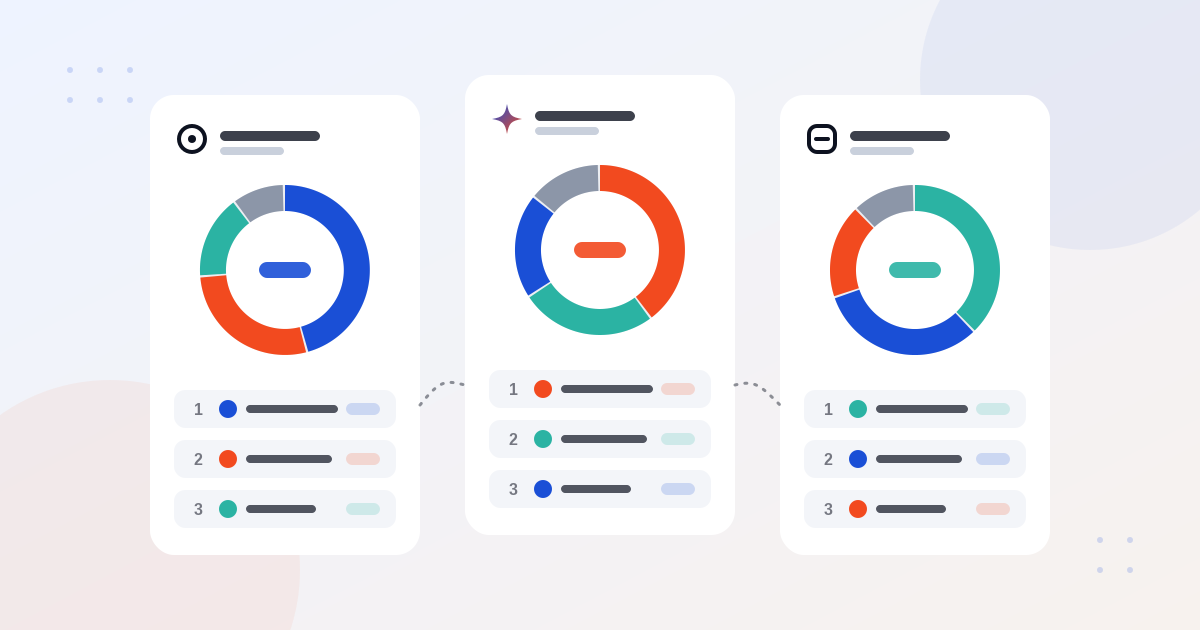
"What is our market share in AI answers?" has no single answer, because each AI model recommends its own set of brands. We measured it on 323 companies, each tracked against up to eleven competitors on the same buyer questions in ChatGPT, Gemini and Google AI Mode. The brand named most often was the same in ChatGPT and Gemini for only 42% of them, and the same in all three models for 32%. This guide shows how an organic search director can calculate recommendation frequency and share of voice, compare them across models without mixing them, and what the tracking costs.
The short answer
- Calculate per model, then compare. Recommendation frequency (the share of answers naming a brand) and share of voice (a brand's mentions out of all tracked brands' mentions), on the same questions, for each model separately.
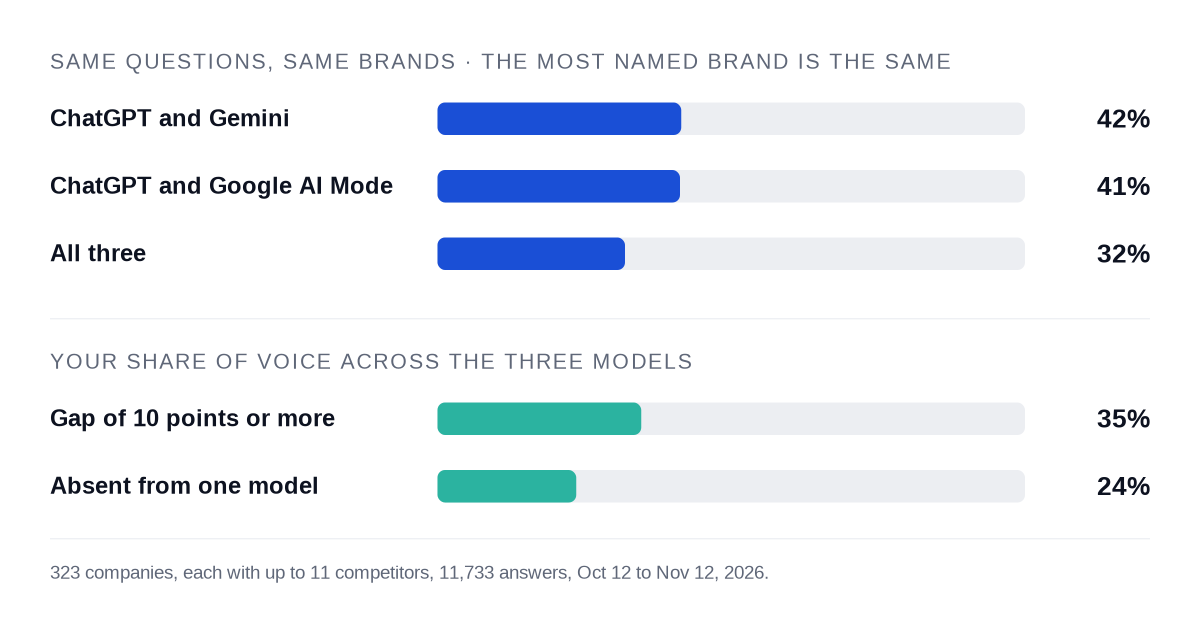
- Expect different leaders. On the same questions and the same brands, ChatGPT and Gemini named the same brand most often for 42% of the companies; all three models agreed for 32%.
- Expect gaps for your own brand. Among companies named by at least one model, 35% had a share of voice 10 points higher in one model than in another, and 24% were absent from one model while named in another.
- Budget by answers, not by seats. Cost is driven by prompts × models × updates per month. 50 prompts in 3 models every 3 days is 1,500 answers a month; 150 prompts daily is 13,500.
How to calculate AI market share
Fix a panel of buyer questions and a list of competitors, run the questions in each model from your market, and detect the brands named in each answer. Then, for each brand, model, topic and update:
| Metric | Formula | What it answers |
|---|---|---|
| Recommendation frequency (visibility) | Answers naming the brand ÷ answers collected | How often a buyer asking this model hears of the brand at all |
| Share of voice | The brand's mentions ÷ mentions of all tracked brands, each brand counted once per answer | The brand's share of the recommendations, the closest thing to market share |
| Weighted share of voice | Same, with each mention weighted by 1 ÷ its position in the answer | Gives more weight to being named first than fifth |
| Average position | Mean rank among the brands named, when named | Whether the brand leads the shortlist or closes it |
| Rank | The brand's place when all tracked brands are sorted by share of voice | Who leads the category in this model |
A worked example: on 100 ChatGPT answers, your brand is named in 30, competitor A in 45, competitor B in 25. Your recommendation frequency is 30%; your share of voice is 30 ÷ (30 + 45 + 25) = 30%; A leads with 45%. If Gemini's 100 answers name you in 10, A in 20 and B in 30, your frequency drops to 10%, your share of voice to 17%, and B leads. Pooling the two models (40 ÷ 160 = 25%) would hide both facts. Our guide on benchmarking AI share of voice details the metrics and a six-step audit framework.
Why the figures differ from one model to the next
We took the audits Rempa ran between October 12 and November 12, 2026 for 339 companies, each tracked with up to eleven competitors on about 12 buyer questions in ChatGPT, Gemini and Google AI Mode. For the 323 companies where each model named at least one of the tracked brands, we computed each brand's share of voice in each model.
| Measure | Result |
|---|---|
| Same most-named brand in ChatGPT and Gemini | 42% of companies |
| Same most-named brand in ChatGPT and Google AI Mode | 41% |
| Same most-named brand in all three | 32% |
| The company's share of voice differs by 10 points or more between two models | 35% of the 262 companies named by at least one model |
| Named by one model, absent from another | 24% of the same companies |
| The company's rank among the tracked brands differs between ChatGPT and Gemini | 56% of companies named by both |
The reason is in how each model builds its answer. ChatGPT searches the web for most buying questions and cites several pages per answer; Gemini cites fewer and answers more often from what it already knows; Google AI Mode draws on Google's index. They read different pages, so they recommend different brands: on the same question, Gemini cited 8.9% of the websites ChatGPT cited, as we showed in how to track the sources AI assistants cite. A brand that leads in one model can trail in another for reasons that have nothing to do with its market position.
How to compare competitors across models
- Keep one panel for all models. The same questions, the same competitors, the same market, collected at the same dates. Differences then come from the models.
- Report a grid, not a number: share of voice per brand (rows) and per model (columns), with the trend since the baseline. Add a combined column only as a summary, weighted by how much your buyers use each model if you know it.
- Read the gaps. Where a competitor leads in one model and not in another, open its answers and their sources in the model where it leads: that is where its advantage comes from.
- Split by topic. A brand can lead on "best for small teams" and be absent on "enterprise" questions. Market share by topic tells you where to act.
- Judge trends over weeks. Answers vary from run to run. Report a month of updates, and treat a few points of movement on a few dozen answers as noise.
What tracking AI market share costs
AI visibility software is usually priced by the volume of answers it collects: the number of prompts, the number of models, and how often they run. Seats, competitors and exports are where vendors differ most. To compare offers, convert each one into answers per month:
| Setup | Answers a month | Rempa plan |
|---|---|---|
| 50 prompts, 3 models, every 3 days | about 1,500 | Starter, $75 a month |
| 150 prompts, 3 models, every day | about 13,500 | Pro, $195 a month |
| 350 prompts, 3 models, every day, 5 projects | about 31,500 | Enterprise, $395 a month |
Then check what each offer includes for that price: which models (ChatGPT and Gemini in the base price, or as add-ons), how many competitors, seats for the whole team, the answers and sources behind each figure, and data access through exports or an API. A low price on one model can cost more once the second model is added. Yearly billing at Rempa starts at $60 a month, with every competitor, unlimited seats, CSV exports and the API included.
With Rempa: share of voice, weighted share of voice, visibility, position and sentiment for your brand and every competitor, per AI model, per topic and per market, with the trend over each update and the answers behind every figure. Choose 3 models among ChatGPT, Gemini, Google AI Mode, Google AI Overviews, Perplexity, Copilot, Claude, DeepSeek and Qwen. See the Gemini tracker, the ChatGPT tracker and pricing.
Method
The data comes from the audits Rempa ran between October 12 and November 12, 2026: about 12 buyer questions written for each of 339 companies in B2B software, services, retail and consumer goods, mostly in France, the United States and the United Kingdom, each asked to ChatGPT, Gemini and Google AI Mode in the company's market, with the company and up to eleven competitors tracked (eleven for 316 of the 339). A brand counts once per answer. Share of voice is a brand's answers divided by the sum of all tracked brands' answers, per company and model. Leaders are compared on the 323 companies where each model named at least one tracked brand; ties count as a different leader only when the sets of tied brands differ. Gaps in the company's share of voice are measured on the 262 companies named by at least one model, a model that never names the company counting as 0%.
FAQ
How can an organic search director measure competitor market share in generative AI search?
Track the same buyer questions for your brand and each competitor in every model your buyers use, and compute each brand's share of voice (its mentions out of all tracked brands' mentions) and recommendation frequency per model, per topic and over time. Compare models side by side rather than pooling them.
Is my share of voice in ChatGPT the same as in Gemini?
Often not. In our audits, the most-named brand was the same in ChatGPT and Gemini for 42% of companies, and 35% of companies had a share of voice 10 points higher in one model than in another.
How much does software that tracks brand mention market share in ChatGPT and Gemini cost?
It depends on prompts, models and frequency. Convert offers into answers per month to compare them. At Rempa, 50 prompts in 3 models every 3 days costs $75 a month, and 150 prompts every day $195, with every competitor included.
What is the best enterprise software to compare brand visibility against competitors across AI engines?
One that runs the same questions in every engine you need, from your markets, keeps the answers and their sources behind each figure, includes your competitors without extra fees, and gives your team access to the data through exports and an API. Test it on your own questions before buying.
More from the blog
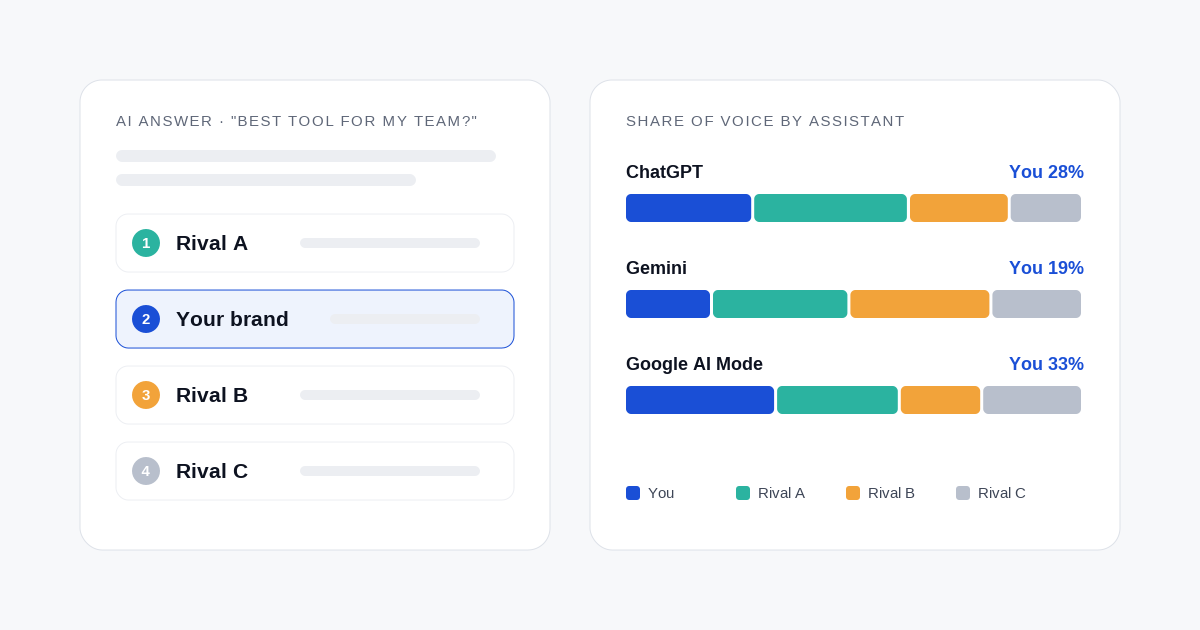
How to benchmark AI share of voice: metrics, a worked example and an audit framework
Share of voice in AI answers, plain and weighted by position, with visibility and sentiment. The standard metrics, a worked example on UK prospecting tools, six steps to run your own, and what makes one lie.
Read the article →
How to track and audit the sources AI assistants cite in your sector
Each AI assistant reads a different web: Gemini cited 8.9% of the websites ChatGPT cited on the same question. How to track the domains each one cites, and what a PR team does with them.
Read the article →
How to measure your brand's visibility in ChatGPT, Gemini and Perplexity
"Are we in ChatGPT's answers?" deserves better than a screenshot. The setup, the five metrics and the habits that turn them into decisions.
Read the article →