Which sources AI cites when it recommends your competitors, and how to find them
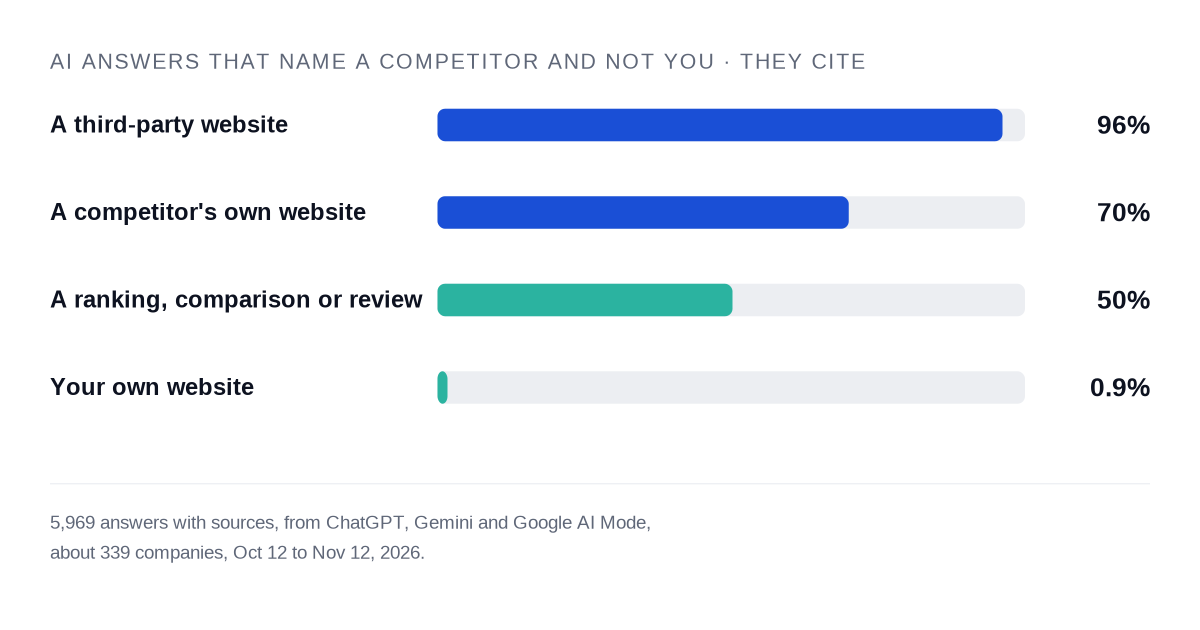
When an AI assistant recommends your competitors and not you, it shows its evidence: the pages it cites. Those pages are your competitors' referral sources in AI answers, and the most direct outreach list a communications team can get. In our audits, 55% of the answers to buyer questions named at least one competitor and not the company audited. Almost all of them (96%) cited a third-party website, and half cited a ranking, comparison or review. This tutorial shows how to find those pages, isolate the exact citation behind each recommendation, and turn the list into a digital PR campaign.
The short answer
- Start from the answers you lose. Ask the assistants your buyers' questions, keep the answers that name a competitor and not you, and collect the pages they cite.
- Separate three kinds of pages. Your competitors' own websites (cited in 70% of those answers), third-party pages that list or review vendors, and everything else. The second group is where PR can act.
- Read each page. Check which brands it names, who wrote it and when, and whether you could be on it. The domain is not enough: the page decides the play.
- Rank by how often a page comes back, across questions, assistants and runs, and start with the ones that name several competitors.
What AI assistants cite when they recommend your competitors
We looked at 11,733 answers from ChatGPT, Gemini and Google AI Mode to buyer questions about 339 companies, asked between October 12 and November 12, 2026, mostly in France, the United States and the United Kingdom. Each audit tracked the company and ten of its competitors. 6,500 answers (55%) named at least one competitor and not the company; 5,969 of them cited at least one page.
| In the answers that name a competitor and not you | Share of answers |
|---|---|
| Cite at least one third-party website | 96.2% |
| Cite a competitor's own website | 70.0% (72.6% on B2B software questions) |
| Cite a third-party ranking, comparison, alternatives or review page | 50.3% |
| Cite your own website | 0.9% |
Two lessons. First, your competitors' own pages do a lot of the work: their product, pricing and comparison pages are quoted to describe them. That part is answered with content on your own site, not with PR. Second, the third-party pages are spread thin: 21,184 different pages on 12,111 websites across those answers. There is no universal list of "AI sources" to pitch; the list is specific to your category, your market and your questions, and you find it by looking.
How to audit the publications and review sites cited for your competitors
A tutorial for communications leads, by hand first, so the method is clear.
- Write 30 to 50 buyer questions. "Best [category] for [use]", "[category] for [company size or industry]", "[competitor] alternatives", "[competitor] vs [competitor]", "is [competitor] worth it". Include the questions where you know a competitor is ahead.
- Ask them in each assistant your buyers use, with web search on, from your market's country and language, in a clean session without personal history.
- Keep the answers that name a competitor and not you. These are the answers you lose. Note which competitors each one names, and in which order.
- Copy every cited page with its full URL and title, and the assistant and question it came from.
- Sort the pages into three groups: a competitor's own website; a third-party page that lists, compares or reviews vendors (rankings, "best of", alternatives, review platforms, directories, community threads); and other pages (definitions, documentation, news).
- Open each third-party page. Note which brands it names, whether you are on it, who wrote it, when it was last updated, and how to reach the author or the editor.
- Repeat after a week and keep the pages that come back. A page cited once may be noise; a page cited on several questions and runs shapes the answers.
How to isolate the exact citation behind a recommendation
An answer can cite eight pages and name five vendors. To know which page carried which competitor into the answer, go down to the sentence:
- Use the inline markers. ChatGPT, Perplexity and Google AI Mode attach their sources to sentences or paragraphs. The page linked next to "X is a good fit for mid-size teams" is the evidence for that claim about X.
- Clean the URLs before counting. Strip tracking parameters (ChatGPT adds
utm_source=chatgpt.comto many links), fragments and trailing slashes, and count www and subdomains with their site. Otherwise the same page is counted three times. - Count once per answer. An answer that cites the same site four times should weigh as much as an answer that cites it once.
- Check the page names the competitor. Fetch it and search for each tracked brand and its other names. A page cited next to a competitor that does not name it was used for something else, such as a definition or a price range.
- Keep the date. Assistants that search the web change sources from week to week. A citation trend over a month says more than one answer.
From the list to a digital PR campaign
| Kind of page | The play |
|---|---|
| Ranking, "best of" or alternatives article | Ask the author to add you, with facts they can check: who you serve, a customer case, prices, what you do that the listed vendors do not |
| Review platform | Complete your profile and ask customers for reviews; assistants quote the summary and the recent reviews |
| Directory or marketplace | Get listed, in the right category, with the same description as on your site |
| Media article | Offer data, a customer story or a comment to the journalist who covers the topic |
| Community thread | Answer as yourself, with useful detail, where the question is still open; no promotion |
| A competitor's own page | Publish the page they have and you lack: the comparison, the use case, the pricing page |
Prioritise the pages cited on the most questions, in the assistants your buyers use, that name several competitors and not you. Log each placement with its URL and date, and check at the following updates whether the page is still cited and now names you. Our digital PR guide details each play, and how to track the sources AI assistants cite covers the comparison across assistants.
With Rempa: every answer keeps its cited pages by URL, with the brands it names. The Sources page shows, for each assistant, the websites and pages cited in your market and the brands named next to them, and lists the websites to win: those cited in answers that name your competitors and not you. For the most cited websites, Rempa reads the cited pages for their title, author, date and the brands they list, and the Recommendations page turns them into outreach tasks with a draft message to the author. Everything exports to CSV or through the API.
Method
The data comes from the audits Rempa ran between October 12 and November 12, 2026: about 12 buyer questions written for each of 339 companies in B2B software, services, retail and consumer goods, each asked to ChatGPT, Gemini and Google AI Mode in the company's market, with the company and up to eleven competitors tracked (eleven for 316 of the 339). We kept the 11,733 answers that completed. An answer "names a competitor and not you" when a tracked competitor is detected in it and the company is not. A competitor's own website is a site matching the competitor's domain or one of its subdomains. Ranking, comparison, alternatives and review pages are read from their address (best, top, comparison, alternatives, vs, review and their French equivalents); pages whose address does not say so are not counted in that share, so it is a lower bound. Pages are counted without their tracking parameters.
FAQ
How do I find which publications and review sites AI engines cite when they mention my competitors?
Ask the assistants your buyers' questions, keep the answers that name a competitor and not you, and collect the pages they cite. Separate your competitors' own websites from third-party pages, open each third-party page to check which brands it lists, and rank them by how often they come back across questions and runs.
Which tools show the exact citations AI models use to recommend competing B2B SaaS companies?
AI visibility platforms that keep each answer with its cited pages by URL, and the brands each answer names. Check that the tool keeps the page, not only the domain, that it reads the cited pages for the brands they list, and that it lets you filter the answers that name a competitor and not you.
What is the best way for communications leads to track competitor citation sources across generative AI answers?
A fixed set of buyer questions, asked in each assistant from your market at a regular cadence, with every cited page kept. Report monthly the pages that name competitors and not you, ranked by how often they are cited, and the placements won since the last report.
Do AI assistants cite competitors' own websites?
Often. In our data, 70% of the answers that named a competitor and not the company cited a competitor's own website. Those pages are answered with content on your own site: comparison, use case and pricing pages.
More from the blog
How to track and audit the sources AI assistants cite in your sector
Each AI assistant reads a different web: Gemini cited 8.9% of the websites ChatGPT cited on the same question. How to track the domains each one cites, and what a PR team does with them.
Read the article →
Digital PR for AI visibility: how to get your brand cited in ChatGPT, Gemini and Perplexity
Assistants cite a different set of sites than the ones PR teams pitch. How coverage reaches AI answers, which tactics get your brand cited, and how to measure a campaign on AI mentions.
Read the article →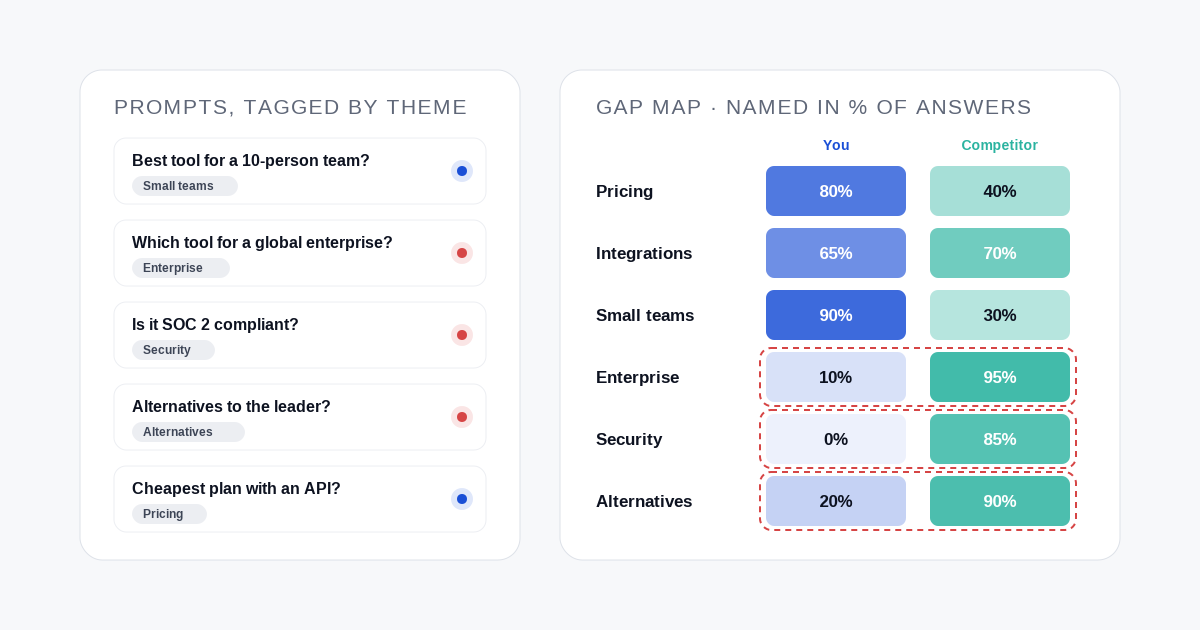
Competitor prompt analysis: how to find the questions where AI recommends your competitors
Share of voice says you lose, not where. How to tag prompts by theme, buyer and size, map the themes competitors win in AI answers, read why from the wording and the sources, and act.
Read the article →