Does LinkedIn get cited in AI answers? What 11,733 answers show
LinkedIn is often presented as a shortcut to AI visibility: post more, and ChatGPT will start naming you. We checked how often it actually happens. Across 11,733 answers from ChatGPT, Gemini and Google AI Mode to buyer questions, LinkedIn is one of the most cited sites, but it appears in only 1.3% of answers, mostly on Google AI Mode, and through a few kinds of pages: company pages, Pulse articles and posts that rank providers. This guide gives the figures, explains which pages get cited and why, and what a company can do with it.
The short answer
- LinkedIn is cited, but rarely. It appears in 154 of 11,733 answers (1.3%), as often as Reddit (150). It is still one of the most cited sites, because no site is cited often: the answers draw on thousands of different websites.
- It depends on the assistant. Google AI Mode cites LinkedIn in 2.8% of its answers, ChatGPT in 1.1%, Gemini almost never.
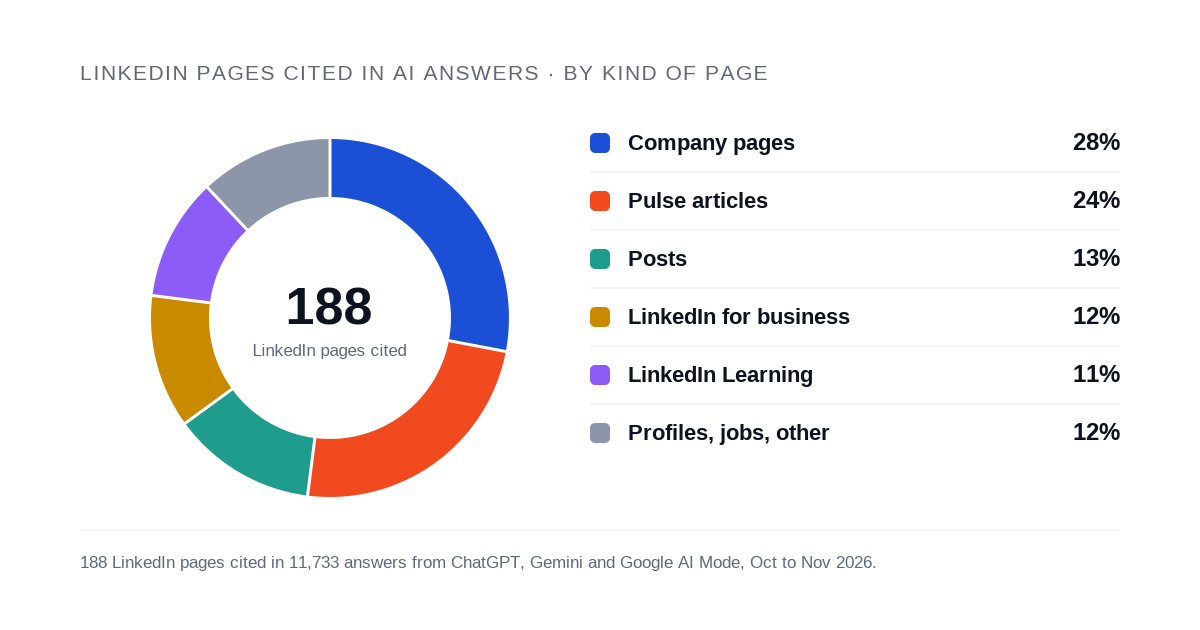
- Company pages and articles, not profiles. Company pages make up 28% of the LinkedIn pages cited, Pulse articles 24%, posts 13%. Personal profiles: 2%.
- It is a supporting source. An assistant cites a company page to describe a small provider, and a Pulse article or a post when it ranks providers. Your own website and the comparison pages of your category weigh far more.
How often AI answers cite LinkedIn
We collected the sources of 11,733 answers to buyer questions such as "which agency should I choose for…" or "what is the best software for…", asked about 339 companies between October 12 and November 12, 2026. Most questions were asked in France, the others mainly in the United States and the United Kingdom. A site counts once per answer, however many of its pages are cited.
| Measure | Result |
|---|---|
| Answers citing LinkedIn | 154 of 11,733 (1.3%) |
| Companies with at least one answer citing LinkedIn | 92 of 339 (27%) |
| LinkedIn pages cited | 188 |
| By market | France 1.4%, United States 1.1%, United Kingdom 1.0% |
| For comparison | Reddit is cited in 150 answers, YouTube in 318 |
The two figures tell different stories. Per answer, LinkedIn is marginal. Per company, it is common: more than a quarter of the companies we looked at had at least one answer about their market built partly on a LinkedIn page. That is the usual pattern for AI sources, as our study of what AI assistants cite shows: no site is in more than a few percent of answers, and the sources that matter differ from one category to the next.
Google AI Mode reads LinkedIn, Gemini almost never
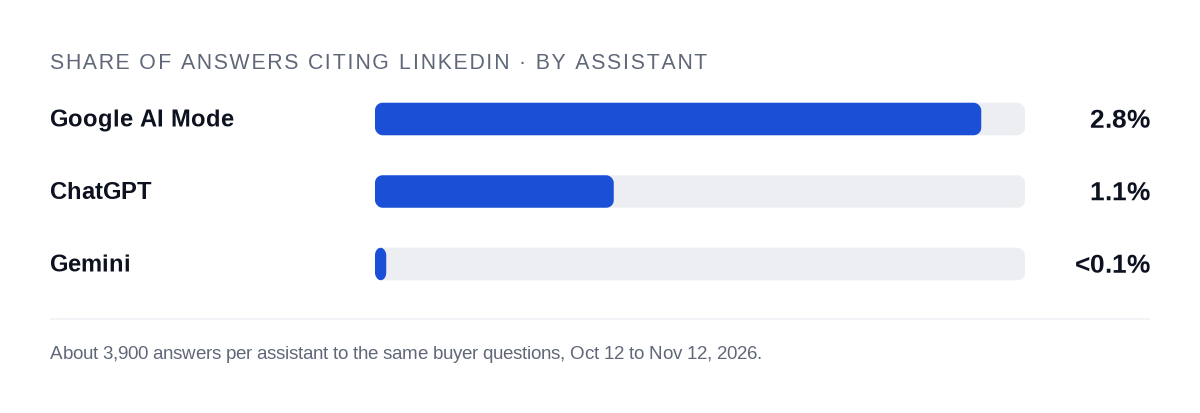
The same questions were asked to the three assistants, about 3,900 answers each. Google AI Mode cites LinkedIn in 107 answers, ChatGPT in 45, Gemini in 2. Part of the gap comes from how each one sources its answers: Gemini answered 28% of the questions without citing any page, against under 2% for ChatGPT and Google AI Mode. But even when it cites, Gemini rarely goes to LinkedIn.
The practical consequence: if your buyers use Google, LinkedIn is worth more to you than if they use Gemini. Work on it with the questions where Google AI Mode answers in mind, not on assistants in general.
Which LinkedIn pages get cited
| Kind of page | Share | When assistants cite it |
|---|---|---|
| Company pages | 28% | To describe a provider they recommend, often a small agency, a regional supplier or a young software vendor whose own site says little |
| Pulse articles | 24% | "Top 10" and "best tools in 2026" lists written by consultants and agencies, and comparisons of two products |
| Posts | 13% | Rankings published by trade media and companies ("15 transport management systems to know in France"), and product announcements |
| LinkedIn for business | 12% | Questions about LinkedIn's own products: advertising, Sales Navigator, recruiting |
| LinkedIn Learning | 11% | Questions about training courses |
| Profiles, jobs, other | 12% | Rarely: personal profiles are 2% of the pages cited |
Two uses stand out. The first is identification: when an assistant recommends a provider, it sometimes points to its company page as the place that says what the company does, where it is and who it serves. The second is ranking: Pulse articles and posts that list the best providers of a category are cited for the same reason as any comparison page, because they answer the buyer's question in a form that is easy to quote.
Leaving aside the pages about LinkedIn's own products and courses, company pages, Pulse articles and posts make up most of what gets cited. Personal posts about a founder's journey or opinions, which make up most of LinkedIn, hardly appear.
What to do with it
- Complete your company page. State in the first lines what you do, for whom, where, and how you differ, in the words your buyers use. Fill in the industry, the location, the size and the website. It is the page an assistant reaches for when your own site is not enough, so it should say the same as your site.
- Get into the rankings published on LinkedIn. Find the Pulse articles and posts that list providers in your category, then contact their authors with facts they can add: who you serve, a customer case, a price range. This is digital PR on a smaller scale, the same work as getting into comparison articles, covered in our digital PR guide.
- Publish your comparisons on your site first. A guide to choosing a provider or a comparison of approaches belongs on your website, which assistants cite far more often. A shorter version as a Pulse article can reach the questions where Google AI Mode reads LinkedIn.
- Do not count on personal posts. They help you be seen by people, which has its own value, but they are rarely an AI source.
- Check your own category. 1.3% is an average. In some categories LinkedIn is cited much more often, in others never. Look at the sources of the answers to your buyers' questions before spending time on it.
With Rempa: every answer keeps the pages it cites. The Sources page ranks the sites cited in your market, LinkedIn included, and opens the answers that cite a given page, so you can see which Pulse articles, posts or company pages are cited on your questions, and whether your competitors are in them.
Method
The data comes from the audits Rempa ran between October 12 and November 12, 2026: buyer questions written for 339 companies in B2B software, services, retail and consumer goods, each asked to ChatGPT, Gemini and Google AI Mode in the company's market. We kept the 11,733 answers that completed and their cited pages. Any page on linkedin.com or one of its country subdomains counts as LinkedIn. Kinds of pages are read from the address: /company/, /pulse/, /posts/, /learning/, business.linkedin.com, /in/ for profiles. These are counts of citations, not a measure of influence: a page can shape an answer without being cited.
FAQ
Does ChatGPT use LinkedIn as a source?
Yes, but rarely. In our data, ChatGPT cites LinkedIn in 1.1% of its answers to buyer questions, mostly company pages, Pulse articles and posts that rank providers.
Can posting on LinkedIn make AI assistants recommend my company?
Not directly. Personal posts are hardly ever cited. What gets cited is a complete company page, and the articles or posts by others that list you among the best providers of your category.
Which AI assistant cites LinkedIn most?
Google AI Mode: 2.8% of its answers, against 1.1% for ChatGPT and almost none for Gemini.
Is LinkedIn more important than Reddit for AI visibility?
In our data they are cited about as often, in 1.3% of answers each. For a company, your own website and the comparison pages of your category weigh far more than either.
More from the blog
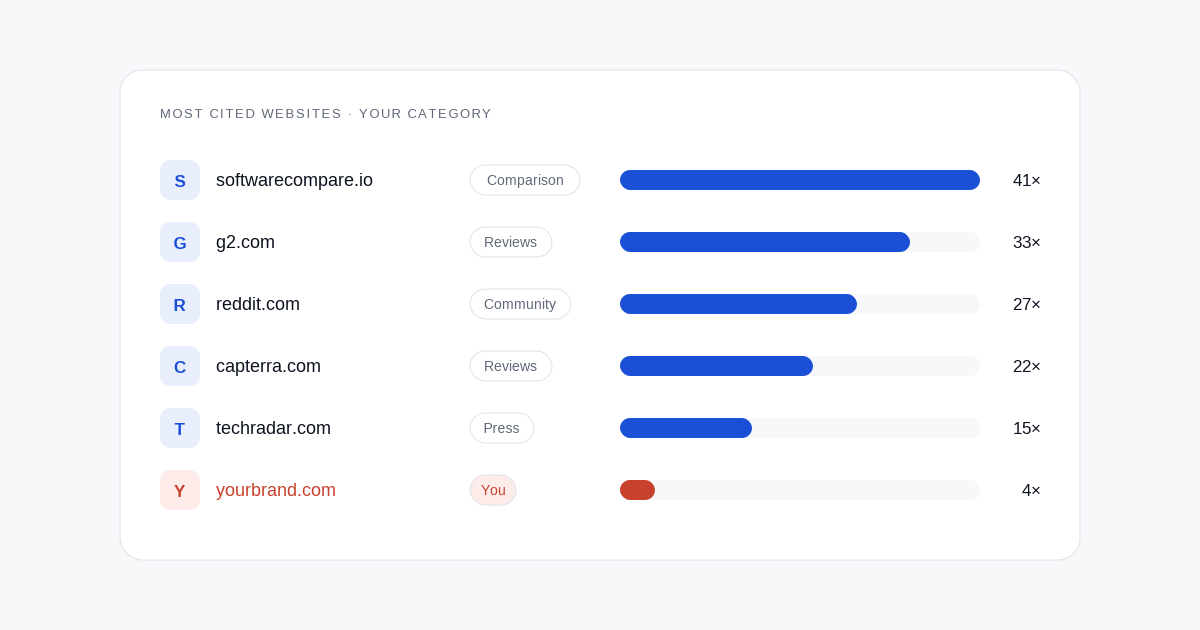
Which sources do AI assistants cite, and how to get your brand into them
When an assistant recommends a product, it is summarizing a comparison site, a review platform or a forum thread. Find those sources and get into them.
Read the article →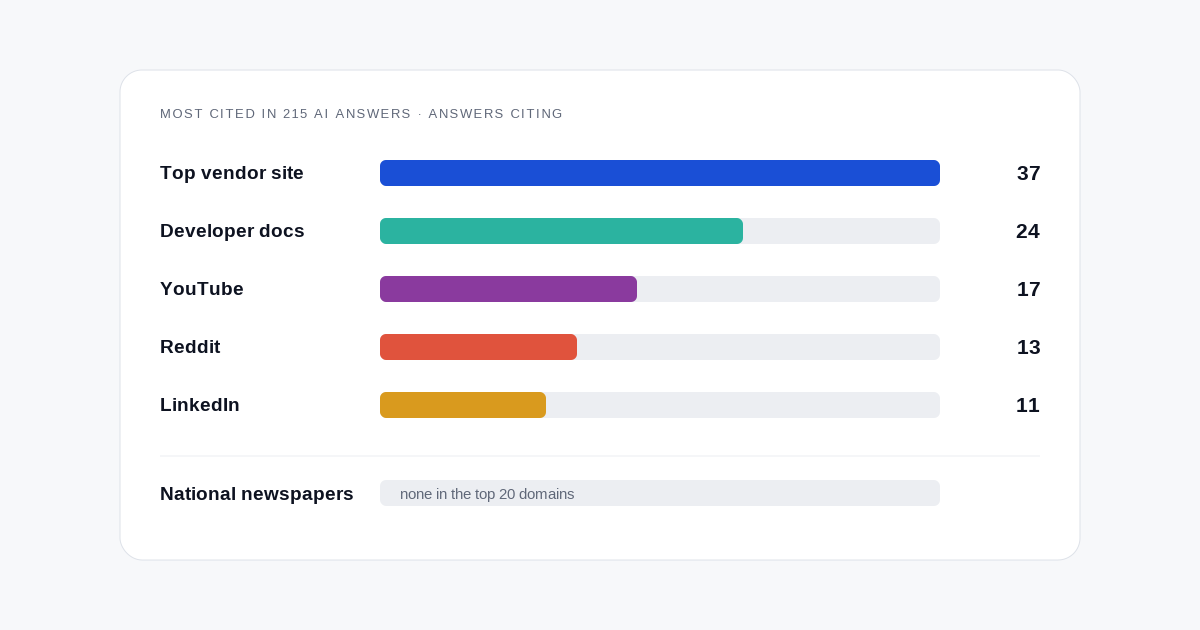
Digital PR for AI visibility: how to get your brand cited in ChatGPT, Gemini and Perplexity
Assistants cite a different set of sites than the ones PR teams pitch. How coverage reaches AI answers, which tactics get your brand cited, and how to measure a campaign on AI mentions.
Read the article →
How to get your company cited and recommended by Perplexity
Perplexity shows every source it read, which makes it the most transparent assistant to work on. How it chooses what to cite and recommend, and how to become one of its sources.
Read the article →