How reliable is GEO tracking? How much AI answers change from one day to the next
Ask an AI assistant the same buyer question two days in a row and you will often get a different answer: other brands, another order, other sources. So how reliable is a GEO tracking platform that reports your visibility in ChatGPT, Gemini or Google AI Mode? We measured how much the answers actually change, on 4,961 answers to the same 144 questions asked again day after day. Per answer, the change is large. Per brand, over a full set of questions, it is small. This guide gives the figures and explains what a tracking platform must do to report a number you can trust.
The short answer
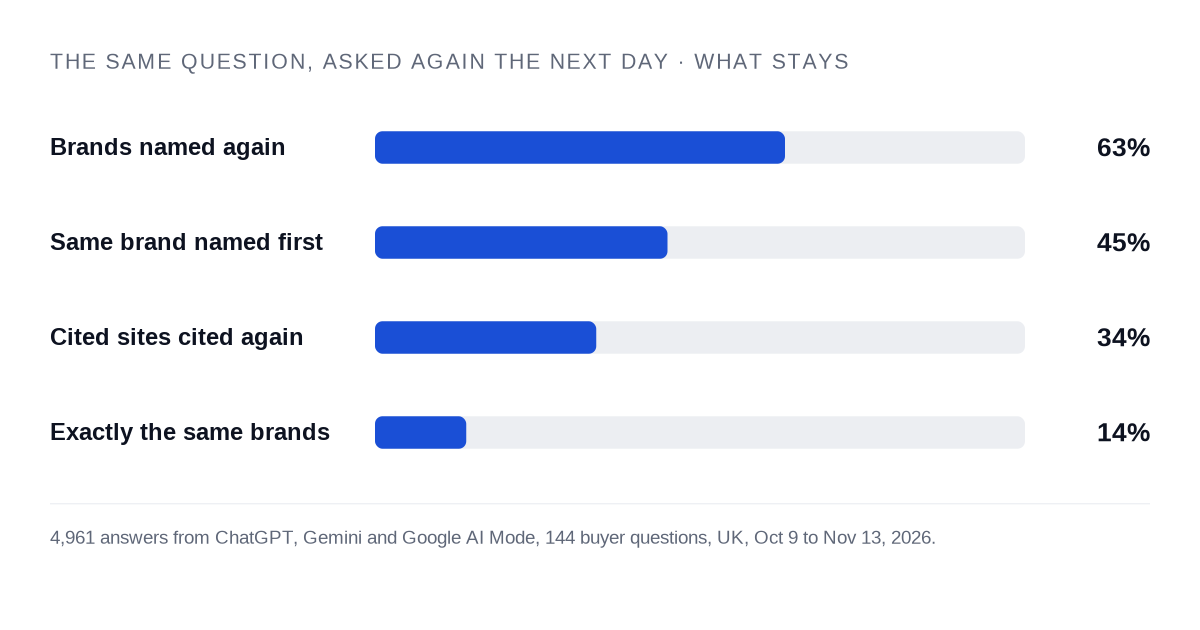
- A single answer is one draw. Asked again the next day, the same question to the same assistant names 63% of the same brands, the same brand first in 45% of cases, and exactly the same brands only 14% of the time. A third of the cited sites are cited again.
- Most of the change is chance, not a trend. Answers four days apart differ no more than answers one day apart: 61% of brands named again in both cases, on the same questions.
- A rate over many answers is stable. The share of answers naming a brand, over about 70 answers per assistant, moved by 2.8 points from one day to the next at the median, and by less than 7 points nine times out of ten.
- No tracker sees "real time". Each update is a sample of answers taken at a moment. Reliability comes from the method: the same questions, clean sessions in the right country, enough answers, a regular cadence and the text of every answer kept.
How much AI answers change from one day to the next
We took 144 buyer questions tracked every day in the United Kingdom, in two B2B software categories, between October 9 and November 13, 2026, such as "what are the best platforms for creating multi-step outreach sequences across both LinkedIn and email?". Each question was asked once a day to ChatGPT, Gemini and Google AI Mode, from a new session, in English, from the UK. We then compared each answer with the answer to the same question, from the same assistant, at the next update.
| What stays the next day | All assistants | ChatGPT | Gemini | Google AI Mode |
|---|---|---|---|---|
| Brands named again | 63% | 71% | 58% | 53% |
| Same brand named first | 45% | 54% | 41% | 37% |
| Exactly the same brands | 14% | 21% | 8% | 11% |
| Cited sites cited again | 34% | 43% | 18% | 26% |
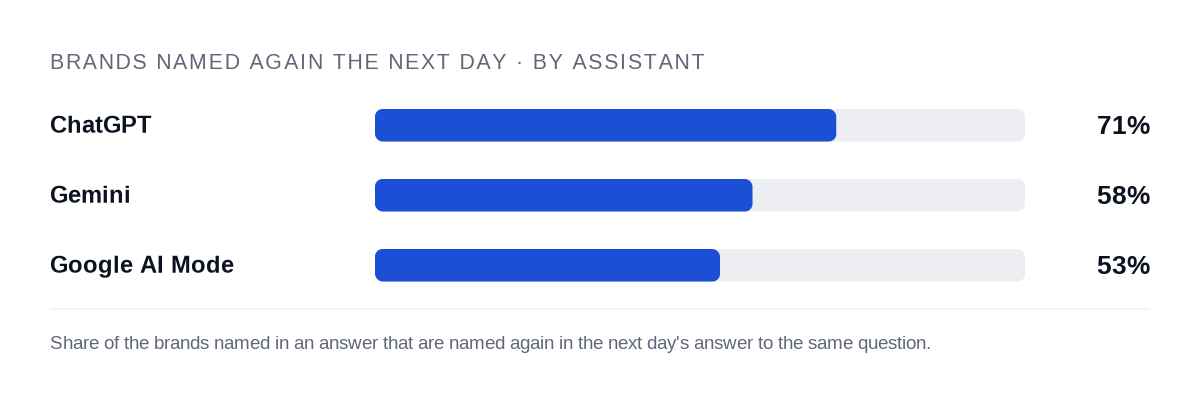
ChatGPT is the most consistent of the three, Google AI Mode the least. Sources move even more than brands: on average, two cited sites out of three are replaced the next day, and Gemini keeps fewer than one in five. A brand that appears in today's answer has roughly one chance in three of being missing from tomorrow's, without anything having changed on its side.
This is why a screenshot of one answer, or a manual check on a Monday morning, says little about a brand's visibility. It shows one draw out of many possible answers.
One day or four days apart: the same change
On the same 72 questions, we compared answers one day apart and answers four days apart. If the change came from the web or the models evolving, answers four days apart should differ more. They do not:
| Same question, same assistant | 1 day apart | 4 days apart |
|---|---|---|
| Brands named again | 61% | 61% |
| Exactly the same brands | 10% | 10% |
| Cited sites cited again | 30% | 27% |
Brands vary as much after one day as after four. Most of the difference between two answers is chance: the assistant runs a new web search, gets a slightly different set of pages, and writes a new answer from them. Sources drift a little more with time, as new pages are published and others drop in the search results. Real trends exist, but they show over weeks and over many questions, not between two answers.
So "capturing real-time fluctuations" is not what makes a tracker reliable. Checking more often than every day mostly records more chance. What matters is how many answers stand behind each figure, and whether they are collected the same way every time.
Per answer it moves, per brand it holds
The picture changes when you count across all the questions. For each brand named in at least 10% of answers, we computed the share of answers naming it at each update, over about 70 answers per assistant, and compared it with the next day's share.
| Day-to-day change in a brand's share of answers | Result |
|---|---|
| Median change | 2.8 points |
| 9 changes out of 10 | Under 7 points |
| Changes of 10 points or more | 3% |
A brand named in 30% of answers one day is named in 23% to 37% of them the next day nine times out of ten, even though about a third of its individual mentions came and went. The randomness of each answer averages out over the set of questions. That is the number a team can follow, and it becomes more precise as the number of answers grows: our methodology gives the margin of error for 50 and 200 answers.
When a whole update looks wrong
On one day of the period, the Google AI Mode answers collected for one of the two categories were less than half their usual length, and 65 of the 72 named none of the tracked brands, against about 33 on the other days. The next day, everything was back to normal. Nothing had happened to the brands: that day's answers were simply different.
A tracker that only stores scores would show a sudden collapse, and a team might spend a week looking for its cause. With the text of every answer kept, the anomaly is visible at a glance, and the day can be read for what it is. We left that day out of the figures above.
What makes a GEO tracking platform reliable
Given how much single answers vary, these are the questions to ask any tracking platform, ours included:
- Are the answers those a buyer sees? The assistants as people use them, with their web search, rather than a bare model API answering from training data alone. The two can name different brands.
- Is every question asked from a clean session, in the right country and language? No account, history or memory, so the change from one update to the next comes from the assistants and the web, not from the person asking. A question tracked for the UK should be asked from the UK.
- Are the questions the same at every update? Rewriting them changes the numbers. New questions should be added, not swapped for old ones.
- How many answers stand behind each figure? A rate on 20 answers can move 20 points by chance. Ask for the number of answers, by assistant and by topic, next to each rate.
- How often are the answers collected? Daily or every few days is enough to see trends; more often adds little but chance. Many questions asked once give more information than a few questions asked many times.
- Is the text of every answer kept? It is the only way to check a figure, read a sentiment score, or spot an update that went wrong.
- Is the model version recorded? When an assistant changes model, a step in the series can come from the model, not from you.
- Are mentions checked, not just matched? A brand whose name is also a common word must not be counted every time the word appears.
With Rempa: every prompt is asked once to each assistant at every update, from a new session with no account, history or memory, in your market's country and language: the consumer ChatGPT with web search, the Gemini app, Google AI Mode and AI Overviews, Copilot, Perplexity and Claude. Updates run every day on Pro and Enterprise and every 3 days on Starter. The full text of every answer is kept with its sources, and the model version when the assistant states it, so any figure can be traced back to the answers behind it. The methodology page gives the details.
How to read your own figures
- Read rates, not answers. Follow the share of answers naming you by topic and by assistant, over many questions. One answer is a draw.
- Read trends over several updates. A move of 3 points in a day is within the usual noise on about 70 answers; the same move held over two weeks starts to mean something.
- Compare brands on the same questions. Your share of voice against competitors is reliable because both are measured on the same answers, with the same chance.
- Look at the answers when a figure jumps. A sudden drop across all brands on one assistant usually comes from the answers themselves, not from your work or your competitors'.
- Judge sources over weeks. Two cited sites out of three change from one day to the next: count how often a site is cited across many answers, not whether it is in today's.
Method
The data comes from two projects tracked by Rempa in the United Kingdom, in two B2B software categories: 72 buyer questions each, asked to ChatGPT and Gemini in both projects and to Google AI Mode in one, from October 9 to November 13, 2026. Updates ran every day, then every four days for one of the projects. We kept the 4,961 answers that completed, leaving out one update of Google AI Mode whose answers were cut short (72 answers). We compared each answer with the answer to the same question from the same assistant at the next update: 3,234 pairs one day apart and 1,293 pairs four days apart. Brands are those tracked in each project; a site counts once per answer. The one-day and four-day comparison uses the project tracked on both schedules. The brand rates are computed for brands named in at least 10% of answers on average, per assistant and project.
FAQ
How reliable are GEO tracking platforms?
As reliable as their method. A single AI answer varies a lot: asked again the next day, the same question names 63% of the same brands. But a brand's share of answers over a full set of questions is stable, moving by about 3 points from one day to the next. A reliable platform asks the same questions from clean sessions in the right country, collects enough answers, and keeps the text of every answer.
Can a GEO tool track AI answers in real time?
No. Each update is a sample of answers taken at a moment, and answers to the same question change from one request to the next. Daily or every-few-days updates are enough to see trends; checking more often mostly records chance.
Why does ChatGPT give a different answer to the same question?
Each answer is written anew, often after a new web search that returns a slightly different set of pages. In our data, ChatGPT names 71% of the same brands the next day, and cites 43% of the same sites.
How often should AI visibility be tracked?
Every day or every few days, over many questions, and read over several updates. Answers four days apart differ no more than answers one day apart, so the number of questions matters more than the frequency.
More from the blog
How to measure your brand's visibility in ChatGPT, Gemini and Perplexity
"Are we in ChatGPT's answers?" deserves better than a screenshot. The setup, the five metrics and the habits that turn them into decisions.
Read the article →
How to benchmark AI share of voice: metrics, a worked example and an audit framework
Share of voice in AI answers, plain and weighted by position, with visibility and sentiment. The standard metrics, a worked example on UK prospecting tools, six steps to run your own, and what makes one lie.
Read the article →
GEO vs SEO: how Generative Engine Optimization differs from traditional search tactics
SEO earns a place in the list; GEO earns a place in the answer. Where the two overlap, where they part ways, and how to run both without doubling the work.
Read the article →