Google search volumes in 2026: what is changing by country and by topic
"Search is dying" has been announced every year since ChatGPT launched. The data says something more interesting: Google handles more searches than ever, but people search differently, click less, and the picture varies a lot from one country and one topic to the next. Here is what the numbers show, with their sources and their limits.
The headline: more searches than ever, then a plateau
In March 2025 Google disclosed, for the first time since 2016, how much it handles: more than 5 trillion searches a year, about 14 billion a day, up from the "more than 2 trillion" of 2016. The same month, SparkToro and Datos (a clickstream panel owned by Semrush) measured a 21.6% rise in Google searches per user in 2024 on US desktops, and estimated that Google received roughly 373 times more searches than ChatGPT.
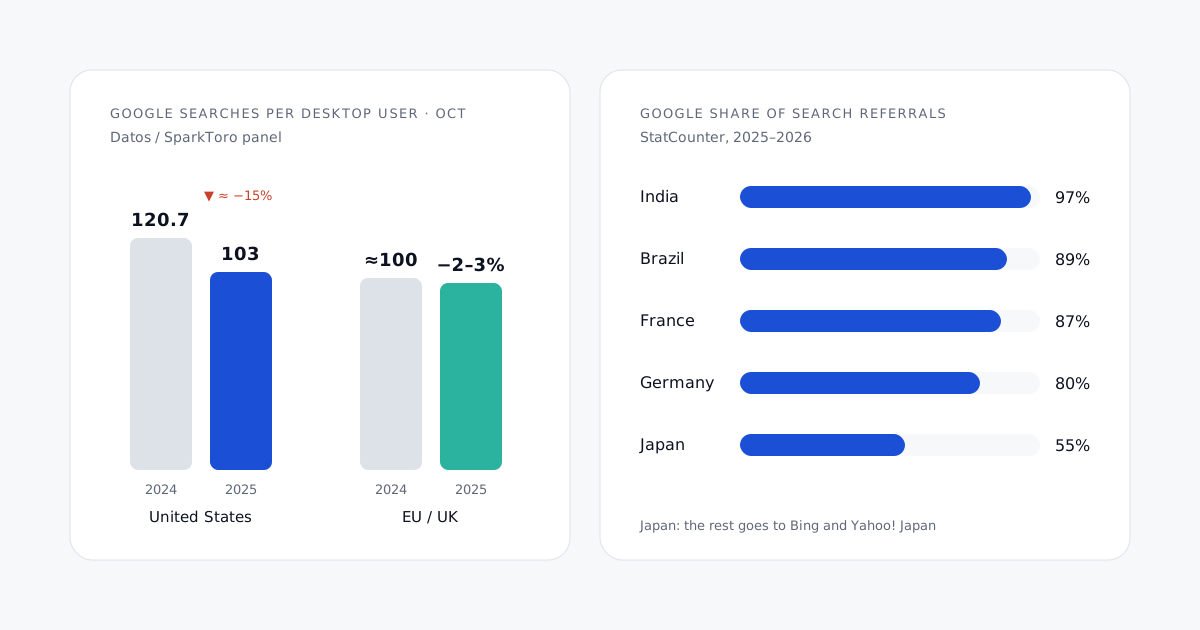
2025 told a different story. According to the Datos/SparkToro State of Search Q4 2025 report, the average US desktop searcher ran 103 Google searches in October 2025, down from 120.7 in October 2024, a fall of about 15% (Rand Fishkin rounds it to "nearly 20%"). The authors read the 2024 spike as largely an election effect, and the 2025 figure as a return to the historical norm of about 100 searches per user per month. So the honest summary is: a record year, then a plateau, not a collapse.
Two caveats apply to every panel figure in this article. They measure desktop browsers only, while roughly two thirds of Google searches happen on mobile. And they count searches, not what people do with them.
By country: the United States moves first
Searches per user
The most striking geographic difference is in that 2025 decline. Per SparkToro's reading of the Datos panel, searches per user fell nearly 20% in the US but only 2 to 3% in the EU and UK. The US adopts AI tools earlier and had the election spike to come down from; Europe's search habits have barely moved.
Where searches happen
When you count searches on every platform where people type a query, not only search engines, Google's weight is smaller than the "90% market share" figure suggests. SparkToro's analysis of 41 sites with significant search activity (desktop, Q4 2025) puts Google at 73.7% of all searches in the US and about 79% in the EU/UK. Traditional search engines together take about 80%, commerce sites (Amazon, Booking, eBay…) about 10%, social networks about 5.5%, and AI tools combined 3.2%. Over 2025, Google lost 3.5 points in the US and about 2 in Europe; Amazon, Bing and YouTube gained; ChatGPT shrank slightly in the US and was flat in Europe.
Google's share among search engines
Among search engines proper, Google holds about 90% worldwide (StatCounter, September 2026: Google 89.9%, Bing 5.3%, Yahoo 1.4%, Yandex 1.3%). The national pictures differ more than the global average suggests. Recent StatCounter-based figures compiled by country put Google at about 97% in India, 89% in Brazil, 87% in France (Bing 6%, Ecosia and Qwant around 1% each), 80% in Germany (Bing 10%, Yandex 3%) and only 55% in Japan, where Bing and Yahoo! Japan take most of the rest. Russia is the largest market Google does not lead (Yandex around 73%), China belongs to Baidu, and South Korea is split between Google and Naver.
Keep in mind what StatCounter measures: referrals, that is visits sent to websites, not searches performed. A country where people click less looks smaller in StatCounter than it is in searches.
Fewer clicks for the same searches
Volume is not where the change is; clicks are. In the Datos/SparkToro 2024 zero-click study, for every 1,000 Google searches, only 360 clicks reached the open web in the US and 374 in the EU; 58.5% of US searches and 59.7% of EU searches ended without any click. The Q4 2025 report has Google sending a click, paid or organic, for 44% of desktop searches, against more than 60% a decade earlier.
AI Overviews accelerate this. Ahrefs' December 2025 study estimates that the top organic result loses about 58% of its click-through rate when an AI Overview is present (a modeled estimate, not a before-and-after measurement), and Pew Research found that only 8% of users click a traditional result when an AI Overview is shown, versus 15% without one.
By domain: where AI answers are taking over
The share of Google results pages that show an AI Overview depends heavily on the subject. Semrush's tracking of more than 10 million US keywords shows the overall share rising from 6.5% of queries in January 2025 to about 25% in July, then settling around 16% in November. Within that, Science topped the list with AI Overviews on about 26% of keywords, followed by Computers & Electronics (18%) and People & Society (17%); Real Estate, Shopping and Arts & Entertainment stayed under 3%. Informational subjects get answered; transactional ones still get links.
The frontier is moving towards money. In its study of commercial-intent queries (600,000 US keywords, November 2025 to April 2026), Semrush found the share of commercial searches with an AI Overview up about 71% in six months, with Finance up 231%, Computers & Electronics up 108% and Games up 77%. In Jobs & Education, more than 60% of the most expensive keywords now trigger an AI Overview. Transactional queries, by contrast, saw AI Overviews recede by about 5%. If your category is finance, software, education or health, your customers increasingly get an answer where they used to get a list.
The questions themselves are changing shape. Google's Year in Search 2025 reports "Tell me about…" searches up 70% year over year and "How do I…" searches at an all-time high, up 25%. People talk to the search box the way they talk to an assistant.
Shopping: the surveys disagree
Where product searches start is the one area where the sources contradict each other, because they ask different questions. A Morgan Stanley survey reported by eMarketer has 56% of 16-to-24-year-olds starting product research on Google, YouTube or Gemini, against 10% on Amazon and 12% on TikTok. Surveys of all US adults by CivicScience and Jungle Scout still put Amazon first, at 49 to 57%. Read them together: Amazon dominates when people already know what they want; Google and, increasingly, AI assistants win the "which one should I buy" stage, which is where brands are made.
About that "25% drop by 2026"
In February 2024 Gartner predicted that search engine volume would fall 25% by 2026 because of AI chatbots. In 2026, search volume has not fallen by anything like that; what has fallen is the share of searches that produce a click, and, in the US, the number of searches each person runs. The forecast was wrong about the quantity and right about the direction: the answer is replacing the list.
What it means for a brand
- Volume is not your problem; answers are. Your category's search demand is probably stable. What changes is how much of it is settled on the results page or in an assistant, without a visit to anyone.
- Exposure is topic-specific. Check the AI Overview and AI Mode coverage of your own prompts, not the global average. A finance or software brand lives in a very different search than a real-estate agency.
- Markets move at different speeds. US behavior leads; Europe follows a year or two behind, with Google stronger and AI tools adopted a little faster than the gap in search behavior suggests. Measure each market separately.
- Count the answers, not the clicks. Analytics only shows the visits you still get. Being named, and named first, in the answers people read is now a metric in its own right, and it is measurable: that is what Rempa tracks, prompt by prompt, engine by engine.
Sources
- SparkToro and Datos (a Semrush company): "Google Search grew 20%+ in 2024" (March 2025); "2024 zero-click search study" (July 2024); "Search happens everywhere: an analysis of 41 websites" (March 2026); "State of Search Q4 2025" report, as summarized by Anicca (February 2026).
- StatCounter Global Stats, search engine market share worldwide and by country (2025–2026 figures, compiled by SERP Sculpt).
- Semrush: AI Overviews study on more than 10 million US keywords (2025, via Search Engine Land) and "AI Overviews are expanding across commercial intent search" (November 2025 to April 2026).
- Ahrefs, AI Overviews and click-through rate study (December 2025); Pew Research Center, AI Overviews and user clicks (July 2025); both via PPC Land.
- Google, "Year in Search 2025" (December 2025); eMarketer, Morgan Stanley survey of 16-to-24-year-olds' product research (2025); CivicScience and Jungle Scout consumer surveys (2025); Gartner, press release of February 19, 2024.
More from the blog

How to build an enterprise GEO strategy: a framework for organic search directors
GEO at enterprise scale is a program, not a list of tactics: the questions to win, a baseline, four workstreams with owners, and the tools to measure it.
Read the article →
How agencies report AI visibility to clients: share of voice, citations and a monthly report template
"What does ChatGPT say about us?" deserves a better answer than a screenshot. The metrics, setup and monthly report template agencies use for AI visibility.
Read the article →
How to track AI Overviews: monitoring brand citations in Google's AI answers, with tool pricing
Search Console will not tell you whether Google's AI summaries name your brand. How to track AI Overviews every day, and what each tool really costs per daily check.
Read the article →