How to get your brand into Google AI Overviews and AI Mode

Google now answers many searches itself before showing a single link: a summary at the top of the results (AI Overviews) or a full conversation (AI Mode). Both are built from a handful of pages. Here is how they pick those pages, and what a brand can do to be among them and be named in the answer.
Two surfaces, one engine
AI Overviews appear above the classic results for a growing share of informational and comparison searches. They summarize the answer in a few paragraphs and link to the pages they used. AI Mode is a separate tab where people ask follow-up questions in a conversation, closer to ChatGPT, with sources shown alongside.
Both rely on Google's index and on its ranking systems to choose their sources. That is the good news for brands: the work that makes a page rank well is still the entry ticket. The difference is what happens next. A ranking page gets a click if the searcher chooses it; a source page gets used, summarized and sometimes credited, while the searcher may never visit it. And the brands named in the summary win the attention, whether or not their site is linked.
How the sources are chosen
Google does not publish a recipe, but the patterns across many queries are consistent:
- Pages that already rank for the question or closely related ones are the main pool. If you are nowhere in the first results, you are unlikely to be a source.
- Pages that answer the exact question, early and plainly, are preferred over pages that cover the topic in general.
- Specific, checkable facts (prices, limits, steps, comparisons, dates) are what the summary needs; marketing language gives it nothing to quote.
- Several sources agree: the summary leans on points that appear in more than one place. A claim only you make is less likely to be repeated.
Make your own pages quotable
Answer the question in the first lines
Start pages with the answer, then the details. A pricing page that opens with "Plans start at $29 per user per month, billed monthly" is easier to use than one that opens with a slogan. The same goes for comparison and how-to pages.
Use the structure Google can read
Clear headings that match the questions people ask, short paragraphs, lists for steps and criteria, and tables for comparisons. Add structured data where it fits: Organization on the home page, Product or SoftwareApplication on product pages, FAQ only where the page really is a list of questions.
Cover the questions you lose
Look at the searches where an AI Overview or AI Mode answer names competitors and not you. Each one is a page to write or to fix: "X vs Y", "best X for Z", "how much does X cost", "how to do Z with X". Rempa lists them for you in Recommendations, with the searches at stake.
Be present where the summary looks
Many AI Overviews for "best" and "vs" searches lean on comparison sites, review platforms, forums and trade media rather than on vendors' own pages. Being listed, correctly, on the pages Google already uses as sources is often faster than ranking a new page of your own. Find those pages by looking at the sources cited in the answers for your prompts, then get added, update your entry, and collect reviews from real customers.
Check the basics
- Let Google crawl your site. AI Overviews and AI Mode use Google's regular crawler; a page blocked in robots.txt or behind a login cannot be a source.
- Keep the important facts in the HTML, not only in images, PDFs or scripts that load late.
- Keep facts consistent across your site, your profiles and third-party listings. Contradictions make the summary hedge, or skip you.
Measure it, query by query
Search Console does not tell you whether you were named in an AI Overview. Track it directly: run your key questions in Google with AI Overviews and AI Mode, in your market, at a regular cadence, and record whether you are named, in which position, and which sources are cited. Watch the trend rather than a single day: these answers change often, and the share of searches that show an AI Overview moves too. Rempa does this for Google AI Mode and AI Overviews next to ChatGPT, Gemini and the other assistants, so you can see whether a page you published or a listing you obtained changed the answer.
In short
Rank first, answer plainly, state facts, be present on the pages Google already trusts, and measure the answers rather than the clicks. AI Overviews and AI Mode reward the same quality as classic search, but they reward it in a different currency: being named.
More from the blog

How to build an enterprise GEO strategy: a framework for organic search directors
GEO at enterprise scale is a program, not a list of tactics: the questions to win, a baseline, four workstreams with owners, and the tools to measure it.
Read the article →
How agencies report AI visibility to clients: share of voice, citations and a monthly report template
"What does ChatGPT say about us?" deserves a better answer than a screenshot. The metrics, setup and monthly report template agencies use for AI visibility.
Read the article →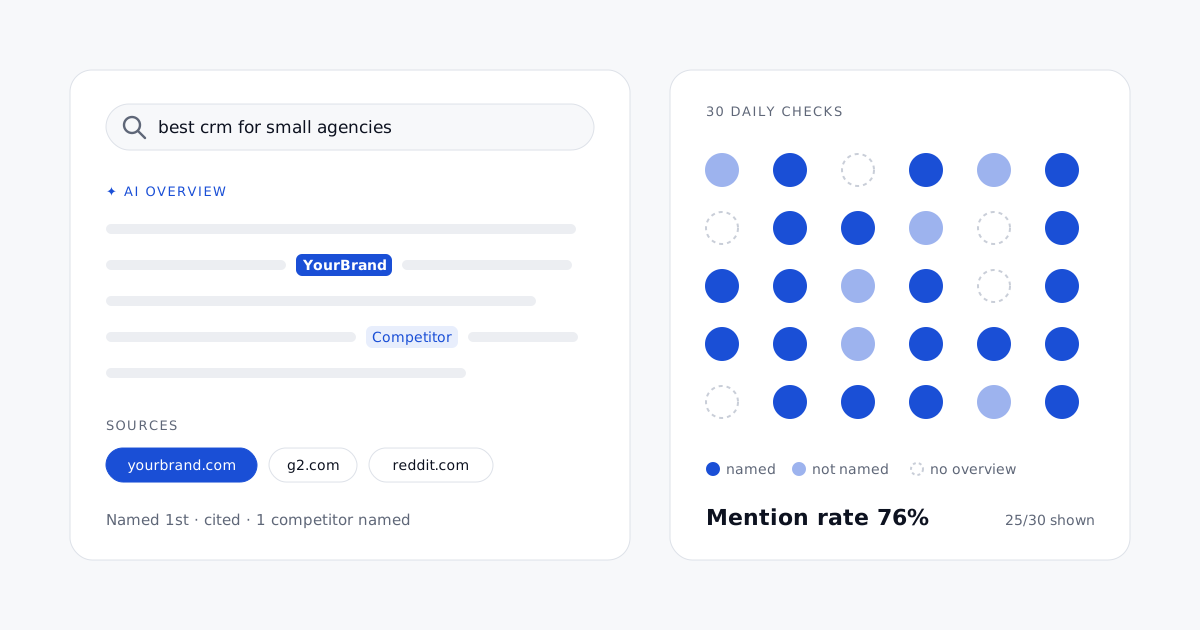
How to track AI Overviews: monitoring brand citations in Google's AI answers, with tool pricing
Search Console will not tell you whether Google's AI summaries name your brand. How to track AI Overviews every day, and what each tool really costs per daily check.
Read the article →